iPhone

Catalogue entries: iPhone (2007)

Between the 2007 iPhone and the 2025 iPhone 17 family, the camera changed along several paths: modules, optics, focus, sensors and processing. This annual selection separates physical components from framing options and video formats. More megapixels are not a complete measure of quality.
MP is documented resolution, not physical sensor size or the resolution of every mode. Focal lengths in mm are 35 mm equivalents. fps means frames per second. Video formats are selected, not exhaustive.
Annual historical selection, 2007-September 2025. Includes major branches and SE, not every regional variant. Excludes iPhone 18, rumors and 2026 models.
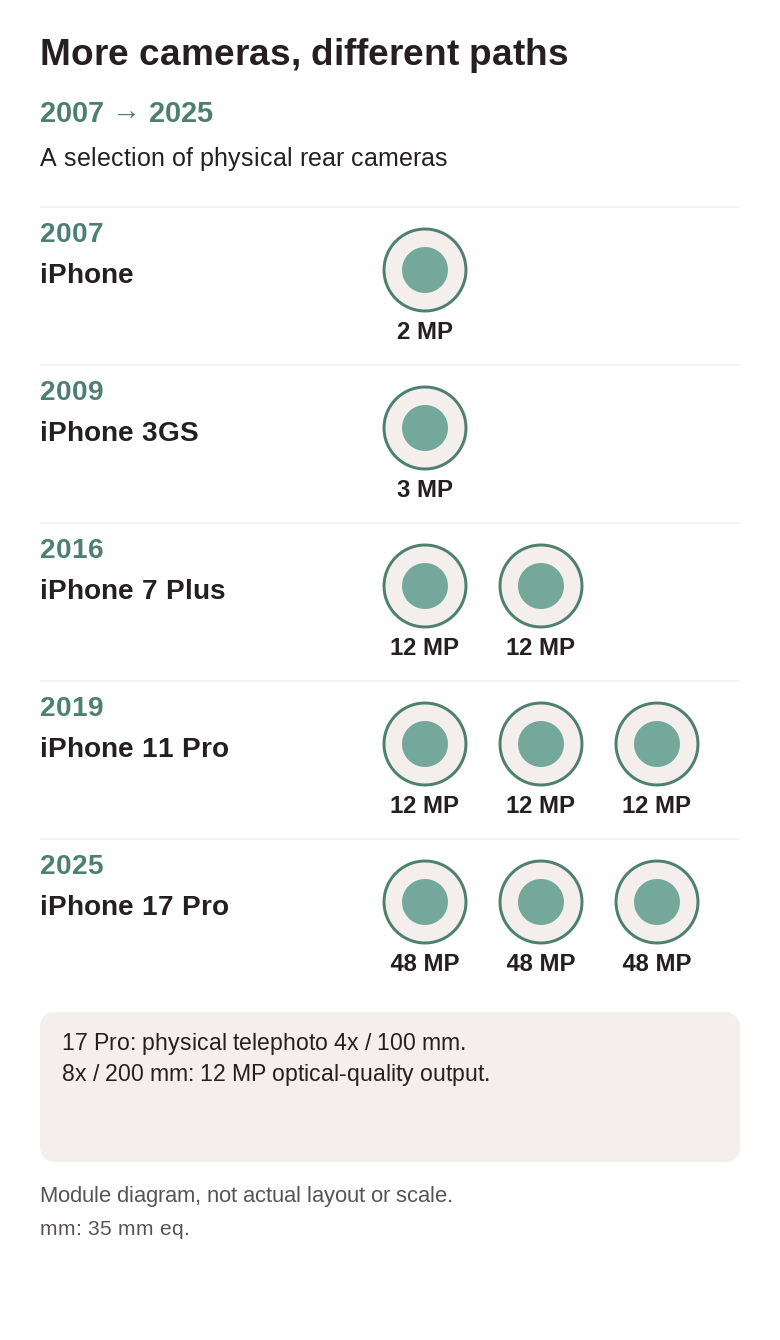
The original iPhone was introduced with a 2 MP camera. Photography and onscreen photo management form the starting point; playable video formats are not confused with camera recording.
Original sources: Apple 3
Catalogue entries: iPhone (2007)
iPhone 3G retained a 2 MP camera, documented in an archived original Apple specification. A connectivity change does not by itself mean higher photo resolution.
Original sources: Apple 30

Catalogue entries: iPhone 3G (2008)
iPhone 3GS moved to 3 MP with autofocus and tap to focus. VGA recording up to 30 fps with audio, together with clip trimming, made captured video an explicit announced feature.
Original sources: Apple 4 · Apple 5

Catalogue entries: iPhone 3GS (2009)
iPhone 4 combined a 5 MP rear camera, backside-illuminated sensor and LED flash with a front camera for FaceTime. Rear video reached 720p at 30 fps; photos, video and video calls are different uses.
Original sources: Apple 10 · Apple 53

Catalogue entries: iPhone 4 (2010)
iPhone 4s raised the camera to 8 MP and video to 1080p up to 30 fps. Its specification lists autofocus, face detection and video stabilization; the latter must not be called optical stabilization without evidence.
Original sources: Apple 6 · Apple 45

Catalogue entries: iPhone 4s (2011)
iPhone 5 retained 8 MP and 1080p video at 30 fps, while the FaceTime HD camera offered 1.2 MP photos and 720p video. Evolution is not always a rise in rear-camera megapixels.
Original sources: Apple 15 · Apple 46

Catalogue entries: iPhone 5 (2012)
iPhone 5s retained 8 MP, but Apple documented 1.5 µm pixels, an ƒ/2.2 aperture and True Tone flash. Slow motion at 120 fps represents another axis of change. These facts concern 5s, not every 2013 iPhone.
Original sources: Apple 7 · Apple 9

Catalogue entries: iPhone 5s (2013)

Catalogue entries: iPhone 5c (2013)
iPhone 6 and 6 Plus used 8 MP cameras with Focus Pixels and 1080p video up to 60 fps. Optical still-photo stabilization belonged to 6 Plus. It is not extended to 6 or turned here into optical video stabilization.
Original sources: Apple 16 · Apple 17 · Apple 47 · Apple 11

Catalogue entries: iPhone 6 (2014)

Catalogue entries: iPhone 6 Plus (2014)
iPhone 6s and 6s Plus moved to 12 MP, Live Photos and 4K recording at 30 fps. Optical stabilization, including video, still distinguished Plus. A format leap does not erase differences between sizes.
Original sources: Apple 8 · Apple 48 · Apple 71

Catalogue entries: iPhone 6s (2015) · iPhone 6s Plus (2015)
iPhone 7 Plus added a telephoto to the wide camera: two 12 MP rear cameras, versus one on 7. Portrait mode was announced for a later update. SE retained a single 12 MP camera and 4K.
Original sources: Apple 12 · Apple 56 · Apple 32

Catalogue entries: iPhone SE (2016)

Catalogue entries: iPhone 7 (2016)

Catalogue entries: iPhone 7 Plus (2016)
iPhone 8, 8 Plus and X reached 4K at 60 fps. X combined two 12 MP rear cameras with optical stabilization on both and front TrueDepth. That dual stabilization is not automatically assigned to 8 Plus.
Original sources: Apple 13 · Apple 11 · Apple 38 · Apple 39

Catalogue entries: iPhone 8 (2017)

Catalogue entries: iPhone 8 Plus (2017)

Catalogue entries: iPhone X (2017)
XS and XS Max offered 12 MP wide and telephoto cameras. XR delivered Portrait and Depth Control with one 12 MP rear camera. A background-blur effect alone does not prove two physical lenses.
Original sources: Apple 49 · Apple 14 · Apple 18 · Apple 52

Catalogue entries: iPhone XS (2018) · iPhone XS Max (2018)

Catalogue entries: iPhone XR (2018)
iPhone 11 added Ultra Wide; 11 Pro and Pro Max brought together three 12 MP rear cameras. Wide-camera Night mode and front 4K video marked other advances. Deep Fusion was announced for later.
Original sources: Apple 35 · Apple 50 · Apple 19

Catalogue entries: iPhone 11 (2019)

Catalogue entries: iPhone 11 Pro (2019) · iPhone 11 Pro Max (2019)
12 Pro Max distinguished its Wide camera with sensor-shift stabilization and a 2.5x telephoto. LiDAR arrived on Pro. Dolby Vision reached 60 fps on Pro, versus 30 fps HDR on 12 and mini; ProRAW was announced for later.
Original sources: Apple 20 · Apple 51 · Apple 36 · Apple 37

Catalogue entries: iPhone SE (2020)

Catalogue entries: iPhone 12 (2020) · iPhone 12 mini (2020)

Catalogue entries: iPhone 12 Pro (2020)

Catalogue entries: iPhone 12 Pro Max (2020)
13 and mini extended sensor-shift stabilization. Pro added macro through an autofocus Ultra Wide and a 3x telephoto. Cinematic mode was 1080p; ProRes was announced for an update, with storage-dependent limits.
Original sources: Apple 40 · Apple 29 · Apple 21

Catalogue entries: iPhone 13 (2021) · iPhone 13 mini (2021)

Catalogue entries: iPhone 13 Pro (2021) · iPhone 13 Pro Max (2021)
14 Pro and Pro Max introduced a 48 MP Main with a quad-pixel sensor. Its 12 MP 2x option uses the Main sensor, not a fourth camera. Action mode and 4K Cinematic also reached 14 and Plus; SE retained one 12 MP camera.
Original sources: Apple 24 · Apple 22 · Apple 41 · Apple 34

Catalogue entries: iPhone SE (2022)

Catalogue entries: iPhone 14 (2022) · iPhone 14 Plus (2022)

Catalogue entries: iPhone 14 Pro (2022) · iPhone 14 Pro Max (2022)
15 and Plus gained a 48 MP Main. Among Pro models, the tetraprism 5x telephoto was exclusive to Pro Max; Pro retained 3x. ProRes 4K at 60 fps required external recording, not the same limit as every other mode.
Original sources: Apple 42 · Apple 25 · Apple 23

Catalogue entries: iPhone 15 (2023) · iPhone 15 Plus (2023)

Catalogue entries: iPhone 15 Pro (2023)

Catalogue entries: iPhone 15 Pro Max (2023)
16 and Plus added macro through an autofocus Ultra Wide and Camera Control. Both Pro models shared a 5x telephoto and 48 MP Ultra Wide. 4K Dolby Vision at 120 fps is documented for Fusion, not every lens.
Original sources: Apple 43 · Apple 26 · Apple 27

Catalogue entries: iPhone 16 (2024) · iPhone 16 Plus (2024)

Catalogue entries: iPhone 16 Pro (2024) · iPhone 16 Pro Max (2024)
17 combined two 48 MP rear cameras; Pro, three. On 17 Pro, the physical telephoto is 4x/100 mm; 8x/200 mm is a 12 MP output Apple calls optical-quality. Front Center Stage reached 18 MP. Air and 16e retained one physical rear camera.
Original sources: Apple 65 · Apple 2 · Apple 1 · Apple 44 · Apple 54 · Apple 28

Catalogue entries: iPhone 16e (2025)

Catalogue entries: iPhone 17 (2025)

Catalogue entries: iPhone Air (2025)
On 17 Pro and Pro Max, ProRes RAW requires compatible apps. Apple names Final Cut Camera and Blackmagic Camera. Genlock requires compatible hardware and software; the announcement names Blackmagic Design Camera ProDock. Do not treat them as available in Camera without checking those requirements.
Catalogue entries: iPhone 17 Pro (2025) · iPhone 17 Pro Max (2025)
A year-by-year axis from 1984 compares two different capacities: RAM and internal disk, later SSD. Each point belongs to the named model and configuration, not all Macs of that year, and is not a performance score.
Logarithmic scale: equal distances mean equal ratios, not equal increases. RAM uses powers of 1024; storage uses nominal decimal capacity. Original units are retained. No disk is labelled separately, not plotted as zero on a log scale.
A selection of models, not an exhaustive inventory or annual record. At least one model is selected for every year from1984 to2026. Points are not joined or interpolated.
Official ceiling means the published model/CPU limit or largest listed purchase option, not a third-party-tested maximum. A missing value does not mean no upgrade support.
Model year, not the arrival date of every option. Except for marked announcements, capacities follow the official specification read on 10 November 2026.
Scroll the chart horizontally to read it at full size.

128K
128 KB is RAM; the 400 KB floppy is not an internal hard disk. No built-in RAM expansion.
Original sources: Apple 2
512 KB / 10 MB HDD
23 January 1985 announcement: Lisa 2/10 renamed Macintosh XL, not a new architecture. Standard RAM 512 KB, announced expansion 1 MB. Retrospective support lists up to 2 MB; the June letter names AST boards for 2 MB, not a January factory option. Included internal disk 10 MB; no physical upgrade ceiling is asserted.
1 MB
No internal disk; external SCSI drives are outside this chart.
Original sources: Apple 5
1 MB / 40-80 MB HDD
Other documented storage options: 40 MB · 80 MB
Apple lists 40-80 MB disks but does not establish a standard disk for the no-HDD product page here. No invented value is plotted.
Original sources: Apple 6
1 MB / 40-80 MB HDD
Other documented storage options: 40 MB · 80 MB
Apple lists 40-80 MB disks but does not establish a standard disk for the no-HDD product page here. No invented value is plotted.
Original sources: Apple 7
1 MB / 40 MB HDD
The source lists 0-40 MB: the 40 MB option is selected, not a universal standard disk.
Original sources: Apple 8
1 MB
Other documented storage options: No internal disk · 40 MB
Apple lists no disk or 40 MB. The exact configuration disk is not treated as established.
Original sources: Apple 9
2 MB / 20 MB
Other documented storage options: 20 MB · 40 MB
Original sources: Apple 37
4 MB / 80 MB
Other documented storage options: 80 MB · 120 MB
Original sources: Apple 10
8 MB / 230 MB HDD
Other documented storage options: 230 MB · 500 MB · 1000 MB
Service Source specifies 8 MB standard; the support page gives a 4 MB minimum. The 230/500/1000 MB disks are options, not a physical upgrade limit.
8 MB / 160 MB
Other documented storage options: 160 MB · 250 MB
Original sources: Apple 12
8 MB / 500 MB
Original sources: Apple 13
12 MB / 750 MB
Other documented storage options: 750 MB · 1 GB
Original sources: Apple 14
16 MB / 2 GB
Original sources: Apple 15
233 MHz /A; 32 MB / 4 GB
Revision /A: official 32-128 MB. Not merged with /B, which the source separates as 32-256 MB.
Original sources: Apple 16
32 MB / 3.2 GB
The original 32 MB/3.2 GB branch is selected, with a 288 MB RAM ceiling. The source also includes a later 64 MB/6 GB branch with 320 MB maximum RAM.
Original sources: Apple 17
450 MHz
Original sources: Apple 18
400 MHz
Reference: 400 MHz, 128 MB and 10 GB. The 500 MHz version was announced with 256 MB and 20 GB.
Original sources: Apple 19
700 MHz / CD-RW
The announced 60 GB disk belongs to the 800 MHz/SuperDrive model. It is not assigned to this 700 MHz/CD-RW model as a maximum option.
Original sources: Apple 20
15-inch / 1 GHz / Combo
Original sources: Apple 40
17″ / 1.6 GHz
1.25 GHz / 2005-01
January launch is used: 256 MB. The current page titled original lists 512 MB after a later update; the two dates are not merged.
Original sources: Apple 36
1.83 GHz Core Duo / 2006-05
Original sources: Apple 32
20″ / 2.0 GHz
20-inch/2.0 GHz: up to 500 GB. 750 GB belongs to 20-inch/2.4 GHz; 1 TB to 24-inch.
Original sources: Apple 22
1.6 GHz / 2008-01
Other documented storage options: 80 GB HDD · 64 GB SSD
The announcement offers 80 GB HDD or 64 GB SSD. A RAM upgrade ceiling is not inferred from standard memory.
Original sources: Apple 23
2.0 GHz / 1 GB / 120 GB
Original sources: Apple 41
2.4 GHz / 2 GB / 320 GB
Original sources: Apple 42
2.3 GHz / 2 GB / 500 GB
The 2.3 GHz branch offers up to a 750 GB HDD. The SSD plus HDD option belongs to the 2.5 GHz branch and is not added here.
Original sources: Apple 43
15″ / 2.3 GHz / 2012
Original sources: Apple 24
CPU ×4 / 2013
Original sources: Apple 25
1.4 GHz / 4 GB / 500 GB
The 1.4 GHz mini offers up to a 1 TB Fusion Drive. The 2 TB option of other branches does not apply here.
Original sources: Apple 44
2.9 GHz / 8 GB / 512 GB
Original sources: Apple 45
2.0 GHz / 2 × Thunderbolt 3
Original sources: Apple 46
8-core Xeon W / 32 GB / 1 TB
The current specification lists up to 256 GB. This is the limit read today, not a claim that this option existed at the 2017 launch.
Original sources: Apple 47
Core i3 / 8 GB / 128 GB
Original sources: Apple 48
CPU ×8 / 2019
1.5 TB RAM requires a 24- or 28-core CPU, not the 8-core reference. Year identifies the model, not the availability date of every option.
Original sources: Apple 26
M1 / 8 GB / 256 GB
Original sources: Apple 39
GPU ×8 / 256 GB
M1 Ultra
M1 Ultra is shown. M1 Max separately starts with 32 GB RAM and 512 GB SSD.
Original sources: Apple 28
M2 Ultra
Original sources: Apple 29
M4
M4 is shown, not M4 Pro. M4 Pro's 64 GB RAM and 8 TB SSD ceilings are not assigned to M4.
Original sources: Apple 30
M3 Ultra
Historical state: 2025 announcement up to 512 GB. State read today: M3 Ultra specification up to 256 GB. The chart uses 256 GB and retains 512 GB as the historical announced ceiling, not a confirmed current option.
M5 Ultra
256/512 GB requires M5 Ultra with 36-core CPU/80-core GPU. The announcement placed 512 GB in late October; this is not shipment confirmation.
M6