
iPhone 7 (2016)
A1660
Apple announced the iPhone 7 family in 2016; this entry distinguishes A1660. The announcement offered 32, 128 and 256 GB, but restricted jet black to 128 and 256 GB. It was introduced with iOS 10: iOS 12 on the retained technical page is not its launch system.
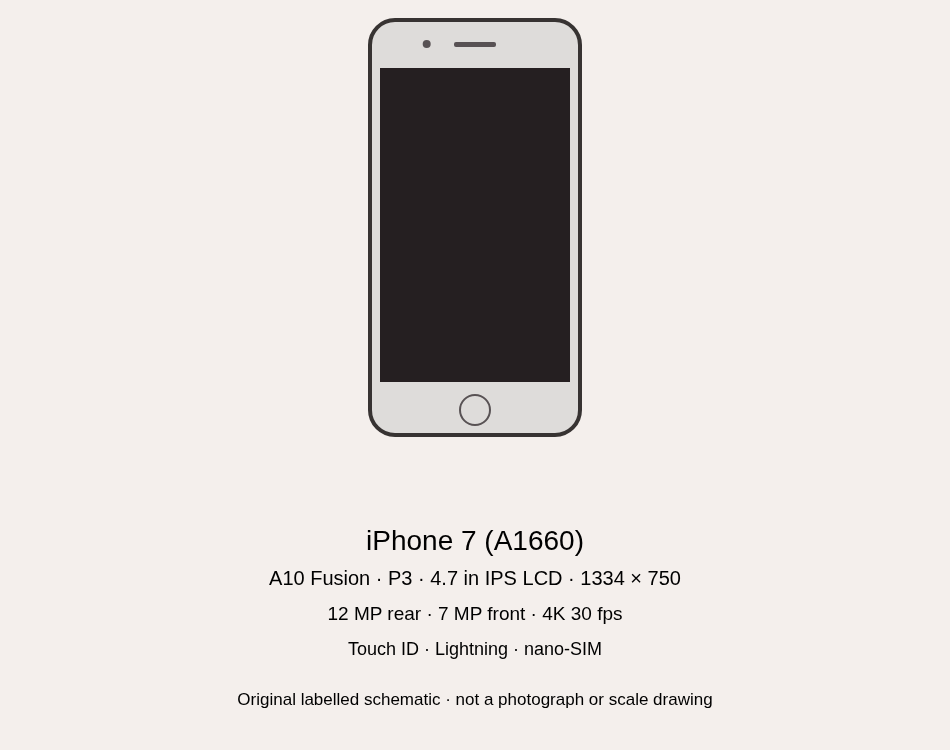
Representative photo of the same model and generation. It does not certify this entry's regional variant, A-number, radio, SIM or storage.

Specifications
| Chip | A10 Fusion |
|---|---|
| Capacity | 32 / 128 / 256 GB |
| Display | 4.7 in · IPS LCD · P3 |
| Resolution | 1334 × 750 |
| Density | 326 ppi |
| Rear camera | 12 MP f/1.8 |
| Front camera | 7 MP · f/2.2 |
| Rear video | 4K · 30 fps |
| Radio | A1660 · FDD/TD-LTE |
| Connectors | Lightning · nano-SIM |
| Dimensions | 138.3 × 67.1 × 7.1 mm |
| Weight | 138 g |
History and documentation
Apple announced the iPhone 7 family in 2016; this entry distinguishes A1660. The announcement offered 32, 128 and 256 GB, but restricted jet black to 128 and 256 GB. It was introduced with iOS 10: iOS 12 on the retained technical page is not its launch system.
Design and specifications
It combines A10 Fusion with a 4.7-inch P3 IPS LCD, 1334 × 750 pixels and 326 ppi. It measures 138.3 × 67.1 × 7.1 mm and weighs 138 g. The solid-state Home button integrates Touch ID and Taptic Engine feedback. Its IP67 rating refers to laboratory tests up to 1 m and 30 minutes; resistance is not permanent.
Use and context
The rear camera has 12 MP and f/1.8 with optical stabilization for photos and video. The front camera has 7 MP and f/2.2. Rear video reaches 4K at 30 fps and 1080p at 30 or 60 fps. It includes a quad-LED True Tone flash and stereo speakers.
Display, sensors and finish care
The specification gives typical 1400:1 contrast and 625 cd/m² typical maximum brightness. It lists dual-domain pixels for wide viewing angles and a fingerprint-resistant oleophobic coating, not OLED panel values. Alongside Touch ID are a barometer, three-axis gyro, accelerometer, proximity and ambient light sensors. Specified conditions are 0–35 °C operating, −20–45 °C nonoperating and 5–95% noncondensing humidity.
Apple separates battery tests by activity: up to fourteen hours of 3G talk, twelve of LTE internet, fourteen over Wi-Fi, thirteen of wireless video or forty of wireless audio. These figures are not added into a mixed session. Note 9 warns of dependence on network and other factors and limited battery cycles; they do not describe a surviving unit's battery life today. Documented charging is via USB to a computer or adapter.
Note 1 describes jet black's nine-step anodization and polishing process. Apple warned that fine micro-abrasions could show with use despite hardness comparable to its other anodized products. This concerns jet black specifically, not a wear classification for every color or evidence of a photographed phone's condition.
Notes and image
It lists FDD-LTE, TD-LTE 38/39/40/41, TD-SCDMA, CDMA, UMTS and GSM. Wi-Fi 802.11ac with MIMO and Bluetooth 4.2; nano-SIM and Lightning, without a built-in 3.5 mm headphone jack. Network service depends on the carrier, not a promise of current service. The original schematic is not a photo or an internal circuit diagram.
Sources
- Apple · technical specifications
- Apple · original announcement
- Apple · model identification
- dimensioncupertino.com · Original schematic illustration
Updated: October 25, 2026 · Compare this product
Historical catalogue links
Relationships already recorded in the catalogue, not a complete succession chain. Same-year variants are shown as related. A missing link does not prove that an earlier or later model does not exist.