
iPhone 7 Plus (2016)
A1661
Apple announced the iPhone 7 Plus family in 2016; this entry distinguishes A1661. The announcement offered 32, 128 and 256 GB, but restricted jet black to 128 and 256 GB. It was introduced with iOS 10: iOS 12 on the retained technical page is not its launch system.
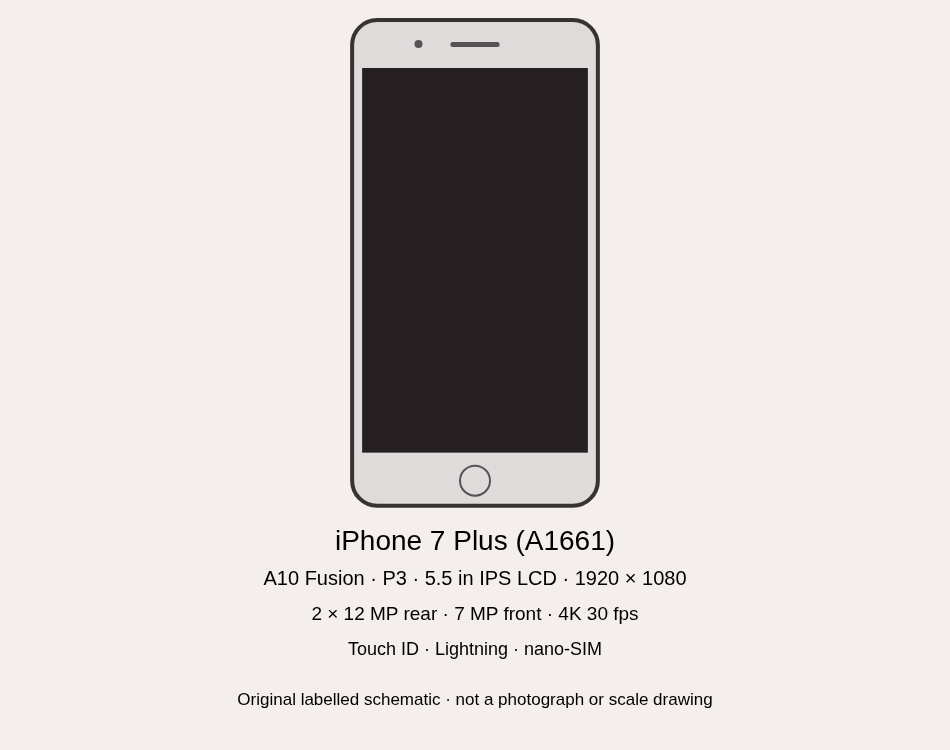
Representative photo of the same model and generation. It does not certify this entry's regional variant, A-number, radio, SIM or storage.

Specifications
| Chip | A10 Fusion |
|---|---|
| Capacity | 32 / 128 / 256 GB |
| Display | 5.5 in · IPS LCD · P3 |
| Resolution | 1920 × 1080 |
| Density | 401 ppi |
| Rear camera | 12 MP f/1.8 + 12 MP f/2.8 |
| Front camera | 7 MP · f/2.2 |
| Rear video | 4K · 30 fps |
| Radio | A1661 · FDD/TD-LTE |
| Connectors | Lightning · nano-SIM |
| Dimensions | 158.2 × 77.9 × 7.3 mm |
| Weight | 188 g |
History and documentation
Apple announced the iPhone 7 Plus family in 2016; this entry distinguishes A1661. The announcement offered 32, 128 and 256 GB, but restricted jet black to 128 and 256 GB. It was introduced with iOS 10: iOS 12 on the retained technical page is not its launch system.
Design and specifications
It combines A10 Fusion with a 5.5-inch P3 IPS LCD, 1920 × 1080 pixels and 401 ppi. It measures 158.2 × 77.9 × 7.3 mm and weighs 188 g. The solid-state Home button integrates Touch ID and Taptic Engine feedback. Its IP67 rating refers to laboratory tests up to 1 m and 30 minutes; resistance is not permanent.
Use and context
The rear system pairs a 12 MP f/1.8 wide-angle camera with a 12 MP f/2.8 telephoto and 2× optical zoom. It offers optical stabilization; the depth-of-field effect was announced for a later update, not day one. The front camera has 7 MP and f/2.2. Rear video reaches 4K at 30 fps and 1080p at 30 or 60 fps. It includes a quad-LED True Tone flash and stereo speakers.
Contrast, zoom and external-output limits
Apple’s specification lists 1300:1 typical contrast, 625 cd/m² typical maximum brightness, dual-domain pixels for wider viewing angles and a fingerprint-resistant oleophobic coating. Beyond Touch ID it lists a barometer, three-axis gyro, accelerometer, proximity sensor and ambient light sensor. These extend the A1661 entry without substituting another region’s radio bands.
The 2x optical zoom is distinct from digital zoom: up to 10x for photos and 6x for video. Panorama up to 63MP is not the native resolution of each 12MP camera. Slow motion reaches 1080p at 120 fps or 720p at 240 fps, not 1080p at 240 fps. Apple also documents a sapphire lens cover, hybrid IR filter and Focus Pixels autofocus.
Wired video output reaches 1080p through separately sold Lightning Digital AV or Lightning to VGA adapters; note 7 limits this output to Standard Dynamic Range. Note 9 warns of limited battery cycles and variation with use and settings, not a guarantee of battery life today. IP67 resistance can decrease with wear; a wet phone must not be charged and Apple warranty excludes liquid damage.
Notes and image
It lists FDD-LTE, TD-LTE 38/39/40/41, TD-SCDMA, CDMA, UMTS and GSM. Wi-Fi 802.11ac with MIMO and Bluetooth 4.2; nano-SIM and Lightning, without a built-in 3.5 mm headphone jack. Network service depends on the carrier, not a promise of current service. The original schematic is not a photo or an internal circuit diagram.
Sources
- Apple · technical specifications
- Apple · original announcement
- Apple · model identification
- dimensioncupertino.com · Original schematic illustration
- iphone-6s-plus-2015
- iphone-6s-plus-2015 ⇄ iPhone 7 Plus (A1661)
Updated: October 24, 2026 · Sources: Wikipedia, Apple · Compare this product
Historical catalogue links
Relationships already recorded in the catalogue, not a complete succession chain. Same-year variants are shown as related. A missing link does not prove that an earlier or later model does not exist.