
Power Mac G4 Cube (2000)
Power Mac G4 Cube: a compact, quiet proposition between iMac and towers, not a cut-down tower chassis.
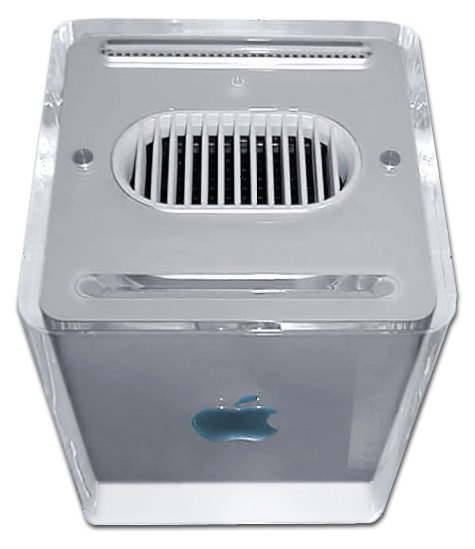

Specs
| Display | external display sold separately |
|---|---|
| Chip | PowerPC G4, 450 MHz; 500 MHz option |
| RAM | 64 MB base; 1.5 GB maximum |
| Storage | 20 GB disk; 40 GB option; slot-loading DVD |
| Ports | 2 × USB; 2 × FireWire; Ethernet 10/100; 56K modem |
Launch and context
Announced on July 19, 2000 with availability planned for early August. Original 450 MHz configuration: PowerPC G4, 64 MB RAM expandable to 1.5 GB, 20 GB disk and top slot-loading DVD. Apple offered 500 MHz and 40 GB options. [cube-launch]
How Apple presented it
Transparent design and fanless convection cooling defined the pitch. Apple included Pro Keyboard, optical mouse and Harman Kardon speakers; display chosen separately. Two FireWire, two USB, Ethernet 10/100 and 56 K modem. Historical US prices: $1799 at 450 MHz or $2299 at 500 MHz. On July 3, 2001 Apple indefinitely suspended production, saying most customers chose minitowers. Not a safety-recall announcement. [cube-launch, cube-end]
The lack of a fan was not explained by the exterior shape alone. The launch release described air flowing through a vertical channel in the Cube's center. Apple also emphasized that the electronics assembly could be lifted out of the enclosure to reach the components and add memory or an AirPort card. It was a different approach to internal access, rather than a sealed case meant only to be admired.
The idea of clearing the desktop extended to the display. The new monitors Apple introduced alongside the Cube used Apple Display Connector: a single cable carried video signals, USB data and power for the display. This does not mean that every monitor worked with that connector, or that a display was included in the Cube's price; it explains what Apple was trying to achieve with the system's design.
The Cube also has a documented life as a design object. MoMA catalogs the G4 Cube Computer, dated around 2000, under Jonathan Ive and Apple Industrial Design Group in Architecture and Design, recording it as a gift of the designers. This is a museum collection record, not certification of the configuration of the computer pictured here or a promise that visitors will find it on display.
Documented issues
Plastic marks prompted complaints in 2000. The Register reported that Apple described them as mold lines rather than cracks or weakness. The article challenges that response but does not establish universal heat-induced cracking. Assessing a collectible example requires inspection of the casing, external power supply and operation. Historical sources do not establish current repair availability. The image is a previously processed derivative credited to photographer and editor; it does not identify CPU frequency. [cube-lines, cube-image]
Sources
- cube-end · Apple, Cube production suspended · https://www.apple.com/newsroom/2001/07/03Apple-Puts-Power-Mac-G4-Cube-on-Ice/
- cube-image · Wikimedia Commons, PowerMac G4 Cube.jpg · https://commons.wikimedia.org/wiki/File:PowerMac_G4_Cube.jpg
- cube-launch · Apple, Apple Introduces G4 Cube · https://www.apple.com/newsroom/2000/07/19Apple-Introduces-Revolutionary/
- cube-lines · The Register, Apple denies Cube is cracking · https://www.theregister.com/2000/09/29/apple_denies_cube_is_cracking
- cube-moma · MoMA · G4 Cube Computer · c. 2000 · https://www.moma.org/collection/works/82134
More from the same family
Updated: October 25, 2026 · Compare this product