
MacBook (2006)
MacBook (2006): Intel Core Duo. Release: 2006-05-16.
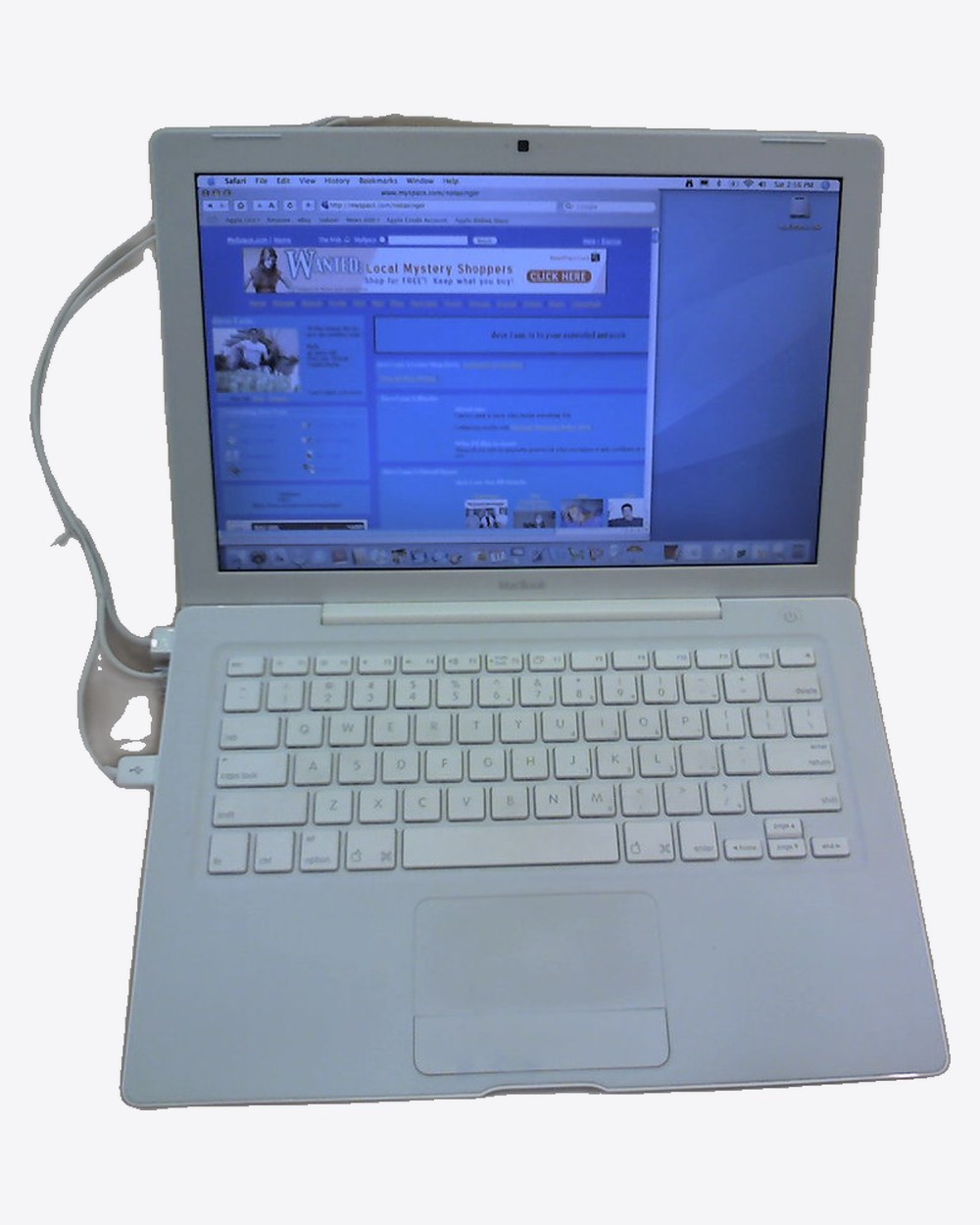
Specs
| Reference | — |
|---|---|
| Chip | Intel Core Duo |
| Highlight | Polycarbonate |
| Release | 2006-05-16 |
| Display | 13.3″ · 1280×800 |
| RAM | 512 MB |
| Price | 1,099 USD |
Launch
Apple announced it on 16 May 2006 to replace iBook and the 12-inch PowerBook, completing its Intel notebook range. The public purpose was to bring that transition to its consumer notebook. The announcement stated immediate availability that day.
Why it existed
Apple announced it on 16 May 2006 to replace iBook and the 12-inch PowerBook, completing its Intel notebook range. The public purpose was to bring that transition to its consumer notebook. The announcement stated immediate availability that day.
What it introduced
It combined Core Duo, a glossy 13.3-inch 1280 × 800 display, an iSight camera and MagSafe power connection. These were documented changes within Apple’s range, not worldwide inventions. Intel GMA 950 graphics were integrated and shared memory, not a dedicated graphics card.
Apple · MacBook Core Duo announcement · 16 May 2006 · Clint Ecker · Apple MacBook review · Ars Technica · 18 May 2006
The new keyboard attracted attention before the computer was even switched on. In his May 2006 Ars Technica review, Clint Ecker devoted a section to questions he had received about the spacing between keys. He explained that, despite its different appearance, its feel did not strike him as dramatically different from other Apple notebooks he had used. In his first impressions of the black model, Harry McCracken likewise distinguished in Macworld between a keyboard that looked unusual and one that felt unusual to type on. These are the authors' experiences, not a universal preference.
The closure was another subtle change: magnets held the lid shut without a mechanical hook that needed to be released with a button. Ecker described it in his review, and McCracken noted that the computer opened and closed without a latch. This is not the same as saying earlier models lacked magnetic elements: some used magnets to activate a hook. The change here was doing away with that mechanism, rather than a guarantee that the closure could never fail.
Against the competition
The Dell Inspiron e1405 reviewed by Ars Technica in July 2006 also used Core Duo and GMA 950, with a 14.1-inch display and Windows XP. MacBook offered Mac OS X Tiger and iLife ’06. This compares platforms and configurations from that year, not a universal winner or proof of simultaneous launch availability.
Nate Anderson · Dell Inspiron e1405 review · Ars Technica · 6 July 2006 · Apple · MacBook Core Duo announcement · 16 May 2006
Documented impact
In his May 2006 review, Clint Ecker praised performance and features such as iSight and MagSafe, but noted heat, screen reflections and integrated-graphics limits. This is one reviewer’s documented response, not agreement by every user or a sales figure.
Clint Ecker · Apple MacBook review · Ars Technica · 18 May 2006
Configurations and limits
May offered white at 1.83 GHz with Combo drive and 60 GB, white at 2.0 GHz with SuperDrive and 60 GB, and black at 2.0 GHz with SuperDrive and 80 GB. All three included 512 MB of RAM, expandable to 2 GB according to Apple. Later revisions’ memory and drives must not be assigned to this launch.
Interest for collectors
A specific object should be documented by color, processor, drive capacity and optical drive, plus any later changes. The announcement distinguishes the three original configurations; black was not merely white with identical equipment. These are historical identity details, not a valuation or promise of rarity.
Relationship to later products
On 8 November 2006 Apple announced a Core 2 Duo revision; the 2.0 GHz models now included 1 GB of memory and larger drives. That revision must keep its identity: sharing a name and year does not make a May Core Duo a November Core 2 Duo.
What it adds and what to know
Introduced on May 16, 2006, it replaced both the iBook and the 12-inch PowerBook at once and completed Apple's notebook transition to Intel processors in just 90 days , a transition that began in February 2006 with the 15-inch MacBook Pro. It debuted a 13.3-inch glossy widescreen display (1280×800), a built-in iSight camera, the MagSafe power adapter and a one-inch-thin design, 20 percent thinner than the iBook. According to Apple, it was up to five times faster than the iBook and up to four times faster than the 12-inch PowerBook. There were three models: two in white (1.83 and 2.0 GHz) and one in black (2.0 GHz). Apple Newsroom
Launch price
1,099 USD (1.83 GHz, white), 1,299 USD (2.0 GHz, white) and 1,499 USD (2.0 GHz, black) · US launch price; not a current price. Apple Newsroom
Trivia
All three May 2006 MacBook models included the infrared Apple Remote to control media with Front Row. Apple · MacBook · 16 May 2006
Its audio input and output combined analog and optical digital signals in the same connectors. Apple · MacBook · 16 May 2006
More from the same family
Updated: October 30, 2026 · Compare this product