
iBook G3 (1999)
iBook G3 (1999): PowerPC G3 · 300 MHz. Announcement: 1999-07-21.
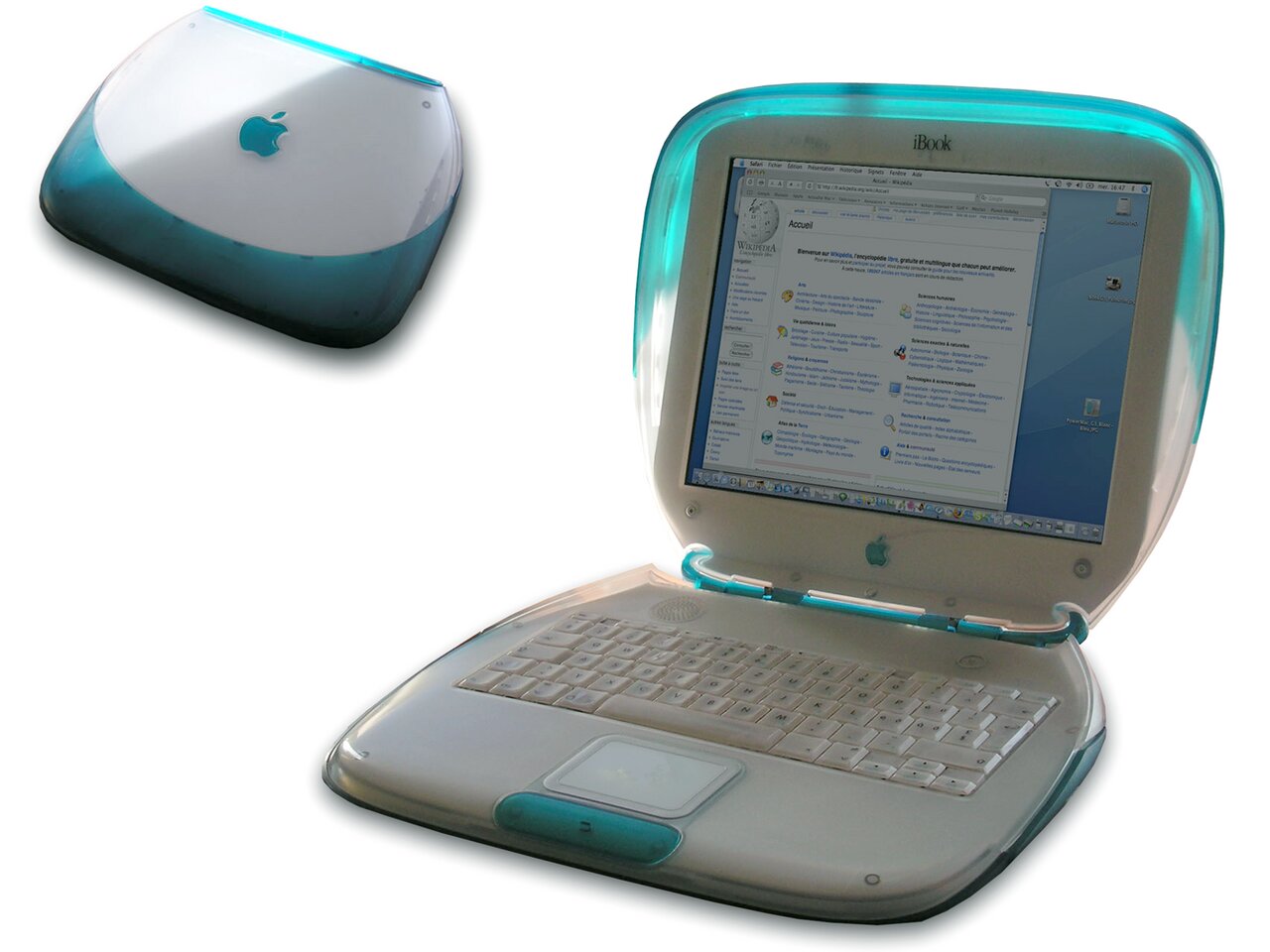

Specs
| Reference | — |
|---|---|
| Chip | PowerPC G3 |
| Highlight | Colored clamshell |
| Announcement | 1999-07-21 |
| Display | 12.1″ · 800×600 |
| RAM | 32 MB |
| Price | US, 1999: 1599 USD (TidBITS) |
Launch
Presentation: Steve Jobs · Macworld Expo, New York · 21 July 1999. Apple announced expected availability for September; this does not establish one universal first retail day.
Marketing
Slogan or campaign: «iMac to go.»
The first iBook: design, configuration and revisions
Apple introduced iBook on 21 July 1999 at Macworld Expo in New York for consumers and education. Its Canadian announcement called it an iMac to go and offered Blueberry and Tangerine. The rubber-coated translucent enclosure, pullout handle and latchless closing mechanism were part of its everyday portability pitch, not a promise of unlimited durability. Apple · Canadian announcement, 1999
Announcement, expected availability and shipments are different events. Apple announced availability for September. CBR's report of 15 September 1999 records Steve Jobs saying in Paris that shipments had begun; it also notes that CompUSA still listed the computer on back-order. This does not establish one first retail day across all countries and stores. Apple · Canadian announcement, 1999 CBR · Report, 15 September 1999
Apple documented the initial configuration with a 300 MHz PowerPC G3, 512 KB L2 cache, 32 MB SDRAM, a 3.2 GB IDE hard drive and an up-to-24× CD-ROM drive. Its Japanese original specifications gave an expansion limit of 160 MB using a module of up to 128 MB: that is the expanded capacity documented then, not factory-installed RAM. Disk space, RAM and video memory are separate quantities. Apple · Canadian announcement, 1999 Apple · Original Japanese specifications
The 12.1-inch TFT display had an 800 × 600 native resolution; Apple also documented a 640 × 480 mode. ATI RAGE Mobility used 4 MB of video memory. Wired connections included one USB port, a 56K modem and 10/100BASE-T Ethernet. The Japanese specifications describe a mono speaker and stereo headphone output: stereo output does not turn the built-in speaker into a stereo pair. Apple · Original Japanese specifications
AirPort was optional. The computer had two antennas and an internal card slot, but wireless-ready did not mean that the card or base station was included in the price. Apple's announcement explicitly distinguished this option. This matters when identifying a surviving unit: its enclosure does not establish which card remains inside or whether it can join a present-day network. Apple · Canadian announcement, 1999
Adam Engst's contemporary TidBITS report of 26 July 1999 put the US price at $1,599. Apple Canada's announcement specified 2,399 Canadian dollars: these are different markets and currencies, not contradictory US prices. Apple advertised up to six hours of battery life; its Japanese specifications list 45 Wh and warn that runtime depends on use. That historical claim does not establish the condition of a used unit's battery. Apple · Canadian announcement, 1999 Apple · Original Japanese specifications TidBITS · Report, 26 July 1999
The same outline does not identify one configuration. On 16 February 2000 Apple announced 64 MB RAM and 6 GB drives across the new range, with 366 MHz and Graphite for Special Edition. Another revision on 13 September 2000 introduced FireWire and new colors. Those capacities, colors and ports must not be transferred to the original 1999 Blueberry or Tangerine merely because they share the iBook name. Apple · February 2000 revision Apple · September 2000 revision
More from the same family
Updated: October 24, 2026 · Compare this product