
MacBook Pro (2006)
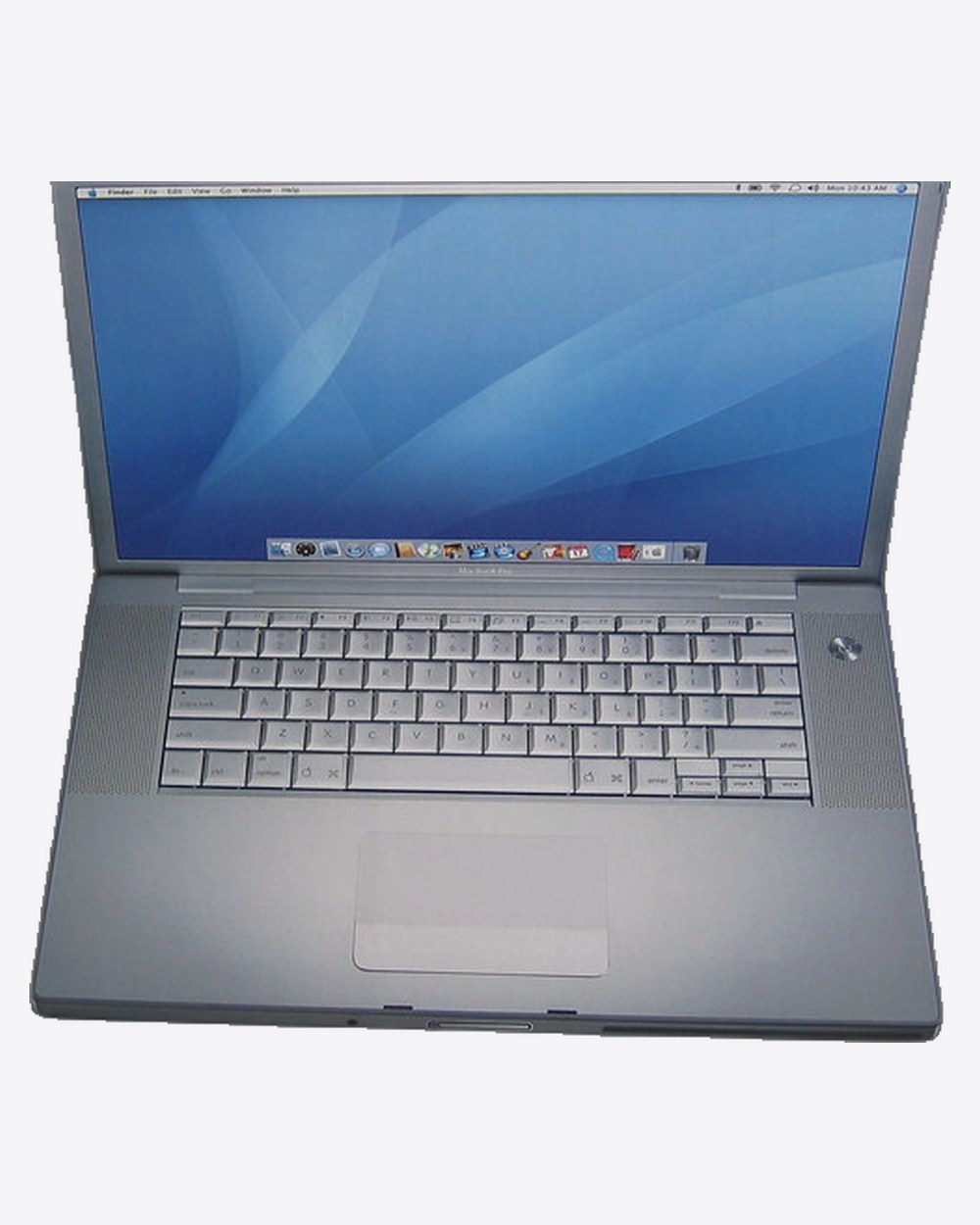
MacBook Pro (2006): Intel Core Duo. Release: 2006-02-14.
Specs
| Reference | — |
|---|---|
| Chip | Intel Core Duo |
| Highlight | First Intel notebook |
| Release | 2006-02-14 |
| Display | 15.4″ · 1440×900 |
| RAM | 512 MB |
| Price | 1,999 USD |
Launch
Presented: Steve Jobs · Macworld San Francisco · January 10, 2006. On sale: February 14, 2006.
What it adds and what to know
Announced on January 10, 2006 in San Francisco, with pre-orders from that day: it was the first Intel-based Mac notebook. It replaced the PowerBook G4 with, according to Apple, up to four times its performance, in a one-inch-thin aluminum enclosure weighing 5.6 pounds. It debuted the MagSafe magnetic connector, included a built-in iSight camera and was the first notebook with Front Row and the Apple Remote. Shipping began on February 14 with faster processors than announced at no additional cost: the $1,999 model went from 1.67 to 1.83 GHz and the $2,499 model from 1.83 to 2.0 GHz, with a 2.16 GHz build-to-order option. Apple Newsroom · announcement · Apple Newsroom · shipping
This notebook belonged to an industrial shift announced before its own unveiling. On June 6, 2005, Apple said it would begin offering Intel-based Macs in 2006 and planned to complete the transition from PowerPC by the end of 2007. Jobs justified the choice by saying Intel had the strongest processor roadmap; this was Apple's assessment, not an independent comparison. The MacBook Pro unveiled in January 2006 brought that strategy to the first Intel-based Mac notebook. The 2005 timetable was an announced plan, not evidence that the transition ended in 2007 or that every model changed at once.
Apple, Intel transition announcement, 6 June 2005 · Apple, first MacBook Pro announcement, 10 January 2006
Launch price
1,999 USD and 2,499 USD · US launch price; not a current price. Apple Newsroom
More from the same family
Updated: October 30, 2026 · Compare this product
Historical catalogue links
Relationships already recorded in the catalogue, not a complete succession chain. Same-year variants are shown as related. A missing link does not prove that an earlier or later model does not exist.