
Apple Lisa (1983)
Apple Lisa (1983): 5 MHz 68000, 1 MB, 12-inch monochrome display, mouse and two FileWare drives. Documented package included a 5 MB ProFile.
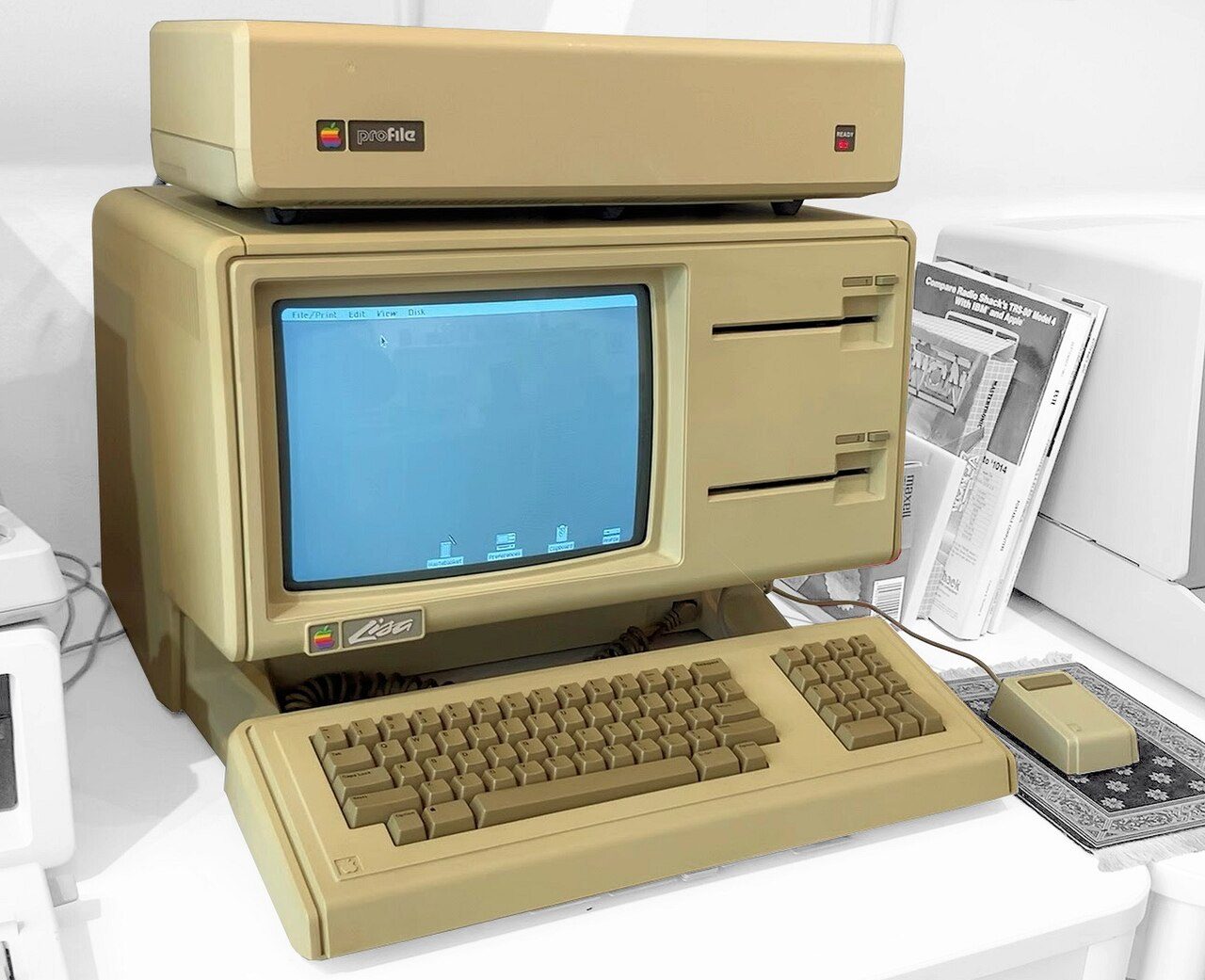

Specs
| Reference | Apple Lisa |
|---|---|
| Launch / discontinued | 1983-01-19 / — |
| CPU | Motorola 68000 @ 5 MHz |
| Memory | 1 MB RAM |
| Storage | 2× 5.25″ FileWare; 5 MB ProFile included in Apple 1983 package |
| Display / graphics | Built-in 12″ monochrome 720×364 |
| Expansion / ports | 3 expansion slots; mouse GUI |
| US launch price | USD 9,995 |
Launch
Apple unveiled Lisa on January 19, 1983. Apple's May 1983 product fact sheet, preserved in its marketing binder, describes the US $9,995 Lisa Office System with the computer, 5 MB ProFile and cable: the hard disk was not always optional in that package. It included a 5 MHz Motorola 68000, 1 MB RAM, detached keyboard, mouse and integrated 12-inch monochrome 720×364 display. The two FileWare drives, nicknamed Twiggy, belong to the original Lisa. Lisa 2 and Macintosh XL are later revisions, not the same configuration.
Apple · Lisa product fact sheets · May 1983 · Wikipedia · Apple Lisa
In late 1979, Steve Jobs and other Apple employees attended demonstrations at Xerox PARC. They saw Smalltalk and a way of working with graphics, windows and a mouse. This was not the birth of Lisa or Macintosh: both projects were already underway. Stanford's reconstruction distinguishes two visits by Apple groups and places Jobs on the second; that does not document two personal visits by Jobs.
Stanford, Making the Macintosh: The Xerox PARC Visit · Larry Tesler oral history, part 2, CHM, 16 December 2016, pp.12,27-29
The recollections do not fit a single, undisputed scene either. In his 2016 oral history, Larry Tesler acknowledged that for years he had merged several demonstrations into one. Jef Raskin explained that he wanted Jobs to understand work already taking place at Apple. The Computer History Museum describes PARC as an important influence, but notes that Apple engineers developed Lisa's interface from scratch. Influence, development and invention are different things.
Jef Raskin interview, Stanford: PARC and the Macintosh · Larry Tesler oral history, part 2, CHM, 16 December 2016, pp.12,27-29 · Computer History Museum, Xerox PARC: The Apple Connection
The relationship later acquired a legal dimension. In Xerox v. Apple, Xerox challenged the copyright registrations for Lisa and Macintosh Finder, alleging that they derived from Star. The order of April 10, 1990 granted Apple judgment on five of the six claims and left the Star ownership claim open. It examined the requirements and remedies for those claims; it was not a ruling deciding whether Apple had or had not copied Xerox's interface.
Xerox Corp. v. Apple Computer, Inc., 734 F. Supp. 1542 (10 April 1990)
A separate case was Apple v. Microsoft and Hewlett-Packard, filed in 1988. It concerned rights in the Lisa and Macintosh interfaces in relation to Windows and NewWave. In 1994, the appeals court upheld the judgments of noninfringement: the 1985 license and the distinction between unprotected ideas and protectable expression were central. This was not a patent dispute or a general trial over who invented the graphical user interface.
Xerox Corp. v. Apple Computer, Inc., 734 F. Supp. 1542 (10 April 1990) · Apple Computer, Inc. v. Microsoft Corp., 35 F.3d 1435 (19 September 1994)
Paper help beneath the keyboard
Lisa's help did not live only on screen. The 1983 manual describes pull-out cards beneath the keyboard: one showed the Option-key layout, two summarized the Office System, and another held details of the computer and support agreement. Once the quick-reference instructions were no longer needed, Apple suggested turning the cards over and using their backs for personal notes.
Marketing
Lisa combined a desktop, windows, icons, mouse, clipboard and multitasking in an office system. The 1983 brochure and May fact sheet list six applications: LisaWrite, LisaCalc, LisaList, LisaGraph, LisaDraw and LisaProject. The seven applications of the later Office System 7/7 name are not attributed to every original package. Its value was exchanging information between documents and presenting text and graphics, not being the first commercial graphical system of any kind: Xerox Star already existed.
Apple · Apple Invents the Personal Computer. Again. · 1983 · Apple · Lisa product fact sheets · May 1983 · Computer History Museum · The Lisa · 2023
Flaws and fixes
The Computer History Museum identifies price, perceived slowness and Twiggy reliability as obstacles, without making one factor the entire explanation. Lisa 2 replaced the two FileWare drives with a 3.5-inch Sony drive in January 1984. In January 1985 Lisa 2/10 became Macintosh XL, discontinued that April according to the museum. The original Lisa, the family and the MacWorks transition are therefore distinguished rather than assigning one 1986 end date to all.
Computer History Museum · The Lisa · 2023
More from the same family
Updated: November 15, 2026 · Sources: Wikipedia, Wikipedia · Compare this product