
Apple III Plus (1983)
Apple III Plus (1983): 256 KB, clock/calendar, revised keyboard and SOS. Apple manuals and prices clarify specifications, cost and emulation limits.
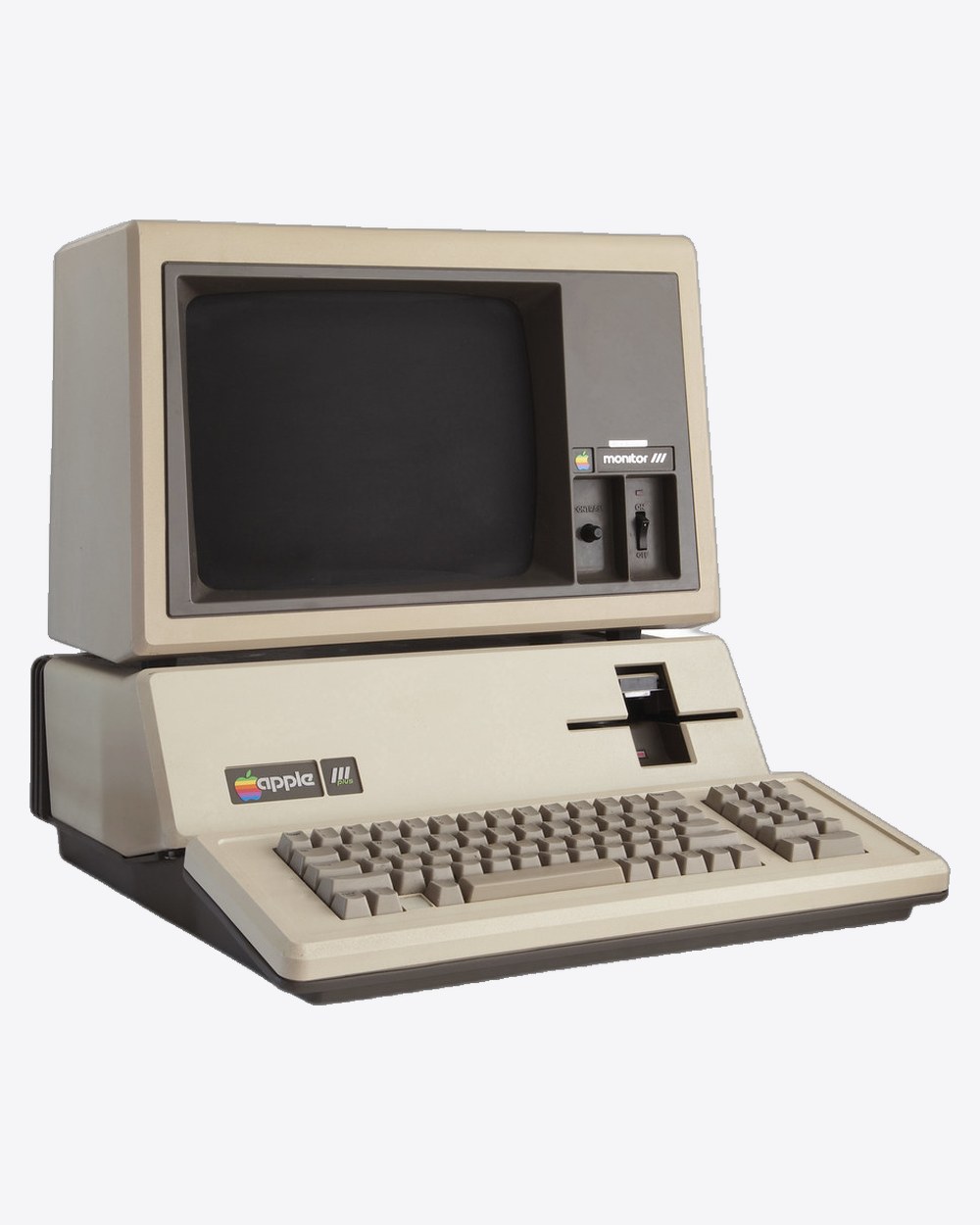

Specs
| Reference | Apple III Plus |
|---|---|
| Launch / discontinued | 1983-12 / — |
| CPU | 6502B · 2 MHz peak / 1.4 MHz average |
| Memory | 256 KB |
| Storage | Built-in 5.25-inch · 143,360 bytes (140 KiB) |
| Display / graphics | 80×24 text; 560×192 mono; 560×384 text interlace |
| Expansion / ports | DB-25 disk port; 4 slots |
| Documented US price | USD 2,995 · 15 February 1984 |
Launch
The Apple III Plus appeared in December 1983 as the final revision of this business-computer family, not as a Macintosh or an Apple IIe. An Apple price list dated 15 February 1984 documents the 256 KB A3S1256 system at a US suggested retail price of $2,995. This is dated evidence of a price, not a receipt for the first sale. The same list separates a $5,330 Business System with Monitor III, ProFile, interface and Catalyst 2.0: that package should not be confused with the basic system. The retirement date is less clear. Apple II History ends its timeline in April 1984, while Apple Museum takes it to September 1985. Without a document explaining the difference, this page does not assign one definitive retirement month.
Apple · Dealer price list · 15 February 1984 · p.15 · Apple II History · III Plus timeline · Apple Museum · Product timeline
Marketing
Apple promoted a computer ready for office work, with 256 KB, a floppy drive, numeric keypad and built-in clock/calendar. Its guide specifies a processor based on the 6502B, with a 2 MHz peak and 1.4 MHz average clock speed, rather than a fixed 1.8 MHz. The manual states a minimum of 128 KB, distinct from the 256 KB in the documented commercial configuration. The internal drive stores 143,360 bytes, or 140 KiB, and the controller supports up to three external drives. There are four 50-pin expansion slots, an RS-232-C serial port and a DB-25 disk connector. Text interlace provides 560×384 dots with a suitable green-phosphor monitor; this does not turn every graphics mode into that resolution. The guide specifies maximum input consumption of 100 W for the electrical version it describes, not the output rating of a power supply.
Apple · III Plus Owner's Guide · pp.186,204–206 · Apple · III Plus System Data Sheet
Flaws and fixes
The Plus is interesting for its usability changes within the III platform: a clock with replaceable batteries, a 75-key keyboard and improved text presentation, while retaining SOS and this family's applications. The brochure advertised access to CP/M programs through the SoftCard III board, an addition rather than a native 6502B capability. Apple II compatibility has specific limits too: the emulation disk defaults to a 48 KB Apple II Plus with Applesoft, provides none of the III's advanced features and cannot emulate a Language Card. A collection record should distinguish computer, accessories and software. A fitting connector does not prove compatibility: the 1984 list explicitly distinguishes a Disk III with adapter, and the manual separately identifies disk, serial and Silentype ports. The clock batteries deserve inspection; the guide warns about leakage and advises against carbon-zinc cells.
Apple · III Plus Owner's Guide · pp.186,204–206 · Apple · III Plus System Data Sheet · Apple · Dealer price list · 15 February 1984 · p.15
More from the same family
Updated: November 15, 2026 · Sources: Wikipedia, Wikipedia · Compare this product