
Macintosh PowerBook 100 (1991)
2 MB, 20 MB HDD
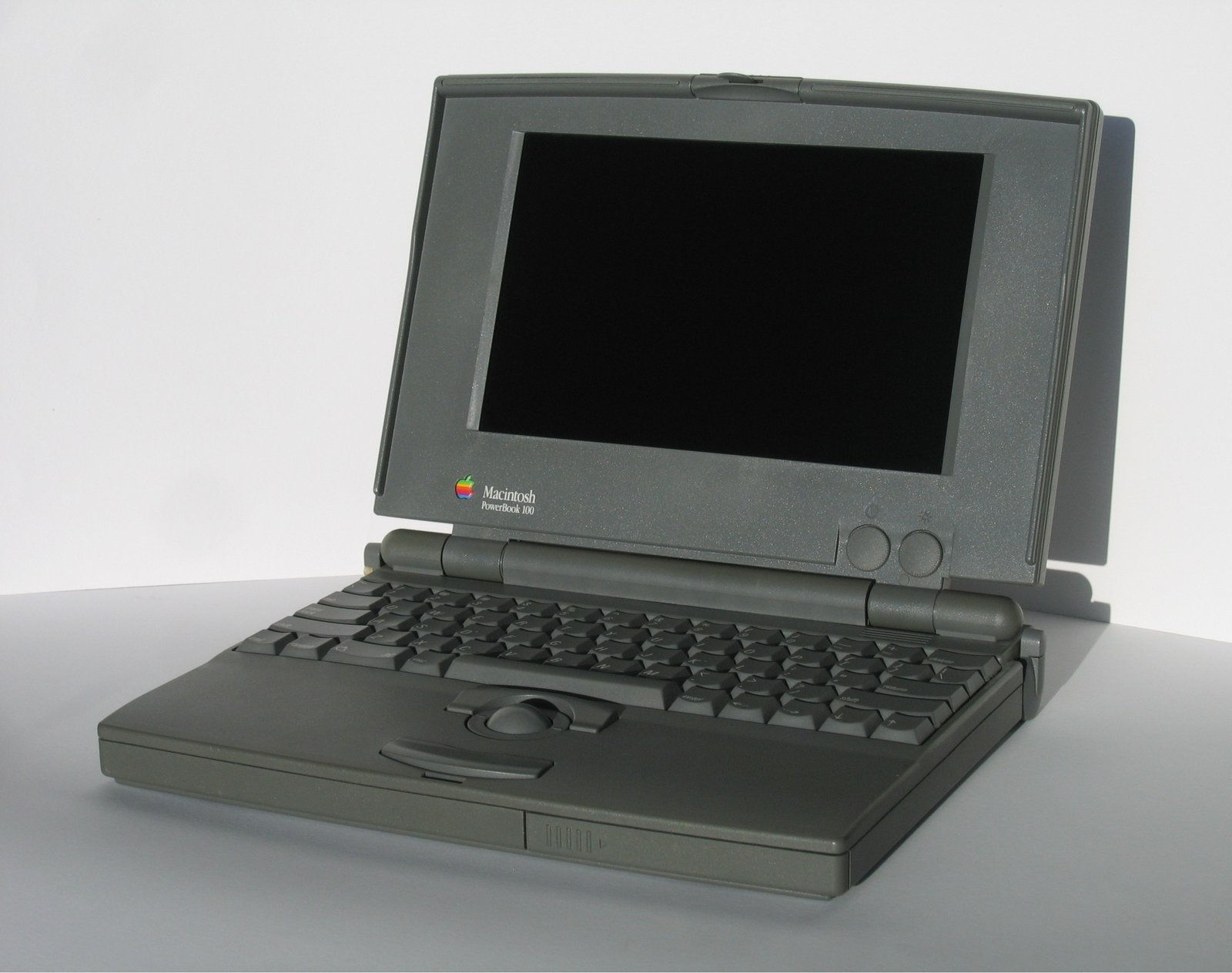
The Macintosh PowerBook 100 combines a 16 MHz Motorola 68HC000 with a portable enclosure, keyboard, palm rest and trackball. Apple's original data sheet documents order M0567LL/A: 2 MB RAM and a 20 MB SCSI hard disk. This entry preserves that exact combination; optional upgrades are not counted as installed equipment. No floating-point coprocessor is included.

Specifications
| CPU | 68HC000 · 16 MHz |
|---|---|
| FPU | not included |
| Installed RAM | 2 MB |
| Maximum RAM | 8 MB |
| ROM | 256 KB |
| Hard disk | 20 MB · SCSI |
| Display | 9 in · FSTN · monochrome |
| Resolution | 640 × 400 |
| Floppy drive | external, not included |
| Serial ports | 1 × RS-422 |
| ADB | 1 |
| Modem | optional, not installed |
History and documentation
The PowerBook 100 did not start with an entirely new architecture. Apple's 1991 developer note links it to the backlit Macintosh Portable, but in a smaller, lighter computer. That continuity had limits: the internal floppy drive and processor-direct expansion slot were gone. Although both supported RAM and modem upgrades, their cards were not interchangeable. Sharing a technical foundation did not mean sharing every accessory.
Working with Sony helped turn that foundation into a different format. Writing in Fortune on November 4, 1991, Brenton R. Schlender reported that Apple had approached Sony because it lacked enough engineers for all the products planned for 1991. Apple supplied the initial blueprint and component selection; Sony took the design through to manufacturing. The article also recorded initial doubts among managers at both companies: this was more than asking a supplier for a smaller case.
The same report preserved a detail about how the computer was developed. Corporate travel restrictions during the Gulf War disrupted meetings between the Apple and Sony teams on opposite sides of the Pacific, so they turned to teleconferences to keep the project moving.
Design and specifications
There are 2 MB soldered PSRAM and one slot for a memory expansion card. The documented maximum is 8 MB and ROM is 256 KB; neither figure replaces this configuration's installed RAM. Apple markets it as 16 MHz; the Developer Note specifies 15.667 MHz.
Use and context
The 9-inch backlit LCD has 640 × 400 pixels. It is a passive monochrome FSTN panel, not an active matrix. No external monitor output is assigned to it. The built-in trackball is 25 mm in diameter and has two buttons. These features are not merged with the color screens of later variants.
Notes and image
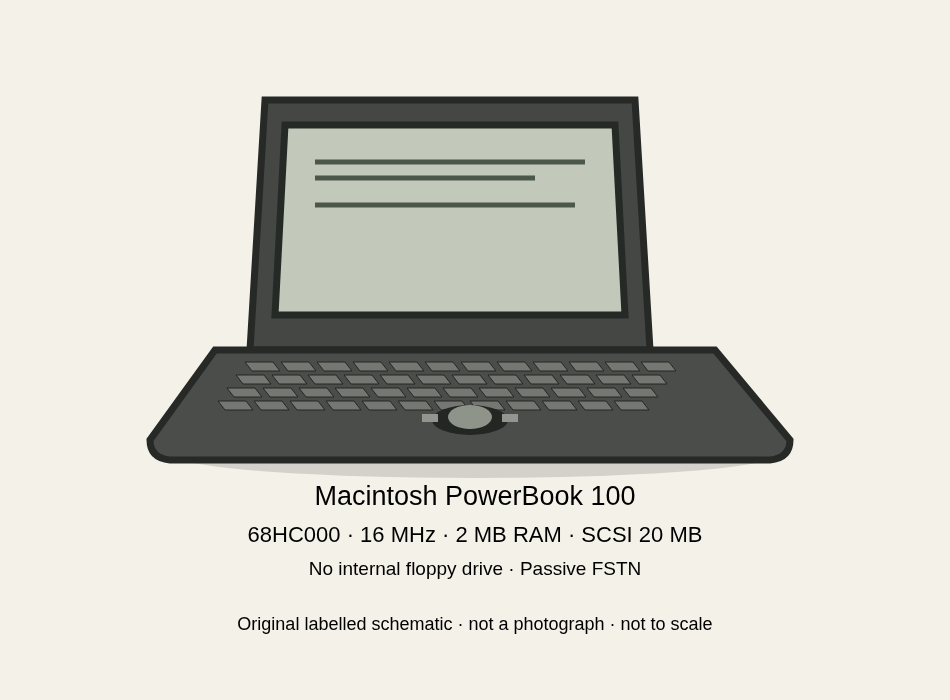
It has no internal floppy drive; its HDI-20 port accepts an external 1.44 MB drive. It has one ADB port, one RS-422 serial port and HDI-30 external SCSI. The modem is optional and is not assumed installed. The rechargeable main battery is sealed lead-acid. It provides sound output, not audio input. The original labelled illustration is a schematic, not a photograph or scale plan.
Sources
- Apple · Macintosh PowerBook 100 · Original data sheet and ordering information
- Apple · Macintosh PowerBook 100 · Developer Note
- dimensioncupertino.com · Original schematic illustration
- macintosh-portable-1989
- macintosh-portable-1989 ⇄ Macintosh PowerBook 100 (2 MB, 20 MB HDD)
- Fortune · Brenton R. Schlender · Apple's Japanese Ally · 1991-11-04
Updated: October 29, 2026 · Sources: Apple Soporte · Apple Tech Info Library · EveryMac · Compare this product