
Apple MessagePad 120 (1995)
Apple MessagePad 120 (1995): Newton personal digital assistant with an ARM 610 at 20 MHz, 2 MB of RAM, 4 MB of ROM and a 320 × 240 LCD.
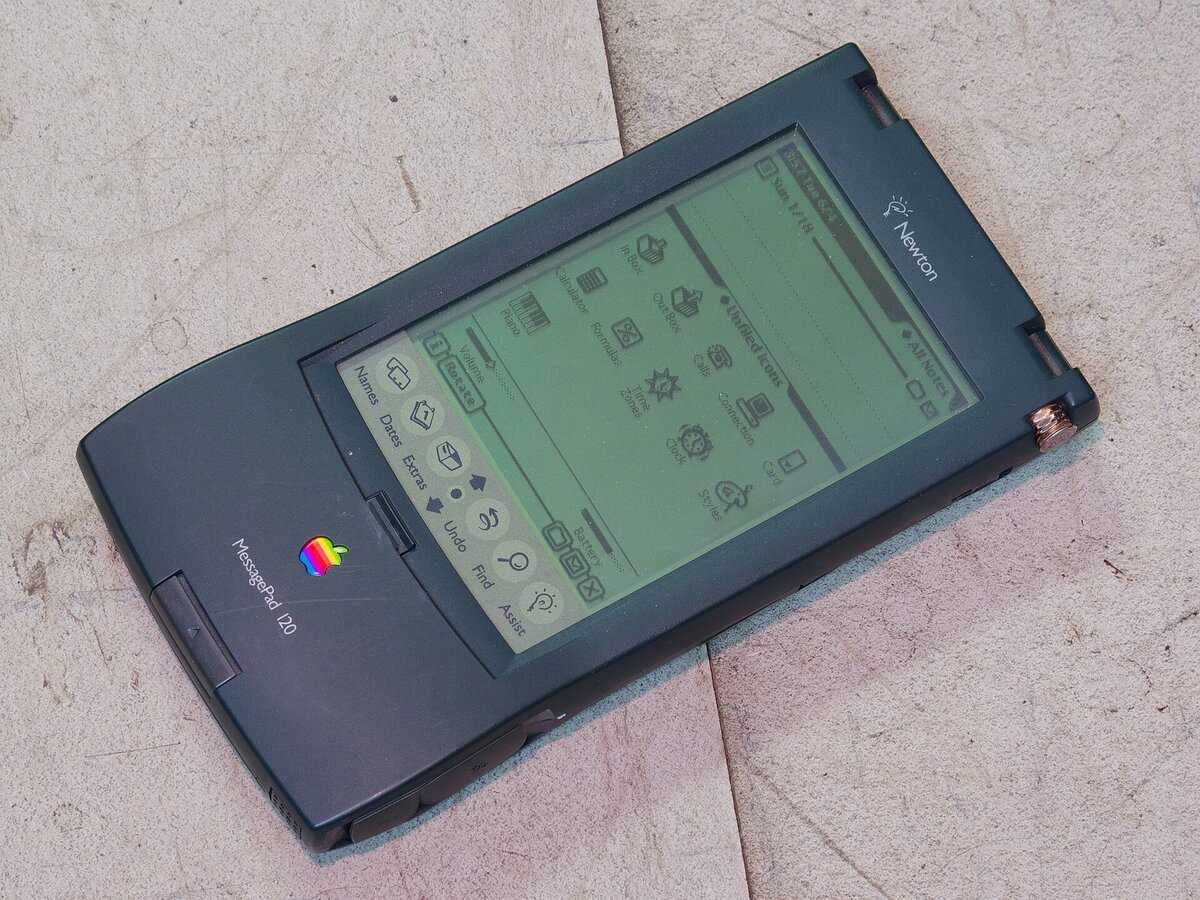
Specs
| Introduced | 1995-01 |
|---|---|
| Chip | ARM 610 · 20 MHz |
| RAM | 2 MB |
| Display | 320×240 |
| Battery | 4 × AA |
| Ports | PCMCIA II · LocalTalk (mini DIN-8) |
| Weight | 0.475–0.58 kg |
| Dimensions | 202 × 106 × 31 mm |
Launch
Dates per Apple's Tech Info Library: introduced January 1995; the table gives no discontinuation date. The dates come from Apple's Tech Info Library table (TIL11051).
Marketing
In its October 1995 data sheet for the MessagePad 120 with Newton 2.0, Apple presented the device as a way to take information along: personal and business organization, exchange with a computer and communications expanded through accessories. This is documented positioning for that later configuration, not a slogan attributed to the January launch or a promise of included wireless connectivity.
Flaws and fixes
Apple documents no model-specific defects in the sources consulted. Limits that do appear in its spec sheet: reflective LCD, not backlit; runs on 4 AA batteries or a rechargeable NiCad pack; memory: 1,5 MB FLASH + 0,5 MB SRAM.
Design, memory and work away from the desk
The MessagePad 120 kept the 20 MHz ARM 610 processor, but its development went beyond that figure. Mark H. Anbinder's TidBITS report of January 30, 1995 described 1 MB and 2 MB configurations, along with changes to the cover, screen and expansion slot. Apple's historical table gives an approximate introduction date of January 1995; it supplies no discontinuation date for this model.
The copier-style cover became removable. The service manual distinguishes this from the MessagePad 110 cover, which folded back and fastened behind the unit. The 120 still had a reflective 320 × 240 LCD with a fixed icon area. The backlight Apple describes for the later MessagePad 130 must not be attributed to the 120.
For the 2 MB model, Apple Service Source lists 1.5 MB of FLASH and 0.5 MB of SRAM. These are not amounts added to 2 MB: they describe its composition. That distinction helps explain why the advertised total was not all free document space. The contemporary report documents a 1 MB configuration too, although the service table consulted details the 2 MB version.
Expansion retained a single PC Card Type II slot. Anbinder noted its side-mounted lock and reported a 325 mA supply capacity, against the 110's 115 mA, for more power-hungry accessories. This improved support for compatible communications and storage cards; it did not put a network radio inside the device. The chosen card occupied that one slot.
The LocalTalk-compatible serial port connected the device to other systems through the appropriate cable and tools. The October 1995 sheet also lists RS-232 compatibility and half-duplex infrared at up to 38.4 kbit/s over one meter. For that configuration, Apple distinguished infrared exchange from mail and fax services, which required an optional modem and the appropriate service.
Power came from four AA batteries or a rechargeable NiCad pack, together with a DL2032 backup cell. The service manual specified 475 g without batteries and 580 g with batteries or a pack, so both weights need their conditions. No universal runtime is assigned here: cards, communications and individual test conditions prevent treating one experience as a guarantee for every unit.
Configurations sharing the same product name also need separating. Apple's October 1995 sheet identifies the 2 MB MessagePad 120 with Newton 2.0 and 8 MB of ROM, against the 4 MB assigned to the original 120 in the service table. This difference does not retroactively change every January unit's hardware. The same documentation limits the optional Newton keyboard to devices with Newton 2.0.
Reception was not uniform either. In his GCN review published September 18, 1995, Michael Cheek valued calendar and contact organization but reported errors recognizing his handwriting and slow synchronization with a computer. These are observations from his test, not a confirmed manufacturing defect across the series. That mix of usefulness and limits places the 120 as an organizer and short-note tool, without presenting it as a universal computer replacement.
More from the same family
Updated: October 26, 2026 · Sources: Apple Service Source · Apple Tech Info Library · Compare this product