
Apple MessagePad 110 (1994)
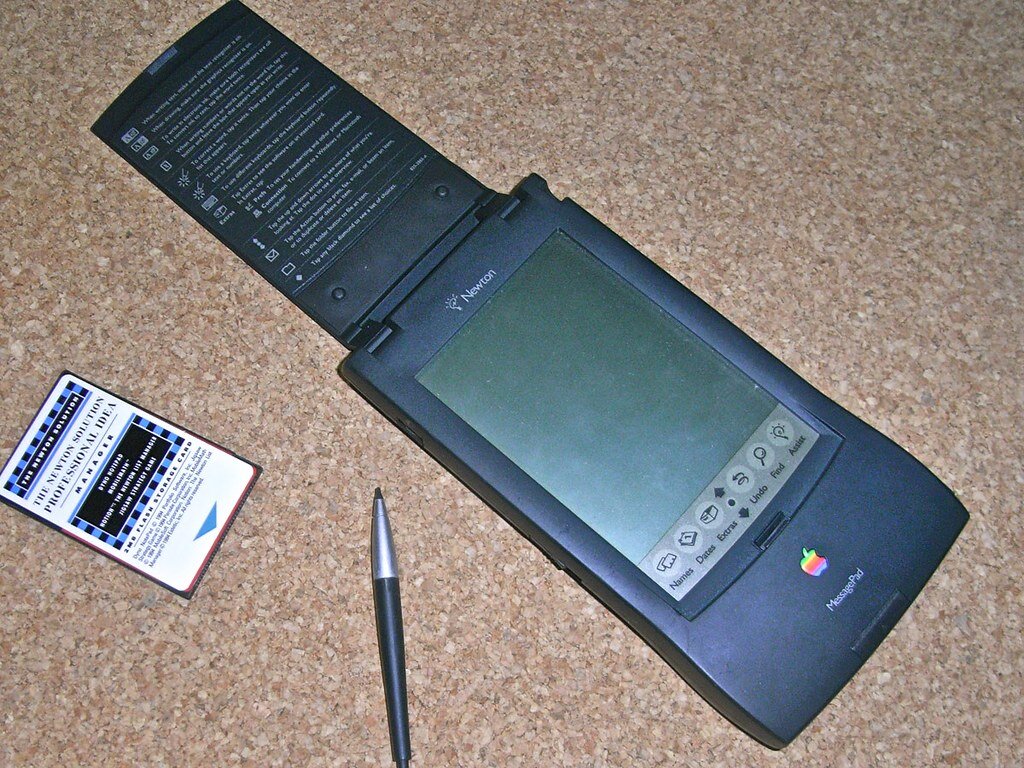
Apple MessagePad 110 (1994): Newton personal digital assistant with an ARM 610 at 20 MHz, 1 MB of RAM, 4 MB of ROM and a 320 × 240 LCD.
Specs
| Introduced | 1994-03 |
|---|---|
| Chip | ARM 610 · 20 MHz |
| RAM | 1 MB |
| Display | 320×240 |
| Battery | 4 × AA |
| Ports | PCMCIA II · LocalTalk (mini DIN-8) |
| Weight | 0.475–0.58 kg |
| Dimensions | 202 × 106 × 31 mm |
Launch
Dates per Apple's Tech Info Library: introduced March 1994; discontinued January 1995. The dates come from Apple's Tech Info Library table (TIL11051).
Marketing
Apple's February 1994 data sheet presented the MessagePad 110 as a way to organize information, communicate and exchange data with a computer. It promised more than three times the memory space and twice the battery life of the original Newton MessagePad. Those were the manufacturer's advertising comparisons, not independent measurements. No undocumented launch price is assigned here.
Flaws and fixes
Apple documents no model-specific defects in the sources consulted. Limits that do appear in its spec sheet: reflective LCD, not backlit; runs on 4 AA batteries or a rechargeable NiCad pack.
A portable Newton, with optional connections
Apple's historical TIL11051 table places the introduction of the MessagePad 110 in March 1994 and its discontinuation in January 1995. The document itself calls these approximate dates. The surviving data sheet was printed in February 1994; its printing date does not establish an exact on-sale day. This separates the promotional document from the product's chronology.
This was not simply the first MessagePad with a different number. Service Source identifies the 110 by an integrated protective lid that flipped back and fastened to the rear. Its stylus fitted into a slot extending into the right side, and its PCMCIA slot was also on the right. The original MessagePad and the 100 had a different arrangement, with PCMCIA at the top and no built-in cover.
The 20 MHz ARM 610 worked with 1 MB of RAM and 4 MB of ROM. The service manual lists 640 KB of RAM for the original MessagePad and the 100; physical capacity should not be confused with the usable space discussed in the advertising. The 110 retained a reflective LCD without backlighting, at 320 × 240 pixels rather than those models' 336 × 240.
Writing was central to the proposal. The data sheet described recognition of printed and cursive handwriting, by letter or word, but also allowed notes to remain handwritten for recognition later. A notepad, to-do list, datebook and contacts were included. These are functions Apple advertised, not a guarantee that every handwriting style would be recognized correctly or a present-day assessment of accuracy.
Connections required separating built-in features from options. The unit included short-range infrared, advertised at up to 38.4 kbit/s over one metre, a LocalTalk-compatible serial port and a Type II PCMCIA slot. Faxing and modem access to email or online services required an optional fax/modem; receiving wireless messages required the optional Newton Messaging Card. This was not integrated mobile connectivity of the kind found in a modern phone.
Exchanging data with a computer also had conditions. Apple offered the optional Newton Connection Kit for Windows 3.0 or later and for Macintosh system software 7.1 or later. Printing depended on the printer and accessories: the brochure listed Apple printers over a serial cable and parallel printers through Newton Print Pack. That historical list must not be read as verified compatibility with today's systems or services.
Power came from four AA cells or a rechargeable NiCad pack, compared with the four AAA cells documented for the original and the 100. Service Source specifies 475 g without batteries or a pack and 580 g with them, not two case variants; dimensions were 202 × 106 × 31 mm. These figures explain a portable assistant, but also the bulk and weight that accompanied its lid and battery compartment.
Apple's manual describes servicing by whole-unit exchange rather than component repair. It includes a power-manager reset that Apple says preserves stored information. This does not establish a defect unique to the 110 or justify assigning every Newton-family problem to it. The sources explain its design and limits without inventing a fault, a defect-related withdrawal or a universal remedy.
More from the same family
Updated: October 26, 2026 · Sources: Apple Service Source · Apple Tech Info Library · Compare this product