
Apple MessagePad 100 (1994)
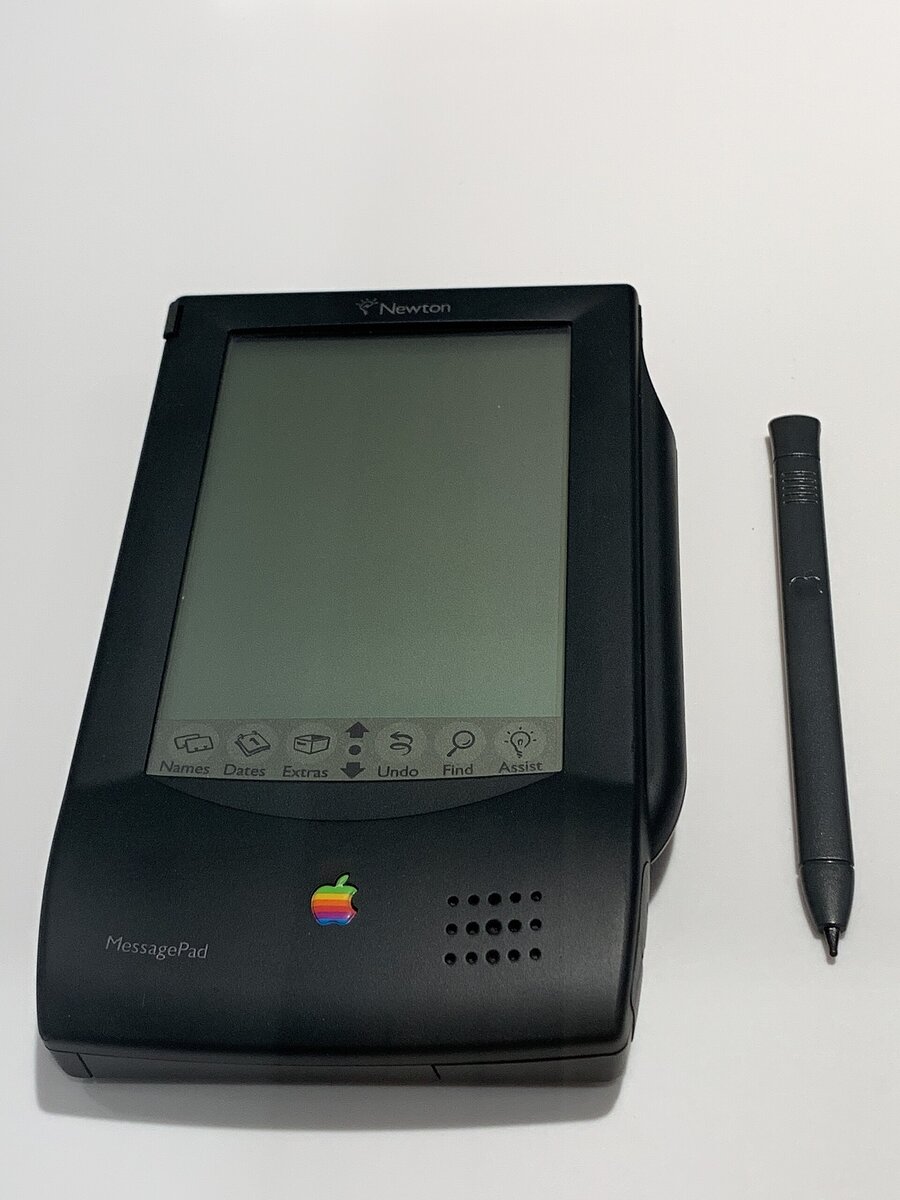
Apple MessagePad 100 (1994): Newton personal digital assistant with an ARM 610 at 20 MHz, 640 KB of RAM, 4 MB of ROM and a 336 × 240 LCD.

Specs
| Introduced | 1994-03 |
|---|---|
| Chip | ARM 610 · 20 MHz |
| RAM | 640 KB |
| Display | 336×240 |
| Battery | 4 × AAA |
| Ports | PCMCIA II · LocalTalk (mini DIN-8) |
| Weight | 0.4 kg |
| Dimensions | 185 × 114 × 19 mm |
Launch
Dates per Apple's Tech Info Library: introduced March 1994; discontinued January 1995. The dates come from Apple's Tech Info Library table (TIL11051).
Marketing
Apple's February 1994 data sheet presented the MessagePad 100 as the affordable member of the Newton family. Its proposition combined personal organization, notes and sketches with communications and synchronization expanded through accessories. This is documented Apple positioning, not an independent assessment of recognition accuracy or a claim that a modem or desktop connection came as standard.
Flaws and fixes
Apple documents no model-specific defects in the sources consulted. Limits that do appear in its spec sheet: reflective LCD, not backlit; runs on 4 AAA batteries or a rechargeable NiCad pack; Apple's Service Source groups the MessagePad 100 with the original MessagePad specifications.
The original form within the Newton family
The MessagePad 100 retained the original Newton's form while the 110 introduced a different case. Apple's March 4, 1994 release explained this choice of designs and announced plans to introduce the 100. It expected April availability in the United States and United Kingdom, not immediate worldwide sales. Apple's later table gives approximate introduction in March 1994 and discontinuation in January 1995; announcement and planned availability are not the same date.
Apple Service Source groups the original MessagePad and the 100 in several sections. It describes a stylus mount on the right side, a PCMCIA slot at the top and no built-in cover. This visibly differs from the 110 with its folding lid. The higher model's cover, AA batteries and 320 × 240 display must not be transferred to the 100.
The 100's own sheet confirms the 20 MHz ARM 610, 4 MB of ROM and 640 KB of RAM. Its reflective 336 × 240 display paired a transparent tablet with a passive pen. Apple described entering notes, text and graphics: this was more than a fixed-field organizer. That advertised capability does not promise perfect recognition of everyone's handwriting.
Physical expansion relied on one PCMCIA Type II slot and a LocalTalk-compatible serial port. The commercial sheet separates built-in and optional features: sending faxes or reaching mail and online services needed a fax/modem; receiving wireless pages needed a Newton Messaging Card. This expansion must not be mistaken for mobile connectivity built into every device.
Infrared let users exchange notes, contact cards and appointments with nearby Newton users. Apple specified half-duplex transmission at up to 38.4 kbit/s over one meter. This was a local device link, not remote Internet access. To share and synchronize information with a PC or Macintosh, the same sheet offered the appropriate Newton Connection Kit separately.
Computer integration had specific requirements: a PC with an 80386DX or later and Windows 3.0 or later, or a Macintosh with a 68030 or faster and system 7.1 or later, with its Connection Kit. Printing did not mean universal compatibility either: Apple listed its own printers and referred to the optional Newton Print Pack for several HP, Canon and Epson models.
Apple's sheet gave dimensions of 184.75 × 114.3 × 19.05 mm and a weight of about 0.4 kg. Power came from four AAA batteries or an optional rechargeable pack, plus a CR2032 backup cell. These are 100 specifications, not the condition-dependent 110 or 120 weights. The power adapter and rechargeable battery were options, not mandatory contents of every box.
Order reference H0123LL/A included the assistant, stylus, batteries, welcome video and documentation. The sheet also offered a temporary upgrade from the original MessagePad to the 100's capabilities. That program helps explain their continuity, but does not identify any old unit as a 100 or give it the 110's physical improvements. This page's main photograph is specifically identified as a MessagePad 100 by its source.
More from the same family
Updated: October 26, 2026 · Sources: Apple Service Source · Apple Tech Info Library · Compare this product