
iPod shuffle (2005)
1st generation · A1112
This entry covers iPod shuffle (1st generation), model A1112, from 2005. The documented configuration offers 512 MB / 1 GB of flash storage.
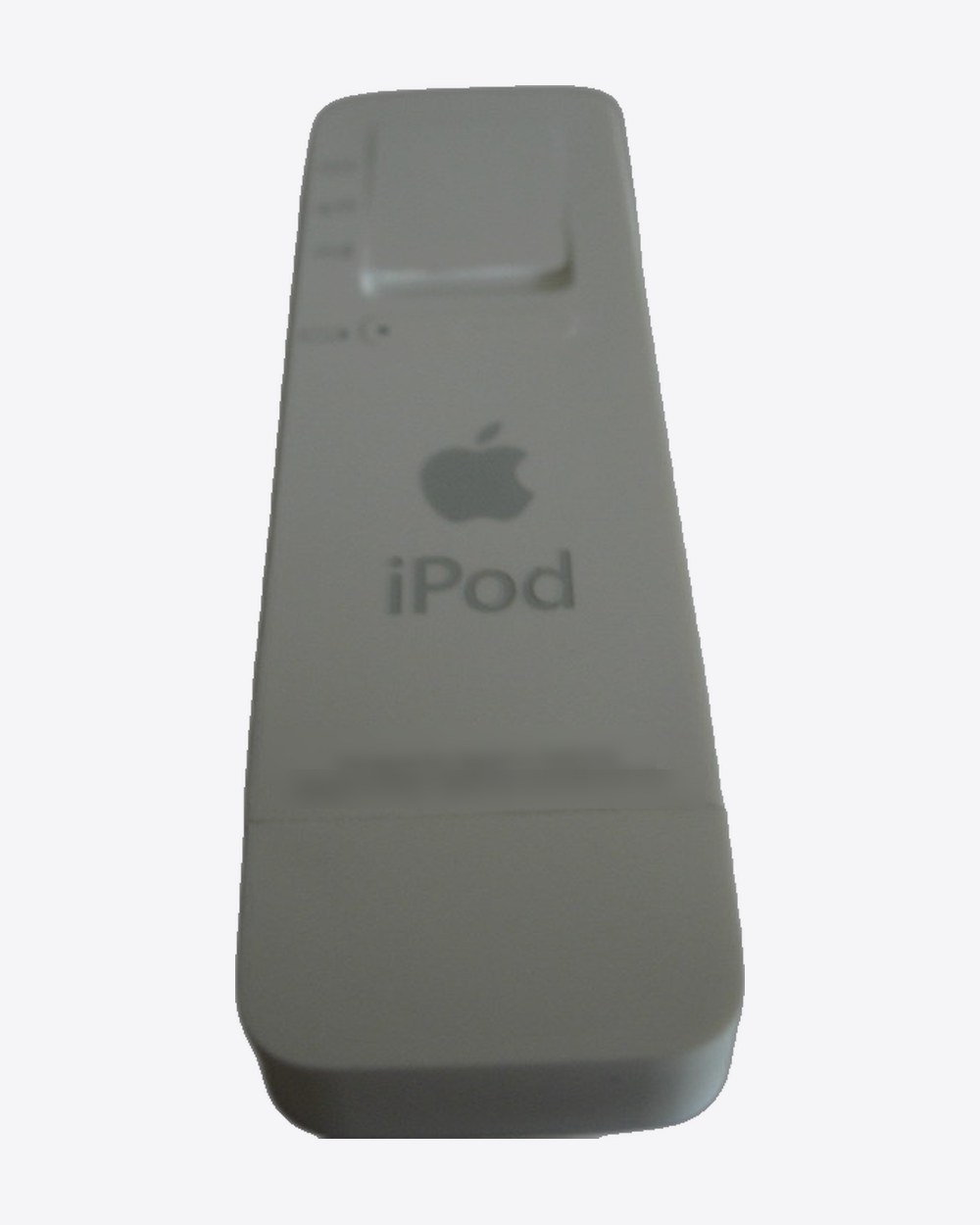


Photograph of the model. It does not establish a unit’s storage capacity or internal condition.
Specifications
| Model | A1112 |
|---|---|
| Documented storage | 512 MB / 1 GB |
| Navigation | Physical buttons |
| Display | No display |
| Frequency response | 20 Hz - 20 kHz |
| Computer connection | Integrated USB 1.1 / 2.0 |
| Height | 3.3 in |
| Width | 0.98 in |
| Depth | 0.33 in |
| Weight | 22 g |
| Music: Apple maximum | Up to 12 h |
| Selected audio formats | AAC / MP3 / WAV |
History and documentation
This entry covers iPod shuffle (1st generation), model A1112, from 2005. The documented configuration offers 512 MB / 1 GB of flash storage.
Design and specifications
It uses Physical buttons for navigation. Display: No display. Status lights are on the front and back.
The front control groups play/pause, volume and track skip; a switch on the back turns it off or chooses between in-order and shuffled playback.
Under the bottom cap hides a USB connector that plugs straight into the computer, with no cable, and doubles as a flash drive for files. At 22 grams and smaller than a pack of gum, it was the smallest iPod and the first under $100.
It launched in two configurations: 512 MB for $99 (up to 120 songs) and 1 GB for $149 (up to 240 songs).
The front circle resembles other iPods, but it is not a scroll wheel: these are push buttons, a distinction Macworld stressed in February 2005. Miniaturization did not remove the realities of the desk, either. The same article presented the optional Dock as a way to charge or connect the shuffle without reaching around the back of a Power Mac. That accessory addressed computer placement, not a requirement for the player to have a dock to work.
Macworld / Breen, Seff, Snell (Feb 2005)
Use and context
It measures 3.3 in high, 0.98 in wide and 0.33 in deep, and weighs 22 g. The technical sheet lists a 20 Hz to 20 kHz frequency response and support for AAC, MP3 and WAV among other formats.
Steve Jobs announced it on January 11, 2005 at Macworld Expo in San Francisco with the slogan "Life is random". His argument: competing flash players made you hunt for music on tiny displays with complicated controls; the shuffle simply serves new combinations from your library every time you listen.
It works with iTunes' AutoFill feature (then version 4.7.1), which picks and copies songs automatically with one click. It arrived when the iPod was already the world's best-selling digital music player: more than 10 million units since 2001, 4.5 million of them over the 2004 holiday season.
A lanyard is included so it can be worn around the neck from day one; optional accessories were a sport armband, a sport case, a Dock, a USB power adapter and a two-AAA battery pack adding up to 20 more hours. On February 7, 2006 Apple cut its prices to $69 and $99.
The line continued with three more generations (2006, 2009 and 2010), always without a screen.
Notes and image
Computer connection: Integrated USB 1.1 / 2.0. Apple quotes up to 12 hours of music on a full charge under its test conditions. This is a historical figure, not a runtime guarantee or an assessment of a used unit's battery.
Documented curiosity: because of its gum-pack size, Apple's US website carried the footnote "Do not eat iPod shuffle"; the UK site warned against chewing it.
Without a screen, shuffle used lights to communicate different states. Apple's original guide distinguishes steady amber while charging from continuous blinking during disk use; the latter requires ejecting the device before disconnecting it to avoid damaging files. The rear button checks something else, the battery: green means a good charge, amber a low charge and red very little charge. Colour alone is not enough to interpret the device: which indicator is lit, whether it is steady or blinking and whether the player is connected all matter. These are signals described in the manual, not a diagnosis of the photographed unit's battery.
Apple, iPod shuffle User's Guide (2005), pp. 16-19
Sources
- Apple · technical specifications
- Apple · model identification
- Yohanes.niko · CC BY-SA 3.0
- Yohanes.niko · CC BY-SA 3.0
- Apple · original announcement (January 2005)
- The Guardian · "Life is random" (January 2005)
- Engadget · "Do not eat iPod shuffle" (January 2005)
- Apple · price cut (February 2006)
- Atomicdragon136 · CC BY-SA 4.0


Updated: November 7, 2026 · Compare this product
Historical catalogue links
Relationships already recorded in the catalogue, not a complete succession chain. Same-year variants are shown as related. A missing link does not prove that an earlier or later model does not exist.