
iPod nano (2005)
1st generation · A1137
This entry covers iPod nano (1st generation, 2005), model A1137, from 2005. The documented configuration offers 2 / 4 GB of flash storage.

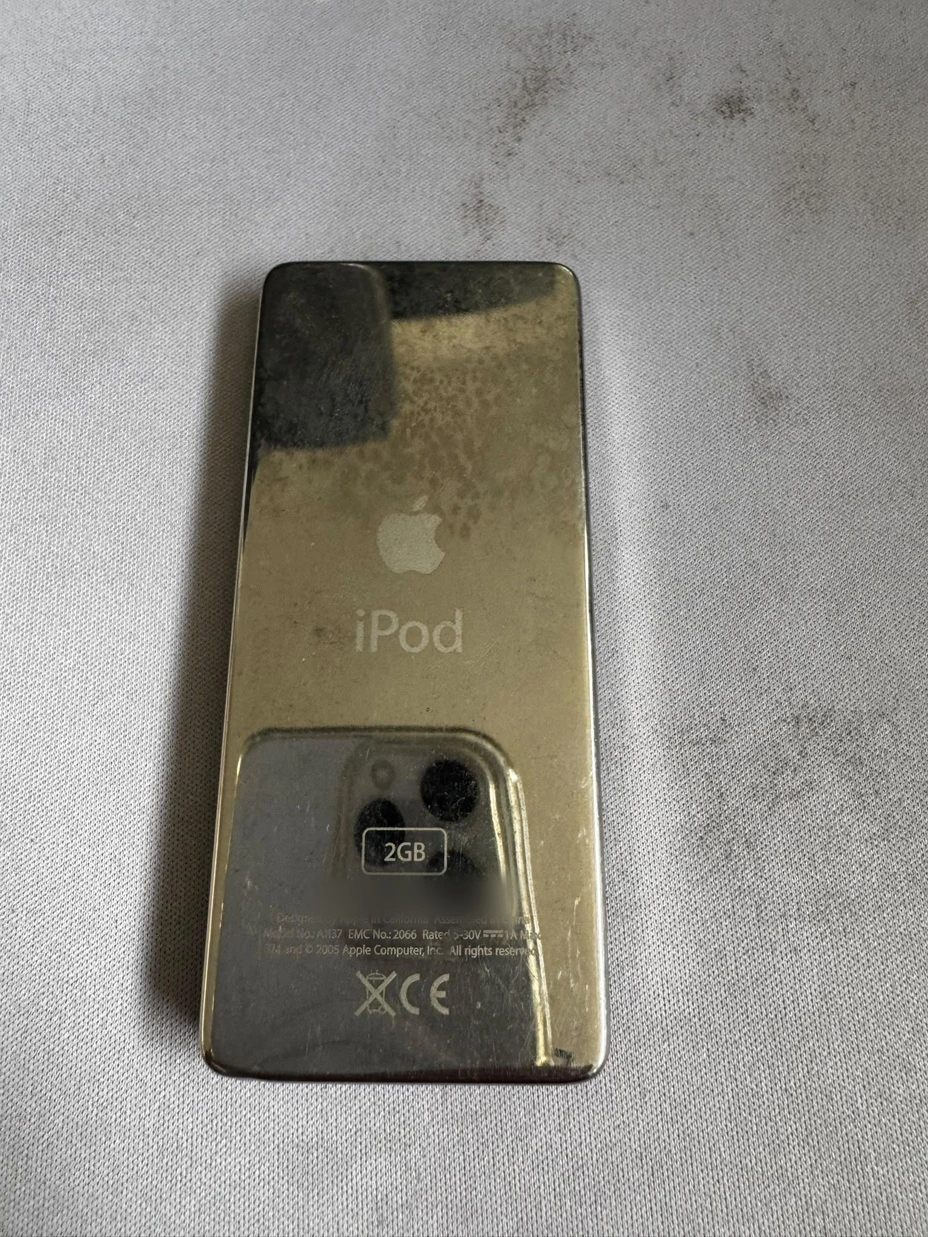


iPod nano · A1137 · 2 GB. Photos from the iMuseo collection. Serial number hidden; the stated capacity belongs to the photographed unit.
Specifications
| Model | A1137 |
|---|---|
| Documented storage | 2 / 4 GB |
| Navigation | Click Wheel |
| Display | Color LCD · 1.5″ · 176 × 132 |
| Frequency response | 20 Hz - 20 kHz |
| Computer connection | USB through Dock Connector |
| Height | 3.5 in |
| Width | 1.6 in |
| Depth | 0.27 in |
| Weight | 1.5 oz |
| Music: Apple maximum | Up to 14 h |
| Selected audio formats | AAC / MP3 / WAV |
History and documentation
This entry covers iPod nano (1st generation, 2005), model A1137, from 2005. The documented configuration offers 2 / 4 GB of flash storage.
Design and specifications
It uses Click Wheel for navigation. Display: Color LCD · 1.5″ · 176 × 132. It uses flash memory rather than the iPod mini hard drive.
Flash memory removed all moving parts and made a thickness of 0.27 inches possible: Apple introduced it as "thinner than a standard #2 pencil". The color screen shows album art, photo slideshows and games, and the system adds a stopwatch, world clock and screen lock.
At launch (September 7, 2005) it came in two configurations: 2 GB for $199 (up to 500 songs) and 4 GB for $249 (up to 1,000 songs or 25,000 photos), both in white or black. On February 7, 2006 Apple added a 1 GB version at $149, holding about 240 songs.
It uses the same 30-pin Dock connector as the iPod and iPod mini, so it worked with an ecosystem of more than 1,000 accessories; Apple also offered lanyard headphones, colored "Tubes" cases and sport armbands.
In his first look for Macworld, Christopher Breen noted a detail easily missed in a front view: the headphone jack was on the bottom beside the Dock connector, leaving the Hold switch alone on top. Despite the small size, he found the Click Wheel markings clear and its response quick, and judged the screen bright and readable. These were initial impressions from September 2005 after only a few hours of use, not a long-term test or a finding about every unit.
Macworld / Christopher Breen (Sep 2005)
Use and context
It measures 3.5 in high, 1.6 in wide and 0.27 in deep, and weighs 1.5 oz. The technical sheet lists a 20 Hz to 20 kHz frequency response and support for AAC, MP3 and WAV among other formats.
Steve Jobs introduced it on September 7, 2005 in San Francisco and it was available immediately worldwide. Jobs called it "the biggest revolution since the original iPod".
It directly replaced the iPod mini, then the family's best-selling model, barely a year and a half after its debut. On stage, Jobs pulled it out of the coin pocket of his jeans to prove its size: 62% less volume than the mini it replaced.
By February 2006 Apple counted more than 40 million iPods sold since 2001 and more than 2,000 compatible accessories.
Notes and image
Computer connection: USB through Dock Connector. Apple quotes up to 14 hours of music on a full charge under its test conditions. This is a historical figure, not a runtime guarantee or an assessment of a used unit's battery.
Documented problems: on September 28, 2005 Apple acknowledged "unexpected failures" in the color screen of a small number of units and offered free replacements to affected customers. At the same time, many users reported that the front scratched easily, a widespread complaint Apple never acknowledged as a defect.
In November 2011 Apple opened a worldwide replacement program for this model: a battery from a single supplier could overheat in units sold between September 2005 and December 2006, and replacement was free. The program had already been applied in South Korea (2009) and Japan (2010).
The Dock connector does not guarantee the same functions on every iPod. Apple's March 2006 guide explains that this nano can charge through the optional Dock-to-FireWire cable but cannot transfer information over FireWire: data travels over USB. Michael Kobrin observed that distinction in his September 2005 review. When identifying accessories in a collection, it is worth separating three things: whether the connector fits, whether it supplies power and whether it supports syncing. Charging compatibility does not turn that cable into a data connection for the nano.
Apple, iPod nano Features Guide (Mar 2006), pp. 46, 48 · Michael Kobrin, eWeek (9 Sep 2005)
Sources
Updated: November 7, 2026 · Compare this product
Historical catalogue links
Relationships already recorded in the catalogue, not a complete succession chain. Same-year variants are shown as related. A missing link does not prove that an earlier or later model does not exist.