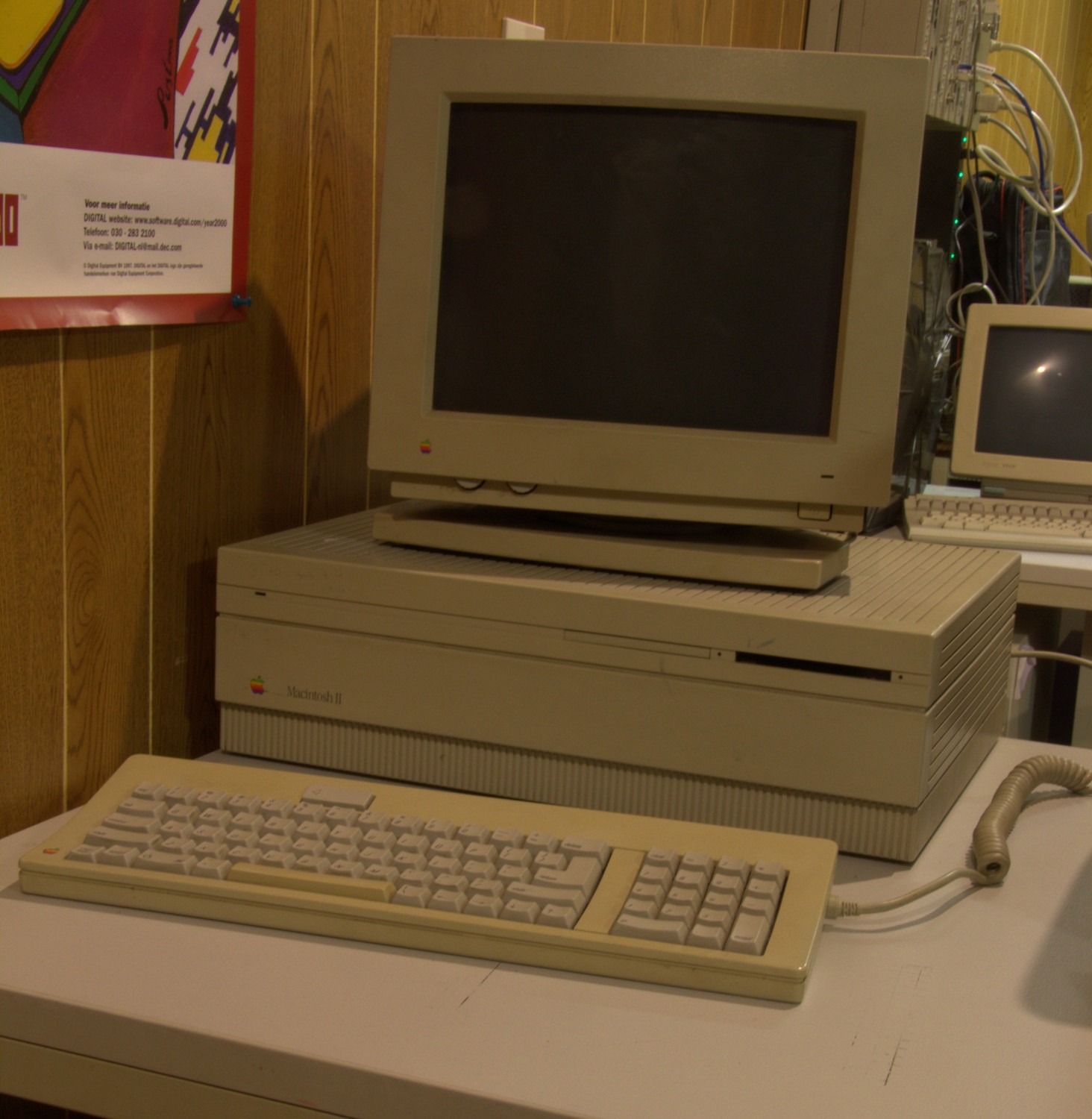
In Under-the-desktop Publishing, Douglas Adams turned his Mac problems into a humorous account. His official archive's index dates the MacUser article to about 1989, not a precise day. This was no frictionless digital desktop: adding devices meant spending time under the desk changing connections.
Adams said he kept his diary and address book in HyperCard and transferred them to a Sharp electronic organiser when going out. A modem, fax, audio recorder and MIDI equipment competed for the same serial port. The object's story is not a connector list: writing, organising and creating depended on which cable was plugged in.
Adding a Caere Typist text scanner led to SCSI-chain problems; the article turns it into an expensive paperweight. He ended by celebrating a NuBus QuadraLink card providing four software-switchable serial ports. That serial-port solution is not presented as a repair of the SCSI scanner. This is an original summary, not a copy of his humorous passages.
What to look for: computer, display, keyboard and cables make a workstation. The photo is another Macintosh II, not identification of the model or configuration Adams described.
Adams's model unknown. The 1987 Macintosh II photo/catalogue only illustrate the family and do not establish his generation, RAM, drives or region. The linked 1 MB floppy-only base is NOT assigned to his differently described setup. Not his unit or a reconstruction of his desk.
Independent editorial entry based on the author's account in his archive. No endorsement by his estate or archive is attributed. The date is approximate and personal incidents are not generalised to all Macs. No portraits, software or full text reproduced.
128 KB Macintosh; recollection of his first Mac in 1984
Stephen Fry
1984 Macintosh according to Sailko, Computer macintosh 128k, 1984 (all about Apple onlus), Wikimedia Commons, CC BY 3.0. Milan exhibition photograph, 2016. Resized to 1600 px and JPEG-recompressed; no crop, rotation or retouch. Another unit, not Fry’s computer or a reconstruction of his desk.
In Device and Desires, published on his website on 16 September 2007, Stephen Fry identified his first Mac as a 128K machine bought in 1984. He recalled it within a long relationship with digital devices, not as his only tool. His claims about British or European purchase order carry his own qualifications: they are not turned into a verified record here.
On 24 January 2014, in Mac at 30, Fry returned to that first Macintosh. He wrote that it changed his life, made him want to write and drew him back each morning. To explain the experience he compared the computer to an inviting physical workspace. This is a writer’s personal judgement, not a productivity measurement or evidence that the machine makes better books.
The object matters for that relationship between interface and habit. The recollection does not establish which novel was completed on this unit, its installed programs or what survives on its disks. Nor do we use the rest of the essay as a technical chronology: this story concerns how Fry said he felt about a writing tool. A photograph of another unit lets us examine the object without reconstructing his desk or turning enthusiasm into specifications.
What to look for: screen, keyboard and mouse as a workplace. The photo shows no Fry manuscript, files, desk or writing session.
In 2007 Fry identified his first Mac as a 128K bought in 1984. Photo and catalogue illustrate that historical model, not his unit. Appearance does not establish original RAM, modifications, region, serial number, disk condition or installed software.
Independent editorial account based on Fry’s autobiographical writing. Opinions and memories remain attributed, without validating purchase rank or platform superiority. No participation or endorsement by Fry, his representatives or Apple. No long literary passages, portraits, interfaces or private files copied.