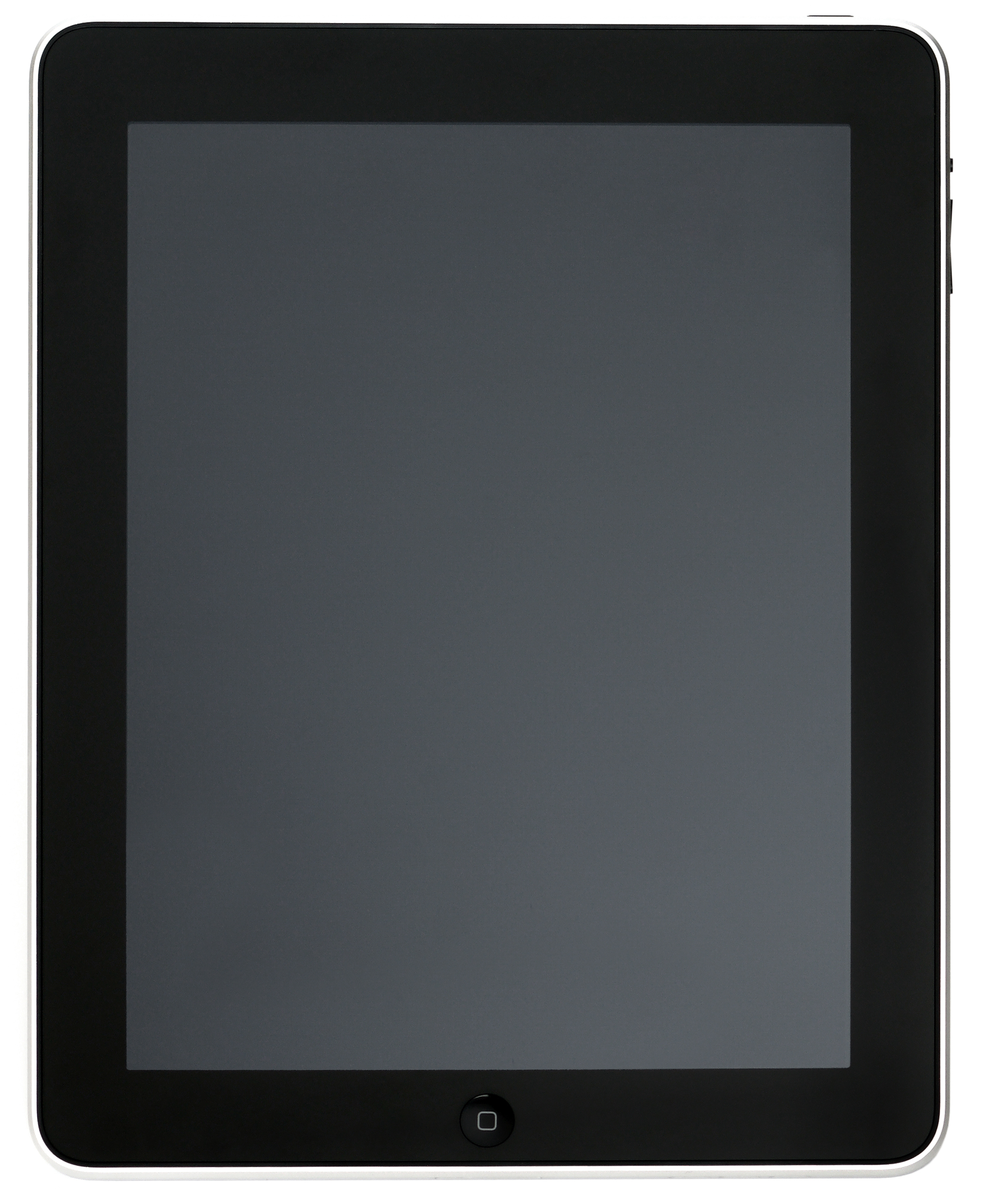
First-generation iPad. Evan-Amos, IPad-WiFi-1stGen.jpg, Wikimedia Commons, released into the public domain by its author. His description identifies the pictured unit as 32 GB Wi-Fi. Front view with display off, not Hockney's unit. Kept complete, with no new retouching or crop.
The David Hockney Foundation's chronology dates his first iPad purchase to April 2010. Hockney was already drawing on an iPhone, but the larger display opened another way of working. After learning Brushes, he used the tablet to draw directly from the landscape, including Yosemite. The date establishes the generation; the source does not specify his unit's capacity or connectivity.
In an interview by Martin Gayford published on 20 October 2010 and preserved on the artist's website, Hockney described moving from drawing with his thumb on iPhone to using all his fingers on iPad. He carried it in the inside pocket previously used for a sketchbook. He was also surprised that the process could be replayed: the screen cleared and marks reappeared in sequence, letting him watch how he had drawn.
The tool does not define the artist's entire identity. In its introduction to his interview with Anders Kold, recorded at the Louisiana Museum in 2011, the museum reports that Hockney considered himself an artist who used an iPad, not an artist defined by it. This account summarises material published by the foundation, the archive and Louisiana Channel; the full video has not been reproduced or inspected, and his drawings are not copied.
What to look for: the original iPad's broad display and Home button. The single photo shows the device switched off, not a Hockney artwork or a Brushes session.
First generation established by the April 2010 purchase. Hockney's capacity and variant remain undetermined. The photographer describes the pictured unit as 32 GB Wi-Fi; that configuration is not attributed to the artist.
Hockney is not participating in or endorsing this museum. The photo shows another person's example, not his tablet or Genaro's personal collection. No artworks, portraits or videos of the artist are reproduced.
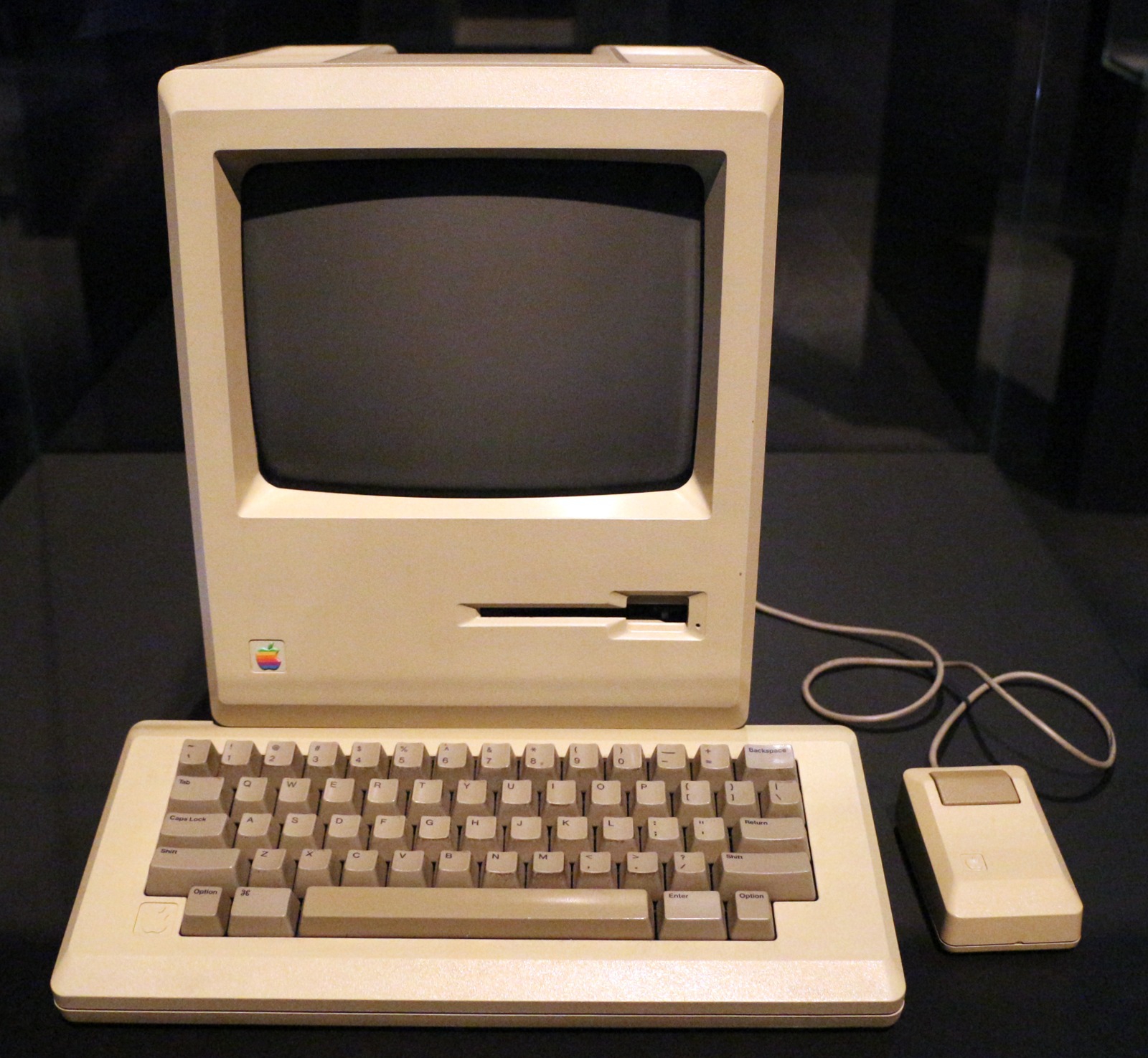
1984 Macintosh according to Sailko’s description, Computer macintosh 128k, 1984 (all about Apple onlus), Wikimedia Commons, CC BY 3.0. Milan exhibition photograph, 2016. Resized to 1600 px and JPEG-recompressed, no crop, rotation or retouch. Not Kare’s prototype or computer.
In Alex Pang’s interview on 8 September 2000, Susan Kare recalled Andy Hertzfeld suggesting that she draw small images on squared paper to transfer to the screen. Her background was sculpture and graphic design, not computing. She said she did that work in exchange for an Apple II, while clarifying that she did not use it to make Mac graphics. This is her recollection, not a reconstruction of employment terms.
The tools changed as they worked. Kare described an early method requiring the drawing to be converted into hexadecimal values, then a better Hertzfeld editor that generated them automatically. Later she used MacPaint to view enlarged and actual-size images together. She said she worked on a Mac, including an early machine with a Twiggy drive. That was not the commercial Macintosh illustrating this entry: a similar enclosure does not identify a development machine.
Design meant collaboration and testing, not solitary decoration. Kare recalled showing alternatives to colleagues, avoiding untranslatable wordplay and distinguishing applications from documents visually. She acknowledged that Lisa already had a trash can. In her 2019 Cooper Hewitt interview she again stressed considering what images mean, not just their appearance. The object tells a story of communicating functions without crediting one person with the whole desktop.
What to look for: the blank screen prompts thought about work behind the symbols. It does not reproduce icons, a MacPaint session or Kare’s equipment.
The 1984 128 KB Macintosh photo and catalogue illustrate a commercial product in that family, not the Twiggy prototype or Kare’s unit. Appearance does not certify original RAM, modifications or installed software. The catalogue configuration is not assigned to her machine.
Independent editorial account from an oral interview reviewed by Kare and a later interview. Memories remain attributed, without claiming she alone invented the interface or trash can. No participation or endorsement by Kare, Stanford, Cooper Hewitt or Apple. No icons, portraits or interfaces copied.