
Apple IIGS (1986)
Apple IIGS (1986): Apple II with a 65C816 at up to 2.8 MHz, 256 KB of initial RAM, super-high-resolution graphics and a 15-voice Ensoniq synthesizer.
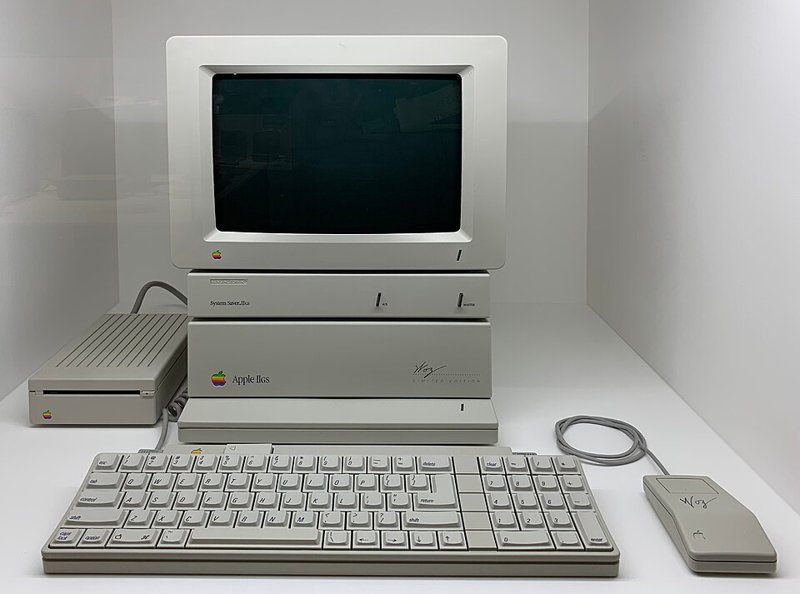

Specs
| Release | 1986-09 |
|---|---|
| Chip | 65C816 · 2.8 / 1.02 MHz |
| RAM | 256 KB initially · 1 MB (ROM 3) |
| Display | 320×200 · 640×200 · 4.096 |
| Ports | 2 × SCC · ADB · RGB · 7 slots |
Launch
Dates per Apple's Tech Info Library: introduced September 1986; discontinued December 1992.
Marketing
Apple's Tech Info Library describes it as combining the best of the previous Apple II computers: built-in accessory ports and expansion slots, a Macintosh-like interface, high-resolution color graphics, 15-voice sound and the 65C816 microprocessor. No verified price.
Flaws and fixes
Apple Technical Note 26 documents fixes between ROM revisions; it does not describe the condition of every unit. Limits that do appear in its spec sheet: 8-bit data bus and a 2.8 MHz top clock (1.02 MHz selectable); Apple's sheet describes the 1 MB, ROM 03 model, expandable to 8 MB.
A 1986 family with revisions that must be kept distinct
Apple's historical table places Apple IIGS introduction in September 1986 and discontinuation in December 1992; the document itself calls these approximate dates. Technical sheet TIL07889 is later: created in 1991, it explicitly describes the 1 MB model with ROM 03. It is not a snapshot of the original 1986 configuration.
Apple's technical procedures distinguish the IIGS with a 256 KB minimum from the later 1 MB version. Technical Note 26, revised in September 1989, dates the start of shipments with 256 KB ROM 3 to August of that year. The later revision's megabyte should therefore not be assigned to every computer in the family.
The 65C816 calls for another distinction: the sheet lists 16-bit registers, but an 8-bit data bus and a 24-bit address bus. The user or a program could select a 2.8 or 1.02 MHz clock. These figures describe different parts of the architecture, not three incompatible versions of the same measurement.
Super-high-resolution modes included 320 × 200 and 640 × 200 pixels alongside inherited graphics and text modes. The connector list documents both 15-pin analog RGB and RCA composite video. Choosing a suitable output and monitor is part of the configuration; generated resolution should not be mistaken for a built-in screen.
Sound involved more than a speaker: Apple describes a 32-oscillator Ensoniq digital synthesizer with 64 KB of dedicated RAM and up to 15 simultaneous voices. Oscillators and voices are not interchangeable counts. The documentation provides for headphones or an external speaker and volume adjustment through the Control Panel.
Expansion combined seven general-purpose input/output slots with a separate RAM/ROM memory slot. The 1 MB specification documents RAM expansion to 8 MB for that model. This does not mean that every revision, card or installed combination in a used machine reaches that limit without checking it.
Built-in ports also reduced the need for cards: there were two eight-pin serial connectors, ADB, a disk drive connection and a game port. The technical sheet allows daisy-chaining up to four Apple 3.5, Apple 5.25 or UniDisk drives at the disk port. This is the documented interface capacity, not a guarantee for every mixture of peripherals.
The service manual also distinguishes physical changes in the 1 MB IIGS: a new keyboard microcontroller, the CYA chip and a clock battery in a holder for easier replacement. The ROM note lists fixes between revisions. These documents support specific changes, not certification that a photographed or surviving unit retains its original board, memory and ROM.
More from the same family
Updated: October 26, 2026 · Sources: Apple Tech Info Library · Apple Tech Info Library · Compare this product