
Apple Cinema Display 22" (1999)
Apple's first widescreen LCD: 22 inches and 1600×1024 pixels in 1999.
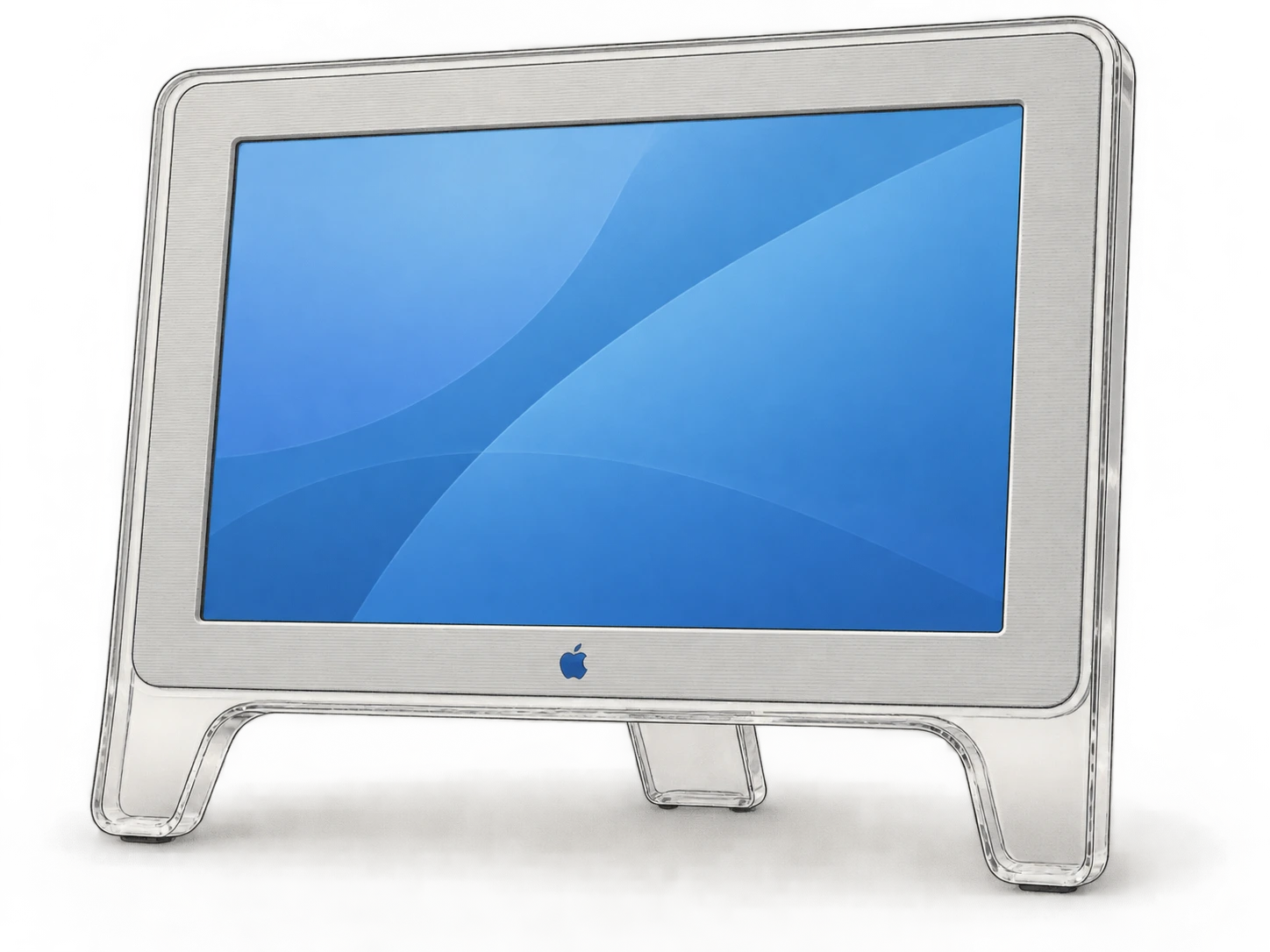
Illustrative recreation · Not a photograph
Do you have a real photo of this model?
Help us replace this recreation. We will review the model identification and permission to use the photo before publishing anything.
Contribute a photoModel reconstruction, not a photograph.
Specs
| Panel | 22" LCD, 1600×1024, 16.7 million colors |
|---|---|
| Connectivity | DVI (1999); Apple Display Connector from July 2000 |
| Key feature | the largest LCD on the market at launch, per the official announcement |
Launch
Apple introduced it on August 31, 1999 at the Seybold San Francisco keynote alongside the Power Mac G4, per the official announcement reproduced by MacTech: a 22-inch LCD panel, "the largest ever brought to market", with the viewing area of a 24-inch flat CRT, letterbox 1600×1024 format and 16.7 million colors. Per Wikipedia, it was released on September 1, 1999 as model M5662 with DVI input and an easel-style stand.
Marketing
In July 2000, at Macworld Expo New York, the family was redesigned with crystal-clear enclosures to match the Power Mac G4 Cube and G4, and debuted the Apple Display Connector, a single cable carrying video, USB and power, with a two-port USB hub, per Apple's press release. That release priced the 22" at $3,999 and called it "the largest all-digital LCD flat panel ever brought to market", able to show two full pages of text and graphics at once.
DVI, USB and power: three connections, not ADC
The 1999 manual shows three separate connections: DVI video, USB to the computer and power through an external adapter. This distinguishes the first Cinema Display from the later ADC revision. Its diagram also places brightness and power buttons on the front edge and USB ports at the back. Apple · Cinema Display User Manual (1999) · pp. 8–10, 13–14
USB was more than a convenience for the keyboard: the manual links its connection to the Mac with features such as onscreen brightness feedback and power-button options. The factory setting allowed that button to shut down or sleep both the monitor and computer, rather than merely blank the image. Apple · Cinema Display User Manual (1999) · pp. 8–10, 13–14
Sharpness had conditions too. Apple recommended 1600 × 1024 for best results and warned that other resolutions could look blurry when scaled to the panel. Its troubleshooting distinguished three short amber flashes, associated with an incorrect video input format, from two short flashes and one long flash, associated with a backlighting lamp. These are documented codes for this version, not a sufficient diagnosis or an invitation to open a surviving display. Apple · Cinema Display User Manual (1999) · pp. 8–10, 13–14
The stand and backlight matter too
The 1999 manual specifies a stand tilt of 10 to 30 degrees. This changes the desktop depth from 210 to 309 mm. The display weighs 11.34 kg, excluding the external adapter’s 398 g. These are original assembly dimensions, useful when planning a display space, not evidence of the stability or strength of a hinge after decades of use. Apple · Cinema Display manual · pp. 17–18
Apple distinguished switching off or putting the display to sleep from running a screen saver. The manual warned that the latter kept the backlight in use and shortened its life; for long idle periods it recommended switching off the system or using Energy Saver. A changing picture does not mean the lamps are resting. This is historical operating advice, not an estimate of a surviving unit’s remaining life. Apple · Cinema Display manual · pp. 16–17
Power figures need their sources kept attached. The original manual lists less than 62 W when on and less than 5 W in the sleep or off states described in its table. The Apple Support specification identified as M7478 with a DVI connection instead publishes a 77 W maximum and 35 W in Energy Saver. These documents remain separate: their limits are not combined or presented as a present-day measurement of this unit. Apple · Cinema Display manual · pp. 18 · Apple · DVI M7478 specifications
Flaws and fixes
ADC simplified the desk but tied the monitor to Macs with that connector or to an adapter, a transition Apple acknowledged in 2002 with a DVI-to-ADC converter. The 22" was discontinued on January 28, 2003, when the 20-inch Cinema Display (1680×1050) offered more pixels of workspace for $1,299, per that day's Apple release and Wikipedia.