
Apple Keyboard (2007)
Goodbye to white plastic: an 8.4 mm ultra-thin aluminium keyboard and the first Apple-logo-free Command key in 27 years.
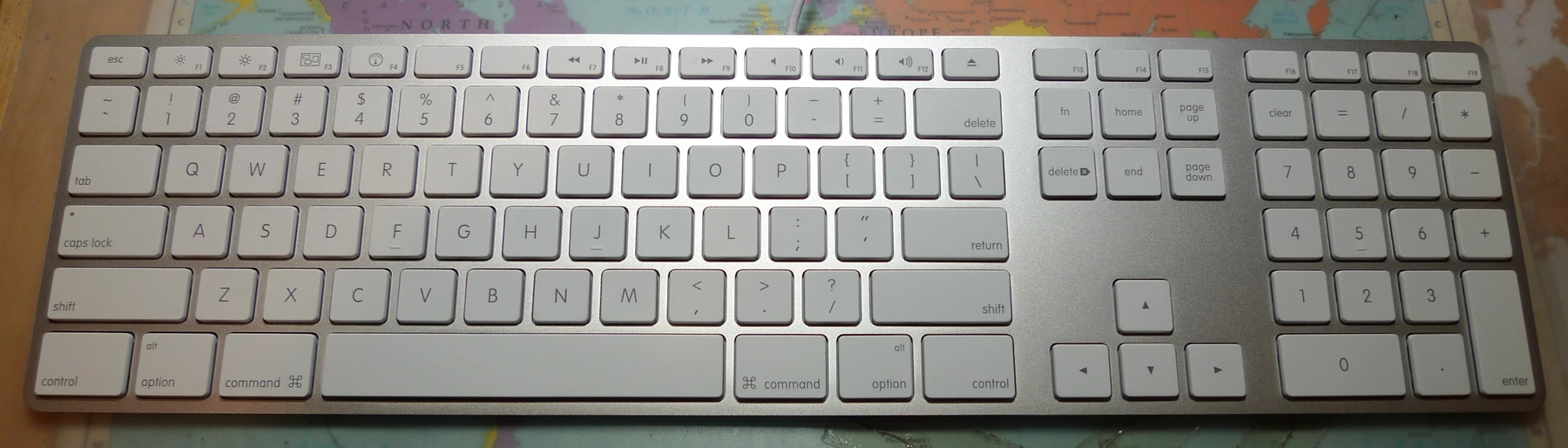
© Wiki637 · CC BY 2.0 ↗ Resized, no crop or retouching.
Specs
| Connectivity | wired USB 2.0, two additional ports, one at each end |
|---|---|
| Keys | 109, up to F19 |
| Key feature | first Apple keyboard without the Apple logo on the Command key in 27 years, per Wikipedia |
Launch
Apple introduced it on August 7, 2007 as part of the new aluminium and glass iMac line, per its official press release: the iMac shipped with this ultra-thin aluminium keyboard, 0.33 inches (8.4 mm) thin at its front edge, and two of the computer's five USB 2.0 ports sat on the keyboard itself. It replaced the Apple Pro Keyboard and its white A1048 successor in the line; per Wikipedia, it is model A1243.
Marketing
The press release described it as part of a "clutter-free" desktop, matching the new iMac's aluminium and glass. Wikipedia records a historical detail: it was Apple's first keyboard in 27 years to drop the Apple logo from the Command key, a legacy of Apple II days. It existed in two variants, MB110LL/A and MB110LL/B, the latter from July 2011 with the F3 and F4 legends updated to Mission Control and Launchpad, per Wikipedia.
Flaws and fixes
In March 2009, when the wired compact A1242 arrived, this model was renamed "Apple Keyboard with Numeric Keypad", per Wikipedia. It stayed in the catalogue for a decade: Wikipedia dates its discontinuation to June 5, 2017 and identifies it as the last wired keyboard Apple made; Magic Keyboards have been rechargeable ever since.
Price, profile and full-size trade-offs
Apple’s official 7 August 2007 release establishes that the new iMac included this wired keyboard; that is not the same as a free standalone accessory. In his original Engadget report that day, Darren Murph gave US$49 for the wired model and US$79 for the wireless one. The US$49 is a contemporary US price documented by the reporter, not attributed here to an independent Apple price list that has not been consulted, a currency conversion or a current valuation. Apple · 7 August 2007 · included with iMac Darren Murph · 7 August 2007 · US$49 / US$79
The official announcement’s 0.33-inch measurement explicitly concerns the front edge, not a uniform thickness across the whole object. Apple’s original page preserved in August 2007 describes anodised aluminium and low-profile keys; in his 16 October 2008 Macworld review, Dan Frakes describes a rear bar that slightly raises the keyboard and houses its ports. The edge measurement and rear geometry must not be confused. This review dates from 2008, not the 2007 launch day. Apple · 0.33-inch front edge Apple · Keyboard · August 2007 archive Dan Frakes · Macworld · 16 October 2008
The full-size layout retains a numeric keypad, arrows and document navigation compared with the compact 2007 Apple Wireless Keyboard. Pages 22 and 23 of Apple’s original Mid-2007 iMac manual identify the keyboard, playback, brightness, volume and eject controls, and USB ports. Frakes documents the row through F19 and an fn key in the navigation group, where he previously expected Help. These are physical-layout differences, not proof that every control retains its function on every current system. Apple · Mid-2007 iMac · pp. 22–23 Dan Frakes · full-size key layout Apple Wireless Keyboard (2007)
Original advertising promised USB 2.0 connectivity for iPod, Mighty Mouse and cameras. Data speed, available power and physical fit need to be separated: Frakes described the two connectors as low-power ports, intended for input devices rather than power-hungry peripherals, and noted the included USB extension lead. These sources establish neither a universal milliamp figure, that every drive works without its own power, nor that every iPod can or cannot charge on every Mac. USB 2.0 alone does not establish that guarantee. Apple · original USB 2.0 advertising Dan Frakes · low-power ports and extension
Frakes liked the short travel and tactile feedback and said his opinion improved after a month; he also reported fingers slipping on flat, smooth keys and hitting neighbours. He disliked the continuous function-key row flush against the number row instead of familiar separated groups. These are reviewer observations, not ergonomic consensus or measurements of force, speed or health. His account of crumbs preventing a keypress also does not measure a general failure rate. Dan Frakes · typing observations and limits
A different testimony comes from MB-switcher of Days of our Macbooks on 11 September 2007: he tried a JIS unit brought from Japan, chose wired for the numeric keypad and eventually preferred it to his Macally iKey5. Yet he missed adjustable tilt and found the USB sockets too recessed to insert some flash drives comfortably without moving the keyboard. His case supplies use and regional-layout context; it cannot assign one key count to every market or make his iPod-charging claim a universal rule. MB-switcher · 11 September 2007 · JIS personal review