Patents in figures. Figures, drawings and links to products. A laboratory to study launch times.
We are conducting a study and we will continue to expand the information.
This experimental section will incorporate new sources, data and documented links as the research progresses.
Documented historical data are separate from hypotheses about the future. This is not an exhaustive census, it does not establish whether patents remain in force, and no predictive algorithm has been implemented or validated.
A patent drawing published in 2026
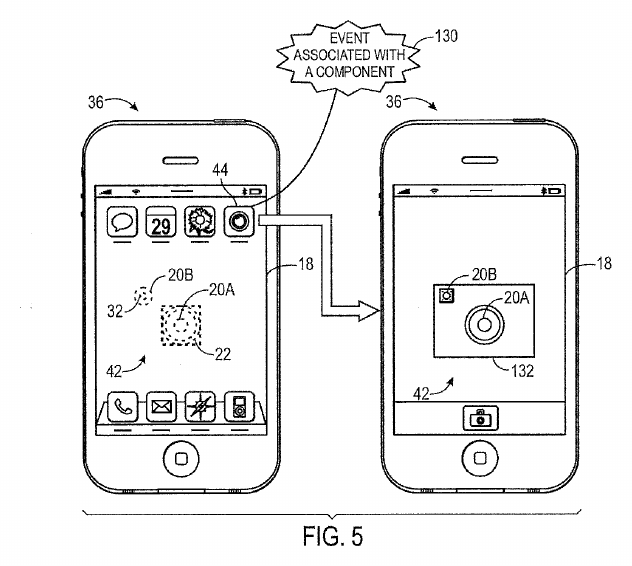
Figure 5 from application US20260360308A1, published on 12 November 2026. States of a component that is uncovered when a function is activated. Drawing from the document, cropped and rotated for readability; not an announced future product. USPTO · US20260360308A1 · Fig. 5
IFI Claims ranking: patents granted to Apple each year. Method limit: IFI states on its 2016 pages that it counts only utility patents; this has not been confirmed for 2024-25, so those two figures may not be comparable. 2014 and the years before 2013 are missing.
Annual patent grants attributed to Apple by IFI (US; 2024-25 method unconfirmed)
2. What a patent looks like: examples with drawings
A document identifies number and type, title, inventors, assignee and dates. Includes drawings, description and claims. In a design patent, the figures are central. It is not a guide to processing a patent.
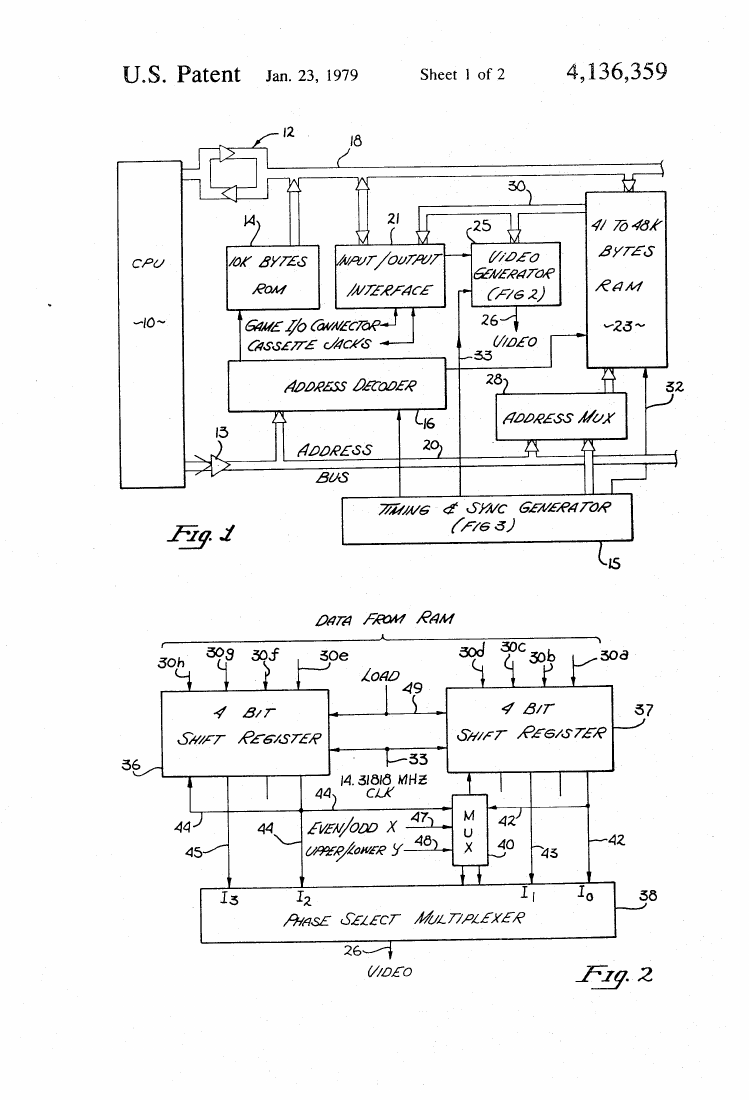
US 4,136,359
Filed: 1977-04-11 · Granted: 1979-01-23
Microcomputer for use with video display. Stephen G. Wozniak; Apple Computer. The National Inventors Hall of Fame links it to the personal computer, but this does not establish a specific commercial model.
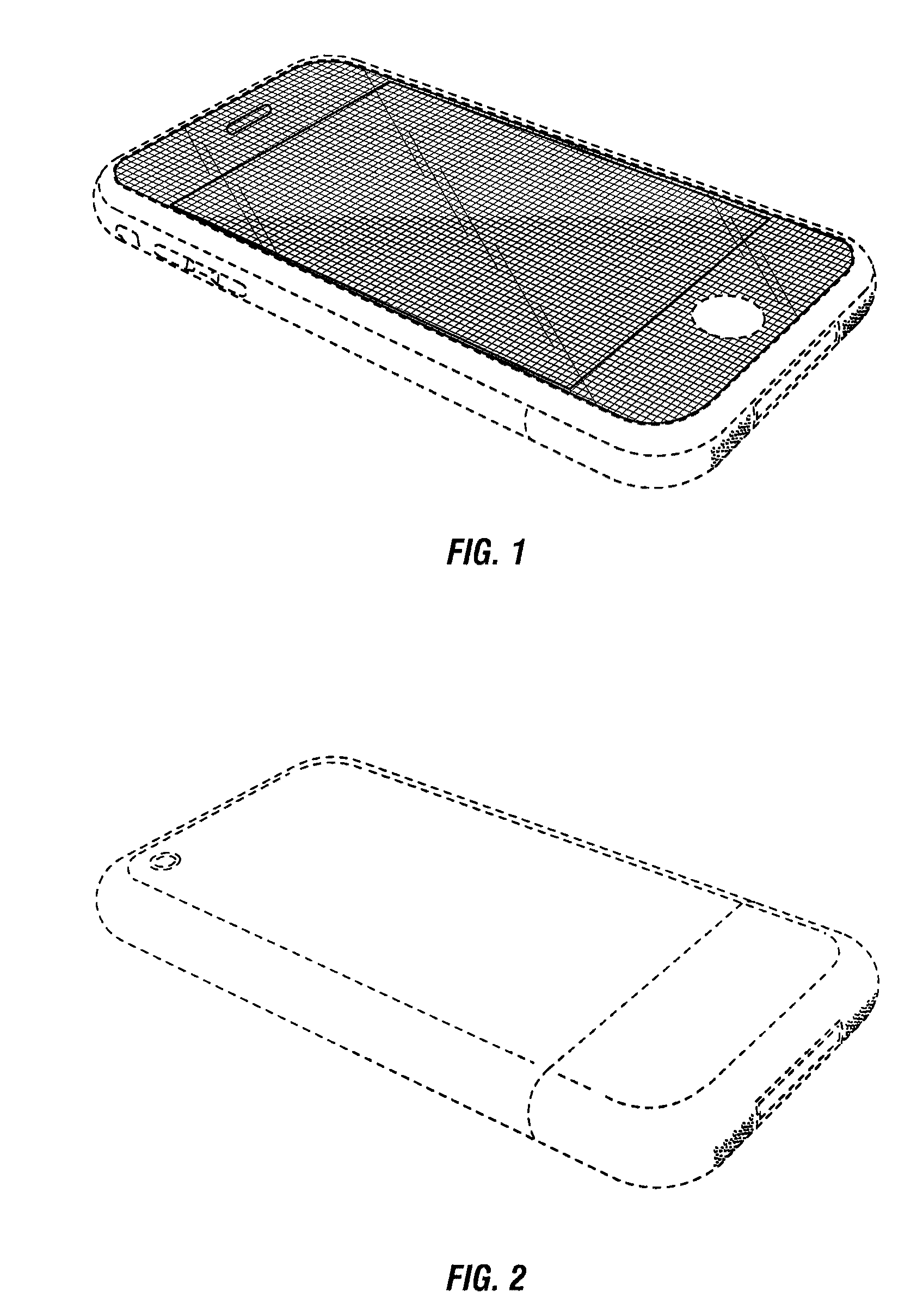
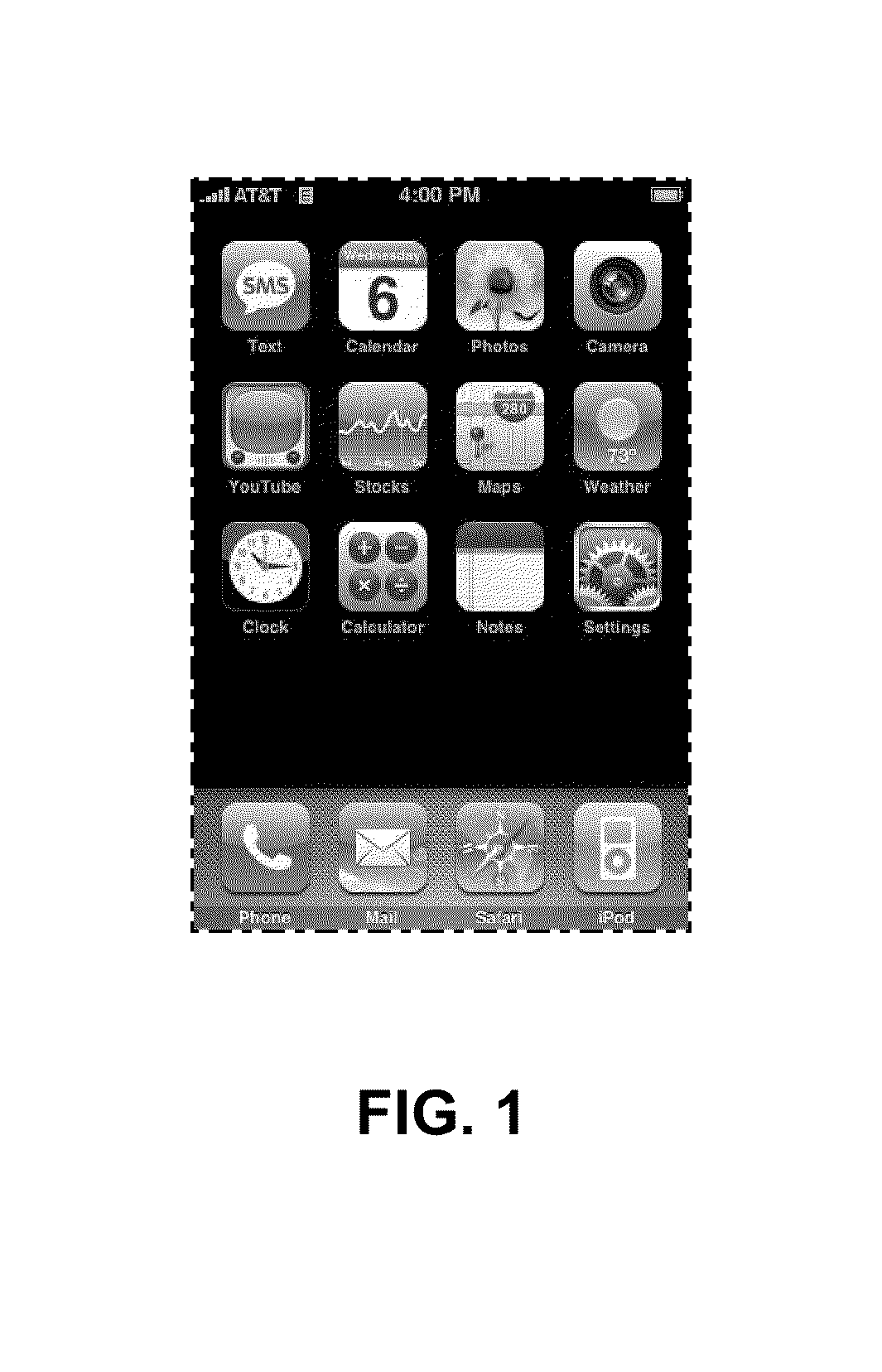
Electronic device. Design of the front face of a phone. The CAFC14-1335 ruling documents elements embodied in the iPhone, it does not identify the first model here.
Text and figures from granted patents. The USPTO says text and drawings are normally free of copyright restrictions unless a notice states otherwise (37 CFR 1.71(d) and 1.84(s)); no such notice was found in these five examples. This is not legal advice. USPTO Rule and Exceptions.
3. Patent and product: documented links only
Unit = commercial product. Several patents for the same iPhone are not independent cases. A generic title does not prove or rule out a link; The criterion is document plus drawing.
iPhone: strong link
CAFC ruling 14-1335 states that D618,677, D593,087 and D604,305 claim designs embodied in the iPhone, and that US 7,469,381, 7,844,915 and 7,864,163 claim functions of its interface. It refers to the iPhone, and to the 3G/3GS for trade dress, not specifically to the first model. Announced 2007-01-09, on sale 2007-06-29.
Apple II: moderate link, specific model not established
US 4,136,359 (Wozniak): filed 1977-04-11, granted 1979-01-23. The National Inventors Hall of Fame links it to the personal computer; its coverage of the specific Apple II is not documented here. Shown 1977-04-17, shipped 1977-06-10.
iPad: claimed by Apple
Design D504,889 (Jobs and Ive among the inventors): filed 2004-03-17, granted 2005-05-10. Apple alleged before the Federal Circuit (12-1105, 2012) that the iPad embodies this design; not independently verified. iPad announced 2010-01-27, on sale 2010-04-03.
US 7,469,381: documented link to iPhone and iPad families
CAFC ruling 12-1105 (2012) describes the bounce-back feature at the edge of a document and states that it is found on Apple smartphones and tablets, such as the iPhone and iPad. It does not identify a specific model here.
iPod and Apple Watch: leads only
iPod: design application 29/153,169 'Media player' (2001-10-22), cited in US 7,046,230; the resulting patent and its product link have not been identified. Apple Watch: D756,823 (filed 2015-03-06, granted 2016-05-24), linked only through title, inventors and press reports.
Press mappings: uncorroborated
MacTech (Jun 1, 2010) assigns D616892 to iPad, D616863 to iPod nano, D616864 to iPod classic, D616881 to MacBook Air, D616899 to iPod shuffle. I have not seen a document or drawing that confirms or contradicts it; D616892 appears as a graphical interface, which does not exclude it from being from the iPad.
No documented cases
Classic 80s Mac, AirPods, HomePod, Apple TV and peripherals.
In the US, ordinary design applications are not subject to the 18-month publication rule; the document becomes public on grant. Utility patent applications are usually published about 18 months from the earliest recognized date, with exceptions such as non-publication requests or secrecy orders. Provisional applications are not published under that rule. Their contents may still become public in a later case record.
In these cases, little information was public before launch. The iPhone design patents were granted after it went on sale (D593,087: filed 2007-07-30, a month later). Exception: iPad design D504,889 was public almost five years before the announcement, but its product link is only an allegation by Apple.
This describes this sample. It supports neither "almost always after launch" beyond this sample nor the opposite.
Appendix to Apple v. Samsung (document 3647-5, 2018-04-09): 50 distinct designs asserted by Apple. They were selected for litigation, not a census or a representative sample of Apple, and the appendix does not identify a product for each design. They are an example of a dated dataset.
The documented historical dates and links are facts, and so are the gaps measured with them. It is a hypothesis to extrapolate them to future products; They can be used for scenarios, always labeled.
H1: technology shortens lead times
Compare periods and families. The five calendar products are not enough to affirm or deny the hypothesis: the lags range from 18 to 227 days, with no clear trend in this sample.
H2: applications anticipate families
Test a rule against a baseline frequency, using published applications, dates and classes. That systematic dataset is not yet available.
H3: design and launch
In this sample, design patents tend to be granted near or after the start of sales. This is not a general claim about all Apple products.
Launch forecasts: experimental design
A forecast is a reasoned, traceable hypothesis, not a certainty. No system has been implemented and no probabilities calibrated; calibration would require measuring outcomes first.
Each forecast is written before the fact, with the date: product or family, expected window, and the public evidence that supports it (published applications, granted designs, Apple's previous calendar).
Record what would refute it (for example, no announcement within the forecast window) and the uncertainty level in words: low, medium or high.
It is saved in a record that is not edited. When the date arrives, it is compared with the real date in the Apple newsroom.
Only after enough forecasts have reached their outcome can we test whether they beat a simple baseline (frequency per quarter). Until then, they are hypotheses.
9. Still to check
Status (expired, abandoned, maintenance fees unpaid): not yet checked in the relevant records. It is not inferred from a patent's age.
Latest published applications: coverage still limited, no systematic review.
Complete annual series (2014 and before 2013) and own total: pending; The official bulk download consulted requires an account.
Links for iPod, Watch, Mac, AirPods, HomePod and Apple TV.
Base published on Nov 4, 2026. Hypotheses and pending coverage will be reviewed with new data.
Documentary complement · 5 Nov 2026
Apple trademarks and patents: what the documents allow us to say
A contribution to Laboratorio Dimension Cupertino. Each claim includes its source and level of certainty. Where something is not established, we say so. This is not legal advice: it is a documentary study of public sources.
1. The Apple trademark: four documented episodes
The word "Apple" and the apple logo were the subject of a long dispute between Apple Computer, the computer company, and Apple Corps, the Beatles' company. A London High Court judgment and Apple's own statements document the history.
1981: the first division. In November 1981, the companies signed an agreement on the use of the word "Apple" and apple logos. Broadly, Apple Computer could use its marks for computer goods and services, with restrictions on equipment specifically adapted for recording, reproducing or synthesizing music and on music services. Apple Corps could use its marks in its musical field, but not for computers and computing systems. This divided their product territories. (Apple Corps Ltd. v Apple Computer, Inc [2006] EWHC996 (Ch), paragraph 39.)
1991: a second agreement after more than a hundred trial days. In 1989 Apple Corps sued Apple Computer for allegedly breaching the agreement. The trial lasted more than a hundred days and ended with a settlement on October 9, 1991, comprising a settlement agreement and a trademark agreement, the "TMA". Apple Computer paid Apple Corps more than US$26 million as part of the deal. (Same judgment, paragraphs 41 and 75.)
2006: iTunes passes the test. Apple Corps sued again over the use of the mark in the iTunes store. On May 8, 2006, Judge Mann ruled for Apple Computer: the apple was being used in relation to the store, not the musical content, so it had not crossed the boundary of the 1991 agreement. (The judgment cited above; BBC also reported the result that day.)
2007: closing the dispute. On February 5, 2007, the companies announced a new agreement replacing the 1991 agreement. The statement said Apple Inc. would own the Apple-related trademarks covered by the agreement between the two companies and license some back to Apple Corps. This is not a statement about every third-party trademark containing that word. The ongoing litigation ended. (Apple press release, February 5, 2007.)
2. From patent to product: what is documented, and how strongly
Saying "this patent corresponds to this product" requires a source that establishes the connection: a judgment, an Apple statement or a court document. A generic title such as "Electronic device" proves nothing on its own. These are the links found, ordered from stronger to weaker support.
iPhone, high level: judgments. The connection between several Apple patents and the iPhone appears in Federal Circuit Court of Appeals (CAFC) opinions in Apple v. Samsung, 12-1105 and 14-1335. This is the highest level of documentary certainty used here.
Apple Watch Series 4, judicial level: the Masimo record. In Apple v. Masimo, District of Delaware cases 22-1377 and 22-1378, Apple asserted four of its design patents against Masimo's W1 watch: D735,131, D883,279, D947,842 and D962,936. It also asserted five utility patents: 10,627,783, 10,942,491, 10,987,054, 11,106,352 and 11,474,483. The October 7, 2024 opinion also records inventor Evans Hankey's testimony that the process of deciding which aspects to protect through design patents and which through utility patents was undertaken with respect to Apple Watch Series 4. An important qualification: the court does not declare that a particular patent is incorporated in Series 4. What is documented is the invention process linked to that model and Apple's assertion of those patents as its own in litigation.
iPad, medium level: Apple's allegation recorded by a court. CAFC opinion 12-1105 records Apple's assertion that its iPad tablet embodied the design of D504,889. This is Apple's allegation recorded by the court, not independent verification by the court.
Apple II, medium-high level: technical and historical sources. US4,136,359, "Microcomputer for use with video display", by Stephen Wozniak, filed April 11, 1977 and granted January 23, 1979, is cited as a significant Apple II reference in the IEEE milestone dedicated to the computer. The specialist history apple2history.org links it to Wozniak's work on Apple II, alongside Rodney Holt's US4,130,862 power-supply patent.
AirPods, medium level: a court allegation by the opposing party. In the Pinn v. Apple complaint, Central District of California, 8:19-cv-01805, 2019, the claimant states that Apple's US10,042,595 relates to Apple AirPods. This is an adversary's allegation, not Apple's or the court's, although the patent text supports the reading: its claims concern the pairing interface for earphones with their case and the charging-status display. The patent was filed September 20, 2016 and granted August 7, 2018. The same complaint documents that first-generation AirPods were already on sale in December 2016, and the second generation in March 2019.
iPod, a documented dispute with gaps remaining. In May 2006 Creative Technology sued Apple over Creative's "Zen" patent US6,928,433 as applied to iPod and iPod nano. It also asked the International Trade Commission to block iPod imports. The same day, Apple countersued over four of its own patents in Wisconsin, expanding the action to seven two days later. On June 1 it added a Texas suit over three more patents. The numbers of those Apple patents do not appear in the sources consulted: this remains a missing piece, not a fact we can publish. The dispute ended on August 23, 2006: Apple paid US$100 million for a license and Creative joined Made for iPod. (Apple's statement that day; reporting by The New York Times, TidBITS and Associated Press.)
No corroborated link: Mac, Apple TV and HomePod. For Mac there is a documentary conflict: secondary sources variously link design patent D268,584, "Personal computer", 1980, to Apple III or to the Apple II enclosure. Without a primary source resolving this, we assign it to neither model. For iMac D620,932 and Apple TV D620,953, only press mappings were found, in MacTech, 2010; we record them as uncorroborated. For HomePod, the material found concerns the reverse: allegations of infringement of third-party patents, Koss v. Apple, 2020. The Japanese iPod wheel case in 2013 concerns a Japanese inventor's patent, not Apple's, and is outside this count.
3. Three dates that are not the same
A patent has at least three dates with different meanings. Mixing them produces false conclusions:
Filing: when the application was submitted. It documents the pace of internal development.
Grant: when the patent office awards it. The US18-month application-publication rule does not apply to national design applications under chapter16. This must not be generalized: international design applications through the Hague system may be published by WIPO. A grant date does not by itself establish the first public disclosure of the design or product.
Public disclosure of the product: announcement and sale follow their own timetable.
Apple Watch illustrates the distinction. The charger design application D735,131 was filed August 11, 2014, a month before the Watch announcement on September 9, 2014; the US patent was granted July 28, 2015. These dates do not establish that the charger design was publicly unknown until grant. The D883,279 application chain starts June 27, 2018, before Series 4 in September 2018; grant followed May 5, 2020. In these examples filing precedes product announcement and grant follows it. That sequence alone proves neither that each patent was incorporated into that product nor that a launch prediction is valid.
The iPhone Duo raises a different question from another annual update: what can the patent archive tell us about a change in how a device is used? Apple introduced Duo on September 9, 2026, and confirmed its arrival in stores on October 23. It is foldable, with an inner and an outer display. That does not make it rollable or establish that it includes every solution Apple has described for flexible displays.
A patent is not an advance product specification. Claimed priority, filing, publication and grant are different moments. Nor should a patent family be confused with a single unchanging invention: its continuations may seek protection for different combinations of features.
The family titled Electronic Devices with Display and Touch Sensor Structures offers a specific documentary antecedent. Application US2016/0357318A1 was published on December 8, 2016. It had been filed on May 19 and claimed the benefit of a provisional application dated June 5, 2015.
The public 2016 document already describes a foldable device with a flexible region joining flat portions. Its description of figure 18 explains that it can open and close like a book. The 2015 date is therefore claimed priority; December 2016 is a publication that was actually located and read. These are not the same date, and neither establishes that Duo had been designed then.
Documentary milestone
Provisional 62/171,634
Date
June 5, 2015
What it establishes
The priority claimed by this family, not a public unveiling of Duo
Documentary milestone
Application 15/159,074
Date
May 19, 2016
What it establishes
Filing of the application that led to the 2016 document
Documentary milestone
Publication US2016/0357318A1
Date
December 8, 2016
What it establishes
A public document describing a foldable device
Documentary milestone
Application 17/224,999
Date
April 7, 2021
What it establishes
A continuation of that application
Documentary milestone
Publication US2021/0223904A1
Date
July 22, 2021
What it establishes
The earlier publication of the application later granted as US11,579,722B2
Documentary milestone
Grant US11,579,722B2
Date
February 14, 2023
What it establishes
Grant of that continuation, not the launch of a phone
Documentary milestone
Grant US12,591,330B2
Date
March 31, 2026
What it establishes
Another grant in the same family, with claims concerning an inner display, outer display and side touch input
Documentary milestone
iPhone Duo introduction
Date
September 9, 2026
What it establishes
Apple's product announcement
Documentary milestone
Duo arrives in stores
Date
October 23, 2026
What it establishes
The commercial arrival Apple documented that day
The comparison shows thematic continuity: flexible displays, two folding portions, and the use of inner and outer surfaces. It does not demonstrate that these claims were implemented in Duo. The sources consulted contain no identification by Apple connecting the product to these patent numbers. A similar drawing and an earlier date are not enough to establish that connection.
US2026/0122799A1, Electronic Devices with Displays, was published on April 30, 2026. The application was filed on September 11, 2025, and claims a provisional dated October 30, 2024.
Its proposal combines movement of the display relative to the housing with mechanisms applying tension when the device is open and compression when folded. Its interest lies not in announcing another phone, but in showing that a flexible display requires control of its movement and the forces it bears. This is a published application: by itself it proves neither a grant nor use in Duo.
US2026/0211458A1, Flexible Display Trim, was published on July 23, 2026, following an application filed on November 20, 2025, claiming a provisional dated January 17 that year.
It describes trim for a flexible display made of rigid elements separated by gaps. Their spacing may vary to provide different flexibility in different regions. This is another scale of the same problem: bending the panel is not enough if its surrounding frame prevents movement. This document does not identify a specific commercial product either.
US12,513,835B2, Electronic Devices with Expandable Displays, was granted on December 30, 2025. The application had been filed on April 17, 2023, and published on October 26, 2023, as US2023/0345655A1. It claims a provisional dated April 21, 2022.
Here the mechanism differs from a book: one part of the display remains visible while another is hidden inside the housing. As the device expands, the stored portion turns around an axis and moves to the front, enlarging the visible surface. The document describes a support with a rigid portion and a flexible portion made of metal strips.
This is a documented example of a rollable, retractable display. It should not explain the operation of Duo, whose format Apple describes as foldable. The grant does not announce that Apple will sell a rollable device either.
US12,169,422B2, granted on December 17, 2024, describes another function: detecting a fall and folding or at least partially retracting a display to reduce its exposure to impact. Its application was published on March 16, 2023, as US2023/0079485A1; it had been filed on February 2, 2022, and claims a provisional dated September 14, 2021.
It provides background for understanding that "retractable" may describe a protective movement rather than a new type of phone. The sources consulted contain no proof that Duo performs this function.
Ring Device: investigating control beyond the phone
The Ring Device family offers a different case. US12,399,561B2 was granted on August 26, 2025, from an application filed on January 11, 2024, and published on August 22 that year as US2024/0281065A1. The family claims a provisional dated February 16, 2023.
A continuation filed on August 22, 2025, was published on February 5, 2026, as US2026/0037065A1. Its abstract describes a device that can be worn on a finger and combine motion, voice and short-range communications to interact with other equipment. It also contemplates biometric data and recording health-related actions.
One detail prevents reducing this to "Apple patents a ring": in that 2026 continuation, claims 2 and 12 refer to an annular housing for the wrist, while claim 17 refers more broadly to a body part. The title and abstract do not replace reading what protection is being sought.
The distinctive possibility is transferring some control to a body-worn device that identifies gestures and communicates with other displays. It is a documented research direction, not an Apple Ring announcement or a launch date.
Duo allows a recent product to be compared with earlier public documents concerning related technical problems. The other files show different paths: controlling tension in a foldable display, making its edge flexible, increasing surface area through rolling, or distributing control between body-worn devices and displays.
That map is more useful than a list of supposedly confirmed future products. Moving from technical antecedent to demonstrated incorporation would require a specific identification by Apple or sufficient technical evidence of implementation. Until then, the relationship should remain described as technical similarity and chronology, not the product's proven origin.
Gesture control: a remote that understands which device you mean
Updated: November 18, 2026.
From gesture to intent
The most interesting idea would not be another ring that counts steps. It would be the ability to point at or look at a device and make a brief gesture to control it, without finding its remote or opening an app. The possible product would be a personal contextual remote, shaped like a ring if that form offers an advantage over a watch and a phone.
This is the Laboratory's product and market hypothesis. It is neither a commercial name nor a confirmed Apple project.
What the patent contains
Apple's application US20260037065A1, titled Ring Device and published on February 5, 2026, considers combining motion sensors, voice and context to direct ring inputs to other devices. It also describes generating a map of controllable devices using pointing, voice, gaze or touch inputs.
Gaze is not measured from the finger: the document considers information obtained with the help of another device to determine which device the input is directed toward. The application was filed on August 22, 2025, and refers to a priority date of February 16, 2023. Publication in 2026 does not mean the idea originated that year.
Imagine selecting a speaker by pointing at it, receiving visual or audible confirmation of the target, and pausing the music with a gesture. You then select a screen to move to the next step in a recipe. Target confirmation and this sequence of use are our interface proposal, not verified commercial features.
An initial product would need to handle a few actions, but handle them well: clear device selection, understandable confirmation and a way to cancel. Its value would lie not in recognizing many gestures, but in getting the intended device right without adding work.
What is new cannot just be pinching
Samsung already documents a double pinch with Galaxy Ring to control the phone's camera and alarms. Apple already offers gestures on Watch and input through eyes, hands and voice on Vision Pro. Calling the ring or the gesture alone disruptive would therefore be an exaggeration.
The difference worth testing is reliable selection among several devices and switching between them without looking for an app or remote. If Watch or a phone can do this equally well, the ring might be unnecessary.
The first use case to explore is people switching between a phone, screen, speaker and television in a room who want to perform brief actions without touching a screen or speaking aloud. Accessibility would be another research direction, offering alternatives for people unable to perform the gestures. This study has not tested demand or accessibility with users.
If it worked, some value could shift from the individual device to the layer that decides which device understands your intent. The opportunity would depend on compatibility, application tools and trust in how context is handled. This is a strategic interpretation, not a sales or market-share forecast.
The commercial risk is clear: adding an accessory that needs charging and setup to solve something a button, voice or a watch already handles. A remote that recognizes few devices or frequently selects the wrong target does not deliver on its promise.
The tests that would decide whether it deserves to exist
Test rooms with several devices and several people. Measure correct targets, errors and corrections, not just staged demonstrations.
Compare the same tasks using a remote, phone, voice and Watch: time, steps, effort and user preference.
Check battery life, comfort, false gestures, cancellation and accessibility in daily use.
Explain which sensors are active, which data is processed and how accidental actions are prevented, especially sensitive commands.
Reproducible demonstrations with a measurable advantage would strengthen the thesis. Frequent errors or a constant need to confirm on another screen would weaken it. This hypothesis includes neither a launch date nor a probability that Apple will commercialize it.