
Apple Color Plotter (1983)
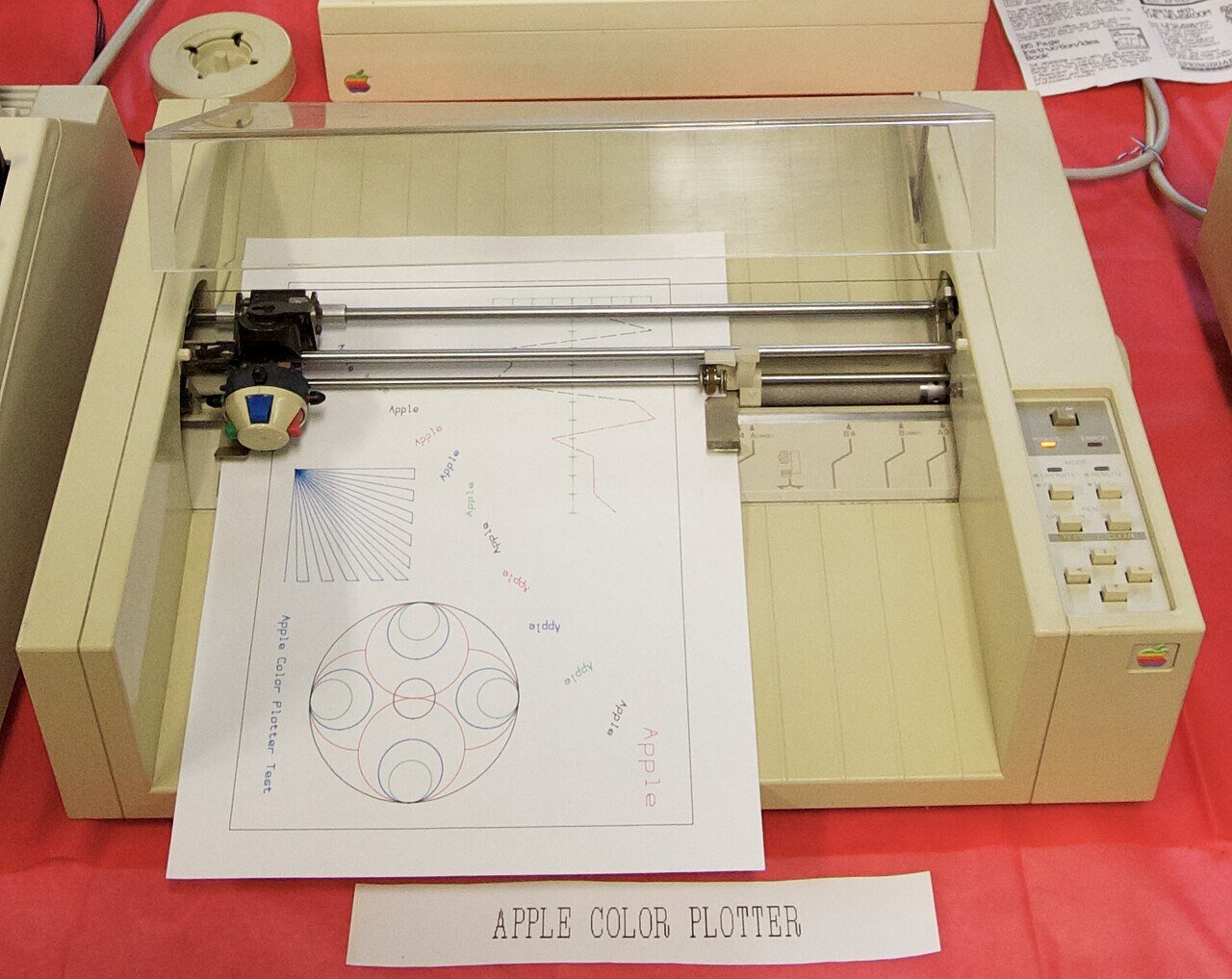
Apple Color Plotter (1983): a four-pen plotter for business graphics on the Apple II and III lines; the only one Apple ever sold.

Specs
| Reference | Apple Color Plotter |
|---|---|
| Launch / discontinued | 1983 / already discontinued by November 1988 |
| CPU | — |
| Memory | — |
| Storage | A4/A3 paper and transparencies |
| Display / graphics | 4 color pens on the horizontal axis; paper moves vertically |
| Expansion / ports | Serial |
| US launch price | — |
Launch
A UPI report dated 24 August 1983 already described the Color Plotter as available to Apple II and III users. This supports a 1983 date, but does not establish the exact announcement day. Apple technical documentation reviewed in November 1988 identifies it as discontinued; no withdrawal month is assigned here that these sources do not confirm. UPI quoted $995, a figure from that report, not a verified official launch price.
Marketing
It moved its four color pens along the horizontal axis while the paper shifted for the vertical axis, drawing precise vector graphics for presentations, including transparencies.
Flaws and fixes
Apple's manual discusses use and maintenance problems rather than a series-wide fault: pens could dry out or clog, and an unsuitable paper surface could produce uneven lines. It recommended keeping tips capped and matching speed to the medium. Various papers and films were supported, not exclusively Apple paper.
Drawing, connection and supplies
The head held a maximum of four pens selectable by software. This simultaneous capacity must not be confused with the eight available supply colors: black, red, green, blue, violet, orange, gold and brown. Pen selection combined colors in one drawing without making the device an eight-head printer.
The pens moved sideways while rollers moved the sheet along the other axis. Apple specified a maximum drawing area of 257 × 391.8 mm and a smallest addressable step of 0.1 mm. The latter describes movement resolution, not guaranteed absolute accuracy or a direct equivalent to a printer's dots per inch.
Supported formats included A4, A3 and 11 × 17 inches, as well as transparency film. Sheet size and usable drawing area differed because the rollers needed margins to grip the material. Apple recommended its own media for best results, but the manual also allowed ordinary paper, drawing paper, drafting vellum, acetate and mylar film.
The serial RS-232C connection used hardware handshaking to avoid overflowing the 255-byte buffer. The technical specification listed selectable rates from 75 to 9,600 baud and different data-format settings. It was not USB, and a matching connector alone did not establish compatibility.
The Apple II guide, published in 1983, expressly covered the Apple II, II Plus and IIe. It required a Super Serial Card and the correct cable; the card was not included with the plotter. The guide's setup used 1,200 baud, seven bits and no parity. Those were settings for that installation, not the interface's maximum speed.
The panel distinguished remote operation under computer commands from local control. It allowed pen selection, raising or lowering the pen and moving it across the sheet; a built-in test was also provided. Drawing commands included lines, points, circles, arcs, text and scaling. Its own microprocessor interpreted these instructions, so the computer did not have to direct every elementary movement separately.
A 1983 Apple advertisement positioned the product for presentation graphics, engineering and illustration, with optional pens for overhead transparency film. It offered different accessory kits for Apple II/IIe and Apple III, containing pens, starter paper, cables and documentation suited to the computer. These were connection and supply kits, not models with more pens mounted at once.
The manual warned that a complex drawing could take several minutes, particularly with heavily inked areas. Drawing speed was programmable from 1 to 10 cm/s per axis; this is not a pages-per-minute rating. The documentation advised slowing down on certain plastic media and checking pen tips before blaming poor lines on the machine's electronics.
More from the same family
Updated: October 24, 2026 · Sources: Wikipedia · Compare this product