
Xserve RAID (2003)
Original
Apple announced Xserve RAID on February 10, 2003, with availability planned for March. It was a 3 U storage array, not another Xserve computer or an Ethernet file-serving NAS. This page covers the original 180 GB ATA/100 drive offer, not later 7 TB or 10.5 TB capacities backdated to launch.
Specs
| Key feature | Original ATA/100 180GB |
|---|---|
| Announcement | 2003-02-10 |
| Planned availability | 2003-03 (planned) |
| Type | 3 U · storage array |
| Drives | 4 /7 /14×180 GB ATA/100 |
| RAID 0 capacity | 720 /1260 /2520 GB RAID 0 |
| Initial US price | 5999 /7499 /10999 USD (US launch) |
| Cache | 128 MB ×2; max 512 MB/controller |
| Data links | 2×2 Gb/s Fibre Channel |
| Management | 10/100 Ethernet ·RAIDAdmin Java |
| Separate host card | Apple Fibre Channel PCI ·499 USD (separate) |
| RAID | 0 /1 /3 /5 /0+1 |
| Dimensions and weight | 133 ×483 ×442 mm ·27–45 kg |
Announcement and role
Apple announced Xserve RAID on February 10, 2003, with availability planned for March. It was a 3 U storage array, not another Xserve computer or an Ethernet file-serving NAS. This page covers the original 180 GB ATA/100 drive offer, not later 7 TB or 10.5 TB capacities backdated to launch.
Capacity and price
The US offer had four, seven or fourteen 180 GB modules for $5999, $7499 or $10999. Apple listed 720, 1260 or 2520 GB total RAID 0 capacity, not equivalent usable RAID 5 space or a promise of formatted data capacity. Each independent controller managed seven ATA/100 channels; the announcement listed 128 MB cache per controller, expandable to 512 MB. Two controllers are not interpreted here as automatic takeover of the other controller’s drives.
Connection and management
Host data used two 2 Gb/s Fibre Channel links. Apple’s Fibre Channel PCI card was sold separately for $499 in the announcement, so the array’s starting price does not describe the complete required host system. 10/100 Ethernet was for remote management. Java-based RAIDAdmin handled configuration, events and alerts; redundant hot-swappable power and cooling were offered. “Up to 400 MB/s” is Apple’s announced figure, not guaranteed performance for every RAID and workload.
Optional batteries and cooling
The March 2003 Service Source documents up to two optional batteries to protect data in the controllers’ cache during a power interruption. The system power supplies recharge them; a new battery takes several hours and requires the system to be on. Seeing a bay alone therefore does not establish that this protection is installed or charged. Apple · Xserve RAID Service Source · March 2003 · Basics 4 / Take Apart 16
Redundancy does not remove cooling requirements: the manual requires a removed power supply or cooling module to be replaced as soon as possible to avoid overheating. A permanently removed battery must be replaced with a blank cover to maintain airflow. These are conditions of the original design, not certification of the present condition of a preserved unit. Apple · Xserve RAID Service Source · March 2003 · Basics 4 / Take Apart 16
Design, relation and image
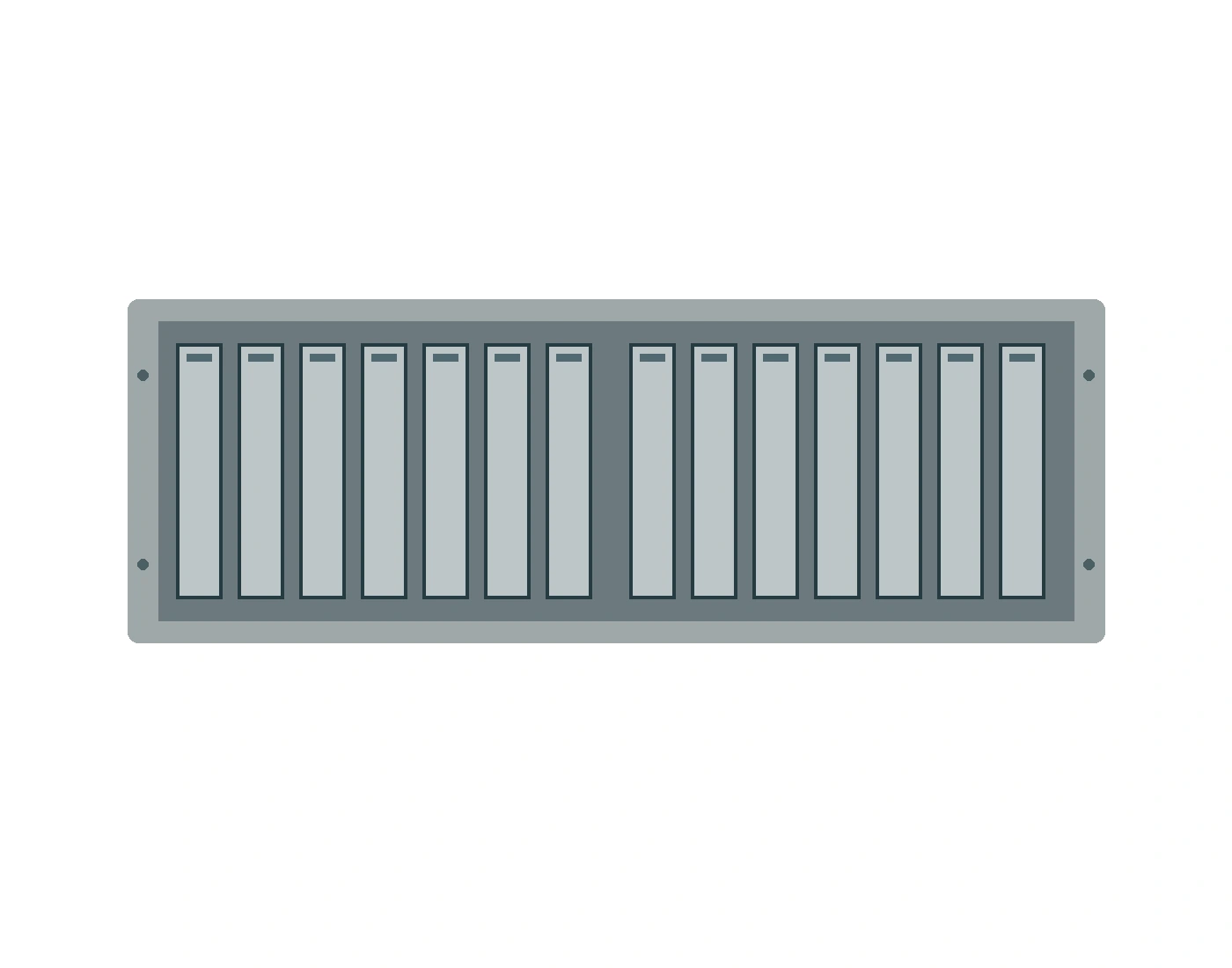
The manual describes RAID 0,1,3,5 and 0+1 per controller, fourteen bays and 133 ×483 ×442 mm dimensions (height ×width with brackets ×depth), weighing 27–45 kg depending on modules. The existing Xserve G4 is a related host computer, not a predecessor or the same product; no generational comparison is forced between different roles. The image is an original front-panel recreation with fourteen trays in two groups of seven. Schematic, not a photograph or a depiction of exact ports, indicators or drives.