
Xserve G4 (2002)
Apple introduced Xserve on May 14, 2002, as a 1U rack-mount server. Orders opened that day and availability was announced for June 2002; the release does not establish the actual first shipping date.
© ChrisDag · CC BY 2.0 ↗
Specs
| Processor | PowerPC G4 1 GHz; one or two processors |
|---|---|
| Memory | 256 / 512 MB DDR; up to 2 GB |
| Storage | 60 GB ATA/100 standard; up to 480 GB |
| Connectivity | 2 Gigabit Ethernet ports |
| Format | 1U rack |
| Price | 2999 USD (1 CPU) / 3999 USD (2 CPU); US announcement |
Launch
Apple introduced Xserve on May 14, 2002, as a 1U rack-mount server. Orders opened that day and availability was announced for June 2002; the release does not establish the actual first shipping date.
Configuration and use
The single 1 GHz PowerPC G4 configuration included 256 MB DDR RAM, a 60 GB ATA/100 drive, dual Gigabit Ethernet, CD-ROM and Mac OS X Server with unlimited clients for $2,999 in the US. The dual 1 GHz configuration included 512 MB RAM and the same 60 GB drive for $3,999.
Context and photograph
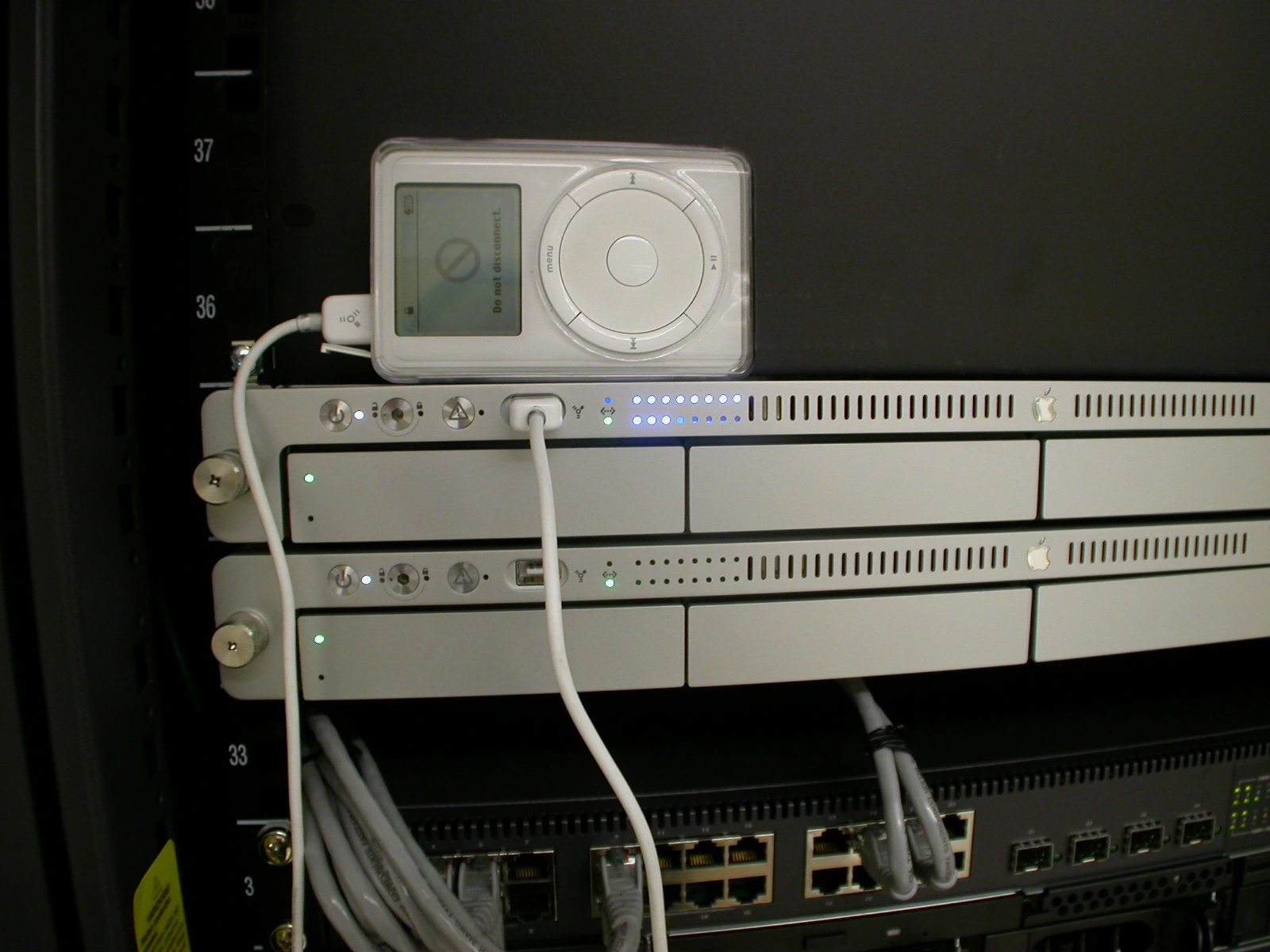
The announced limits were 2 GB memory and 480 GB storage across four drives. These were maximum capacities, not the standard configurations. The original photo shows two first-generation Xserve units in a rack with an iPod connected. The photographer dates it April 4, 2003; it does not identify each unit’s internal configuration.
Cache, expansion and mounting in the first Xserve
Apple’s table distinguishes 256 KB of on-chip L2 cache at 1 GHz and 2 MB of DDR L3 cache per processor. In the dual configuration these amounts apply to each PowerPC G4, not one shared cache. Standard main memory is PC2100 DDR SDRAM.
Three expansion positions did not mean three free slots. Apple lists two full-length 64-bit, 66 MHz PCI slots, with one free in standard configurations, plus a half-length 32-bit, 66 MHz combination PCI/AGP position.
Standard Gigabit networking used one onboard 10/100/1000BASE-T port and a matching card in the PCI/AGP position. The announcement also lists three 400 Mb/s FireWire ports, two rear and one front, two USB ports and a DB-9 serial console. The AGP 4X graphics card was an option, not an extra included item.
The four internal bays had independent ATA/100 channels and accepted hot-plug Apple Drive Modules. A standard configuration filled one bay with a 60 GB 7200-rpm disk; the 480 GB maximum required four 120 GB modules. Formatted capacity was less than nominal capacity.
Mounting was documented for EIA-310-D-compliant 19-inch racks: four-post racks 29 to 36 inches deep or two-post telecom racks. Apple included mounting hardware and a cable management arm for four-post racks; cooling flowed from front to back.
Universal electrical input accepted 90 to 264 V AC at 47 to 63 Hz. Apple distinguished typical continuous power of 125 W for one processor and 175 W for two from maximum continuous power of 400 W. These are not current measurements of every unit; typical and maximum values must remain distinct.