
Twentieth Anniversary Macintosh (1997)
Limited edition for Apple's twentieth anniversary: flat LCD display, Bose sound, and home delivery with concierge service.
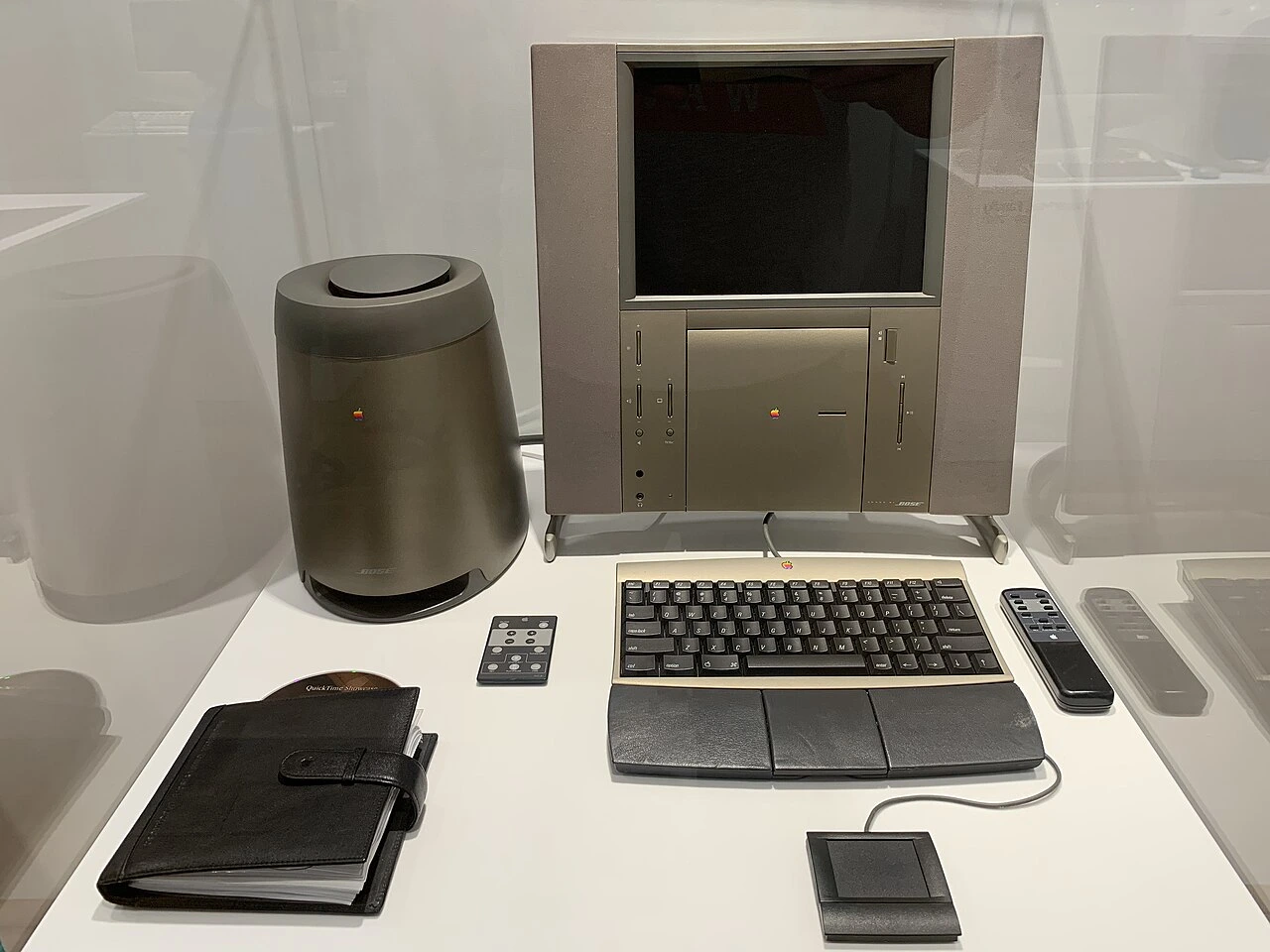
© Benoît Prieur · CC0 1.0 ↗ Resized, no crop or retouching.
Specs
| Processor | PowerPC 603e at 250 MHz, 32 MB RAM · Apple |
|---|---|
| Display | 12.1-inch active-matrix LCD |
| Key feature | Bose Acoustimass sound · Apple |
Launch
Apple announced the Twentieth Anniversary Macintosh at Macworld Expo in January 1997, according to Wikipedia, which records an initial price of $7,499. Macworld’s preview anticipated a price around $9,000 and did not yet describe the final configuration. Apple documents the shipping machine with a 250 MHz PowerPC 603e, 32 MB RAM, a 2 GB drive, and 4x CD-ROM. · Apple
Marketing
Macworld described it as a collector’s piece and reported a plan limited to 20,000 units, a forecast rather than a final production total. Home delivery and setup were part of the concierge service described by Macworld and Wikipedia. Apple confirms Bose Acoustimass sound with an external subwoofer and TV and FM tuners. · Apple
Its reception remained contentious years later. In 2006, PC World included the TAM in the dishonorable mentions of its article on the 25 worst tech products, outside the 25 numbered entries. It criticized the roughly $7,500 price against a weak processor, no network card and a slow CD-ROM drive. This was the magazine's retrospective judgment, not an objective ranking of the computer.
Flaws and fixes
According to Wikipedia, the price fell to about $3,500 during its commercial life. When it was discontinued in March 1998, remaining stock was cleared at $1,995 and US dealers sold out within two weeks. These are historical prices and timings reported by that source, not global sales figures.
Apple's Service Source documentation required any service involving removal of enclosure screws to be handled by a centralized repair center. Detailed repair instructions were therefore not distributed on the Service Source CD. This was a documented service policy, not proof that users could not install memory or expansion cards.
Origins, sales and full specifications
The project began under the codename "Spartacus" (also "Pomona" and "Smoke & Mirrors" internally) to commemorate Apple's twentieth anniversary on April 1, 1996; on a tighter schedule than a normal Mac, the team reused existing components inside a new LCD enclosure. The design was led by Jonathan Ive, then Apple's senior director of Industrial Design, who in the press release spoke of defining "a radically new solution" integrating computer and consumer appliance. The Acoustimass module, meant to sit on the floor, also hides the power supply and connects to the main unit with a single cable.
Apple began accepting orders on May 28, 1997, with shipping planned for that summer, and offered it in the United States, Japan and parts of Europe, in limited quantity on a first-come, first-served basis. In the US, distribution ran through Apple Specialists, the authorized resellers with Apple's highest service certification. The concierge service included a three-year limited hardware warranty and three years of toll-free telephone support, on top of delivery and setup.
Inside it is very close to the Gazelle architecture of the Power Macintosh 6500: 256 KB of L2 cache, RAM expandable to 128 MB in two 168-pin DIMM slots, ATI 3D Rage II graphics with 2 MB of SGRAM (800x600 in thousands of colors) and an internal 33.6k modem in the Communication Slot II, alongside a 7-inch PCI slot. The 75-key ADB keyboard, with Italian leather palm rests and a detachable trackpad, slid beneath the display; a remote control operated TV, FM radio and CD. Installing cards required swapping the rear cover for a larger one, which was included. It measures 438 x 419 x 254 mm and weighs 6.8 kg (the bass unit, 4.8 kg); it shipped with Mac OS 7.6.1 (System Enabler 704) and supports up to Mac OS 9.1.