
Studio Display (2022)
Nano-texture glass · Tilt-adjustable stand
This entry covers Studio Display, configuration from 2022: Nano-texture glass; Tilt-adjustable stand.
Specs
| Key feature | 2022 / 5120 × 2880 |
|---|---|
| Diagonal | 27 inches |
| Resolution | 5120 × 2880 |
| Documented brightness | 600 nits |
| Colors | 1 billion |
| Video input | Thunderbolt 3 (USB-C) |
| Downstream USB | 3 × USB-C · 10 Gb/s |
| Glass | Nano-texture glass |
| Mount | Tilt-adjustable stand |
| Width | 62.3 cm |
| Height | 47.8 cm |
| Depth | 16.8 cm |
| Weight | 6.3 kg |
History and documentation
This entry covers Studio Display, configuration from 2022: Nano-texture glass; Tilt-adjustable stand.
Design and specifications
The diagonal is 27 inches and the resolution is 5120 × 2880 pixels. Documented brightness is 600 nits; listed colors are 1 billion.
Use and context
Video input is Thunderbolt 3 (USB-C). Downstream USB ports are 3 × USB-C · 10 Gb/s. This configuration is 62.3 cm wide, 47.8 cm high and 16.8 cm deep; it weighs 6.3 kg.
Notes and image
Dimensions and weight apply only to the listed mount, not every option in the family. Values are Apple’s published specifications, not measurements of a used unit. Weight may vary by configuration and manufacturing process.
Sources
- Apple · technical specifications
- Apple · model identification
- dimensionapple.com · Reference
- Studio Display (2022) · Standard glass · Tilt-adjustable stand
- Studio Display (2022) · Standard glass · Tilt-adjustable stand ⇄ Studio Display (2022) · Nano-texture glass · Tilt-adjustable stand
- KKPCW · CC BY-SA 4.0

Nano-texture and tilt: a specific 2022 configuration
Apple introduced Studio Display on March 8, 2022, alongside Mac Studio, with first deliveries announced for March 18. This entry combines two choices from that family: nano-texture glass and the tilt-adjustable stand. It does not describe the height-adjustable stand or VESA adapter, even though they share the family's electronics and panel.
Nano-texture addressed a different issue from size or resolution. According to Apple, it scattered light to reduce glare in spaces with bright light sources, including sunlight. It was an alternative to standard glass with an anti-reflective coating, not an increase in the 5120 × 2880 pixels or a stand-adjustment feature.
This configuration's stand allowed tilt between −5 and +25 degrees. The 105 mm of vertical movement belonged to another option, the tilt- and height-adjustable stand. A 100 × 100 mm VESA mount was a third choice, supporting landscape or portrait orientation. Keeping these options separate avoids assigning this stand features it did not offer.
The 27-inch panel offered 218 pixels per inch, P3 wide colour and True Tone. The documentation included reference modes for photography, design and print, digital cinema and HDTV video, alongside sRGB for the web. Those modes explained its creative uses; they do not turn the 600-nit brightness figure into a specification for another model.
The computer connection was an upstream Thunderbolt 3 port able to supply 96 W to a compatible notebook. The three other USB-C ports were downstream connections rated up to 10 Gb/s for peripherals, storage and networking. Sharing the USB-C connector shape did not make their roles equivalent: host connection and accessory ports had distinct functions.
A13 Bionic supported the camera and audio features announced by Apple. The 12-megapixel Ultra Wide camera included Center Stage to keep people in frame as they moved. This describes the system introduced in 2022, without importing camera or connection improvements from later generations.
Audio combined three microphones and six speakers: four force-cancelling woofers and two tweeters. Apple advertised Spatial Audio support when playing music or video with Dolby Atmos. The system integrated video calls and sound into the monitor, but it remained a display connected to a computer, not a standalone Mac.
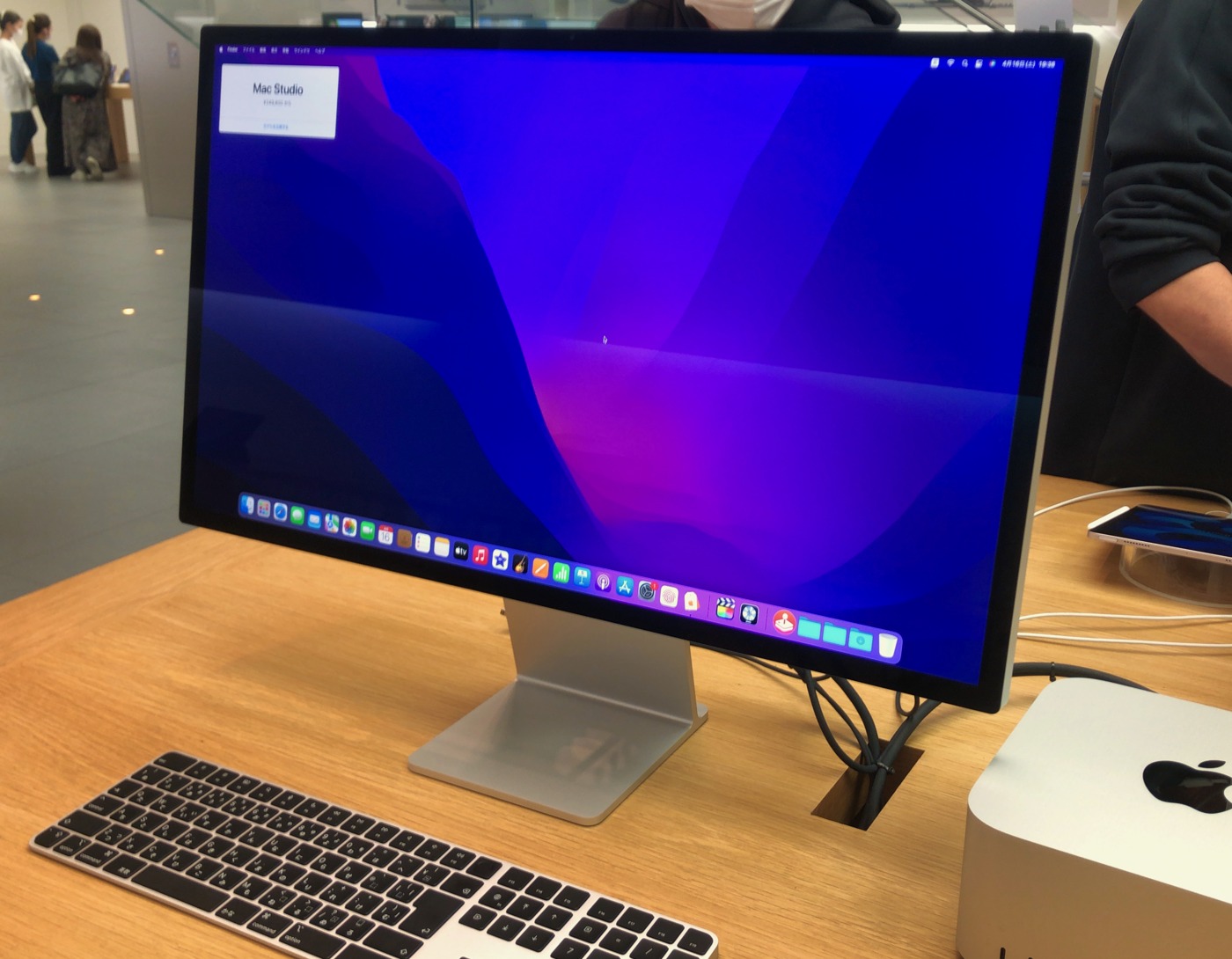
The retained photograph documents a 2022 Studio Display according to its author, KKPCW, who photographed it in April at Apple Nagoya Sakae. It does not visually establish nano-texture glass or the exact stand configuration. The model-representative image warning and CC BY-SA 4.0 attribution therefore remain, without treating it as proof of this particular combination.
More products
Historical catalogue links
Relationships already recorded in the catalogue, not a complete succession chain. Same-year variants are shown as related. A missing link does not prove that an earlier or later model does not exist.