
Apple Studio Display 15" (1998)
Apple's first LCD monitor: a 15-inch flat panel announced in 1998, months before the iMac made translucent plastic famous.
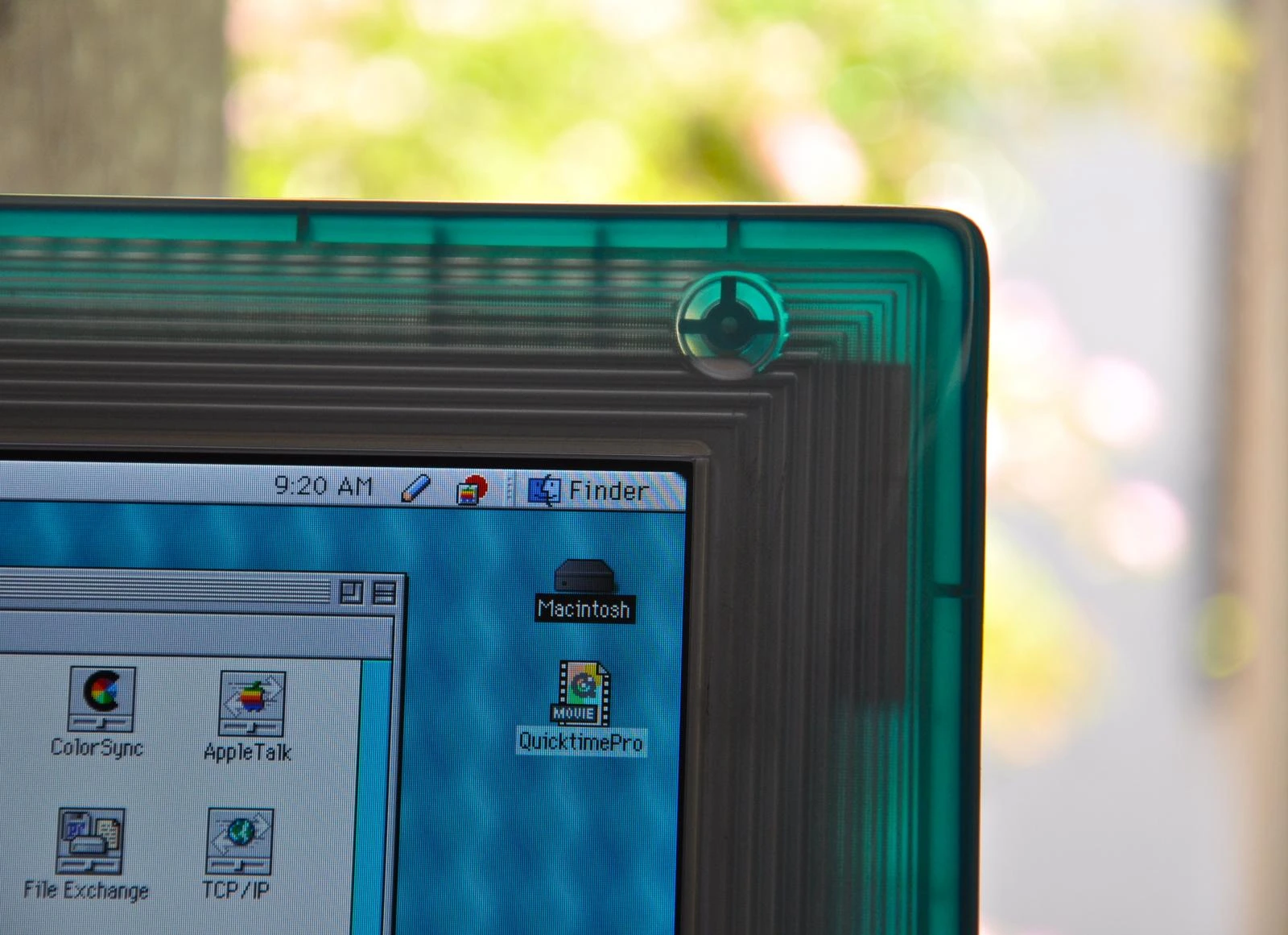
© raneko · CC BY 2.0 ↗ Resized, no crop or retouching.
Specs
| Panel | 15" LCD, 1024×768, 4:3, 180 cd/m² |
|---|---|
| Connectivity | DA-15; two ADB ports, S-Video, composite video, RCA audio and headphone jack |
| Key feature | first translucent Apple product since the eMate, per Wikipedia |
Launch
Jobs announced it on March 17, 1998 at the Seybold Seminars keynote in New York, alongside the Power Macintosh G3/300, per MacTech's report: $1,999 with availability promised for May, shown against a $3,500 Compaq flat screen. Per Wikipedia, it was Apple's first LCD monitor and required System 7.5 or later.
Marketing
Its translucent blue casing predated the iMac G3 by a few months and was, per Wikipedia, Apple's first translucent product since the eMate, although the Power Mac G3 of the day was still beige. Macworld wrote in June 1998 that the price would have seemed aggressive months earlier, but with falling LCD prices it landed in the middle of the pack. In January 1999 a white-and-blueberry revision matched the Power Mac G3 Blue and White, brighter (200 cd/m²) and cheaper ($1,099), per Wikipedia.
Flaws and fixes
Its DA-15 and ADB connections tied it to the Macs of its era; an August 1999 revision moved to DVI and USB, and in July 2000 the M2454 model adopted the Apple Display Connector with a clear stand, per Wikipedia. The 15-inch Studio Display was discontinued in January 2003, leaving the 17-inch as the last of the line.
Measurements, revisions and price path
Apple dates the commercial release to May 7, 1998. Its technical sheet lists 12.1 lb (5.5 kg), 15 in high by 15.7 wide and 9.8 deep (38.1 × 39.9 × 24.9 cm), a 35 W maximum draw and a universal 100-120/220-240 V power supply. The panel, with 15.1 viewable inches, runs natively at 1024 × 768 and accepts modes from 640 × 480 up to its native resolution at up to 75 Hz, including the Mac 832 × 624 mode.
The rev.B technical sheet (January 5, 1999) spells out what the facelift changed on paper: marketing number M6356xx/B, 200:1 contrast, on-screen controls (OSD navigation, graphics/video toggle and reset), Mac OS 8.0 as the minimum and Windows 95/NT compatibility. Apple records its discontinuation on December 2, 1999.
On July 19, 2000 the 15-inch flat panel joined the new Apple Display Connector family at $999: the ADC carried analog and digital video, USB data and power over a single cable, so the display drew power from the computer itself and gained a two-port USB hub. On May 21, 2001 it dropped to $599, when Apple billed itself as the first company with an all-LCD professional display lineup.