
iSight (2003)
The aluminum external camera Apple introduced in 2003 alongside iChat AV. Steve Jobs promised the combination could be set up in under five minutes, a launch claim rather than a guaranteed time for every connection.
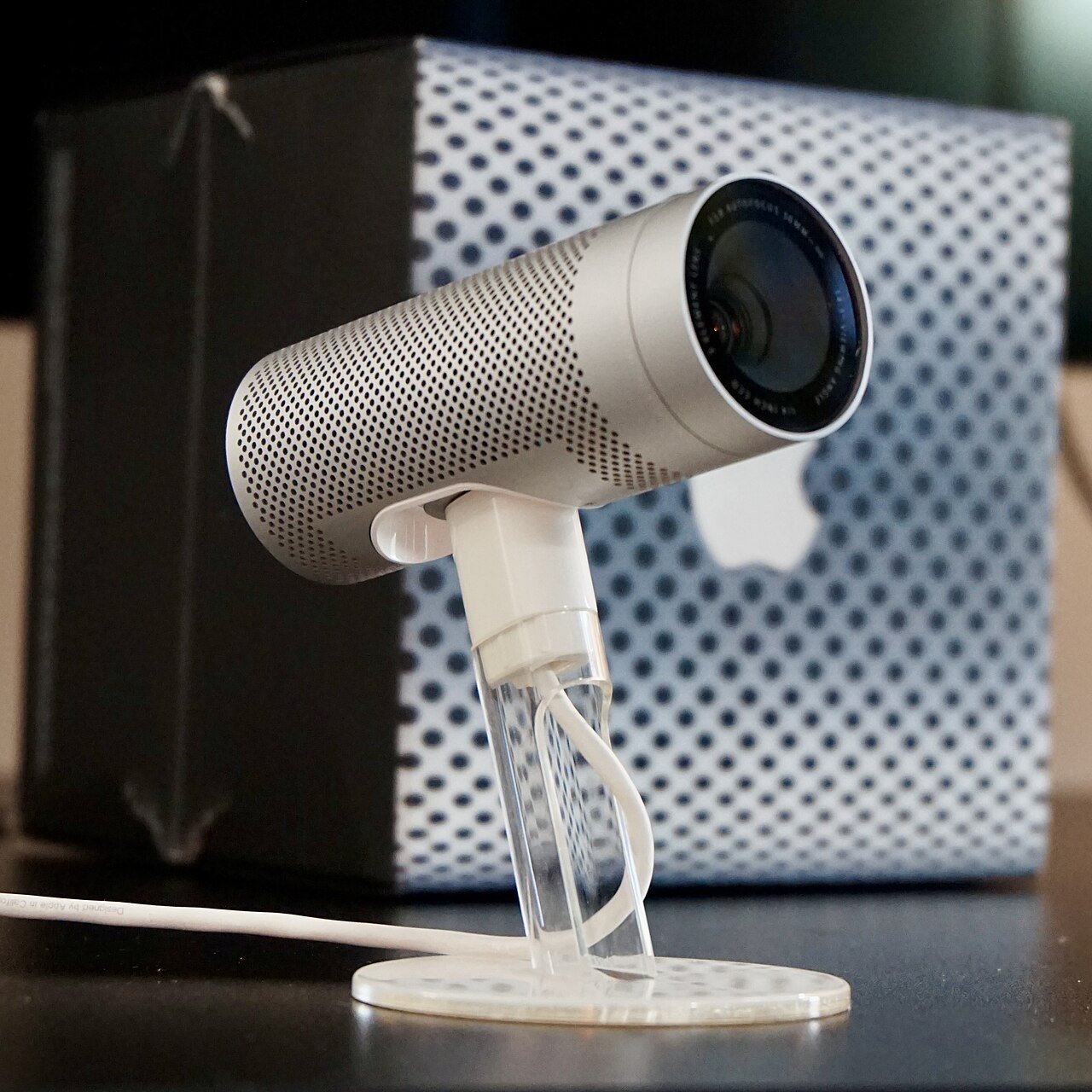

© Kplans · CC BY 4.0 ↗ © Eyesight · CC BY-SA 3.0 ↗ Resized, no crop or retouching.
Specs
| Connectivity | FireWire 400 · VGA · 30 fps |
|---|---|
| Price | $149 |
| Key feature | 2003–2006 |
Launch
Apple introduced iSight on June 23, 2003 at WWDC in San Francisco, alongside iChat AV, on sale that same day for $149. Together they enabled video conferences between two Macs over any broadband connection, and audio conferences even over a 56k modem. iChat AV shipped as a free public beta for Mac OS X 10.2 Jaguar and became a key feature of Mac OS X 10.3 Panther, also sold separately as a $29.95 upgrade. The keynote survives in an archival copy on the Internet Archive. The announcement specified Mac OS X 10.2.5 or later and the iChat AV beta for the camera; video conferencing required a Mac with a 600 MHz PowerPC G3 or faster. The public beta was time-limited, not a permanent free licence for the final product.
Marketing
The idea was video conferencing "for the rest of us": presenting it, Steve Jobs claimed anyone could set it up in under five minutes, just by installing the software and plugging in the camera. The design aimed at natural conversation: a center mount on top of the screen with a tilt-and-rotate mechanism for face-to-face calls, a single FireWire cable carrying audio, video and power, and an aluminum body smaller and lighter than most cell phones of the time, made to travel clipped to a PowerBook or iBook. An on-board processor adjusted color, white balance, sharpness and contrast by itself, and the dual-element microphone suppressed ambient noise.
Flaws and fixes
The June 2003 announcement described broadband video calls between two Mac users and audio over a modem; it does not define every later use of the camera. Resolution stayed at VGA 640x480 at 30 frames per second, fine for 2003 but quickly tight once built-in cameras improved. That was also the ending: Apple began fitting iSight cameras into iMac and notebook screens, and in late 2006 the external one disappeared from the Apple Store and sold out at major resellers, as Engadget documented, with no direct successor: video calling moved to the cameras built into the screens. The iSight name lived on for years in the built-in cameras until Apple adopted the FaceTime brand in 2010. As privacy touches ahead of their time, iSight had a green activity LED and a physical shutter that closed by twisting the front.
Optics, mounts and limits of the external iSight
Apple's technical page archived in July 2005 describes a 1/4-inch CCD sensor with 640 × 480 pixels, an f/2.8 lens and autofocus from 50 mm to infinity. These are focusing distances, not zoom capability or HD resolution. Apple qualified the up-to-30-frames-per-second figure by Internet connection speed: camera capture and the smoothness received in a call are not the same measurement. Apple · archived July 2005 · CCD / f/2.8 / focus
Matthew Honan's original Macworld comparison, published on November 30, 2003, tested four FireWire cameras with three Macs and several connections. Honan praised iSight's colour, motion handling and microphone, but found its low-light image darker than its rivals'. He also saw autofocus choose the background when someone entered behind the subject. That is a result from that test, not a caveat to hide behind the marketing promise of a sharp picture in any light. Matthew Honan · Macworld · 30 November 2003
The FireWire cable carried audio, video and power; Apple's documented small mount adapter held the connector and was not a FireWire-to-USB converter. The manual copyrighted 2004 shows cable, adapter and stand forming the assembly. It also suggests disconnecting an unused camera from a battery-powered PowerBook or iBook to save energy. This is not a wireless camera, and changing a plug's shape alone does not establish compatibility with a current Mac. Apple · 23 June 2003 · FireWire Apple · 2004 User’s Guide · pp. 8–11, 19
Not every accessory should be presented as part of the June 2003 box. Honan described three stands; Apple's page archived in 2005 and the 2004 manual show four, including a magnetic mount for anodised-aluminum Apple displays. The manual distinguishes it from the notebook clamp and adhesive mounts for other displays or desktops. It warns against putting the magnet near a CRT, iPod or external disk and says repeated repositioning weakens the adhesive. The documented edition matters. Matthew Honan · three stands · 2003 Apple · four stands · archived 2005 Apple · 2004 User’s Guide · pp. 6–16, 25
The front cover and green indicator are separate controls: the manual links the light to video capture and explains turning the ring to open the lens. For audio, it describes a separate mute button. It also documents one-way video to a person without a camera: two iSights were not required. Ventilation is required even when switched off if the camera remains connected. These historical instructions do not replace checking physical condition or the privacy settings of the system in use. Apple · 2004 User’s Guide · pp. 18, 21, 28
The iMac G5 announced on October 12, 2005 integrated a camera named iSight into the computer. It was not simply the external model clipped above the screen: Jason Snell explained in Macworld that it sat inside the case, lacked a physical lens cover and also captured VGA 640 × 480. This comparison separates integration from resolution without assuming that a shared name means the same module, mounting or accessories. The related iMac entry is the integrated 17-inch model, not another variant of this external camera. Apple · iMac G5 · 12 October 2005 Jason Snell · Macworld · 16 October 2005 iMac G5 · 17-inch · iSight · 2005