
iPod shuffle (2009)
3rd generation, March · A1271
This entry covers iPod shuffle (3rd generation, March 2009), model A1271, from 2009. The documented configuration offers 4 GB of flash storage.
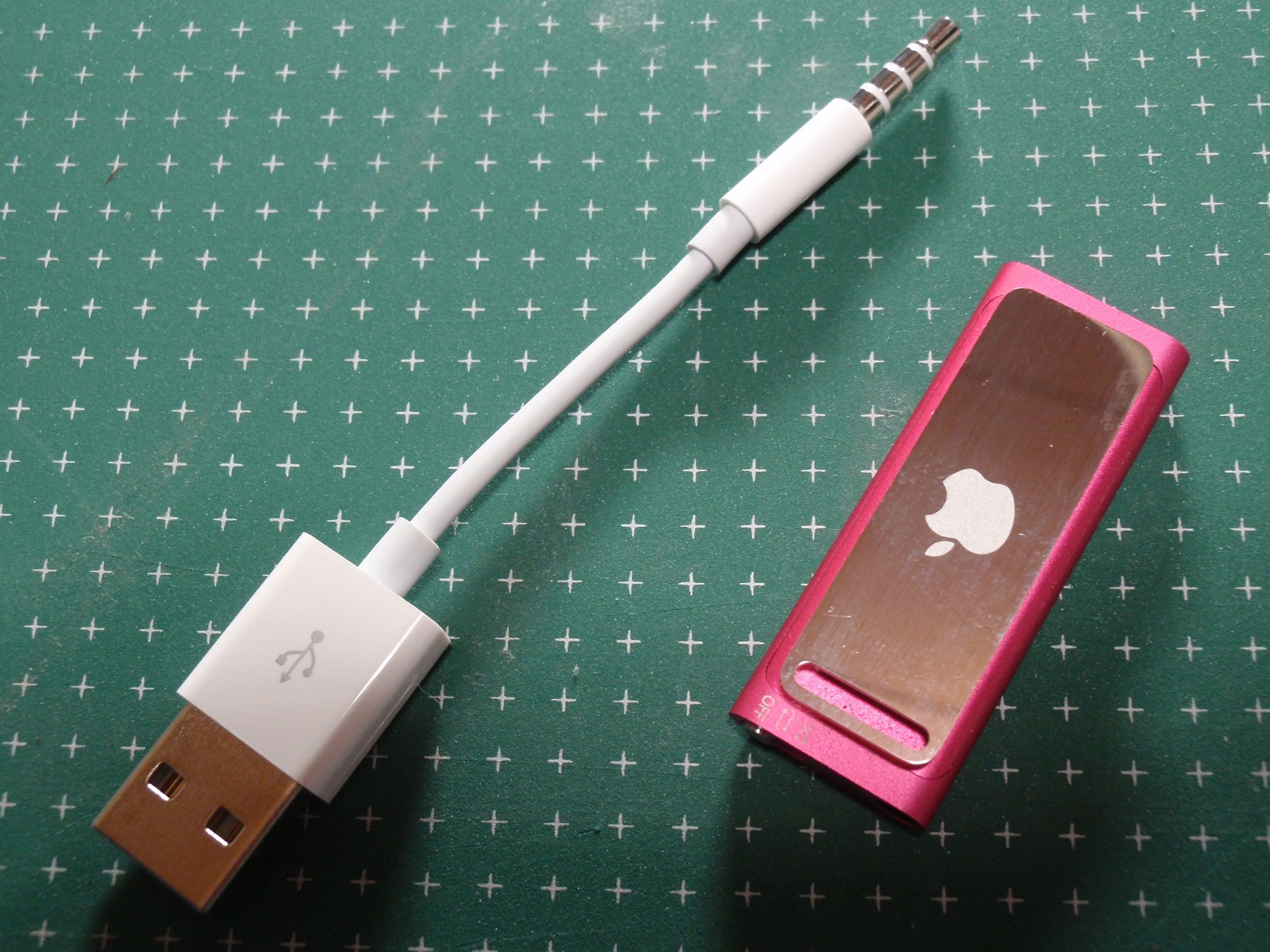
© Cassiopeia sweet · Public domain (PD-self) ↗ Resized, no crop or retouching.
Pink third-generation iPod shuffle with USB cable, expanded 2009 range. Photo: Cassiopeia sweet, Wikimedia Commons, public domain (PD-self). No changes by us; not a March launch photo.
Specs
| Key feature | A1271 |
|---|---|
| Model | A1271 |
| Documented storage | 4 GB |
| Navigation | Earphone remote |
| Display | No display |
| Frequency response | 20 Hz - 20 kHz |
| Computer connection | USB through its dedicated cable |
| Height | 45.2 mm |
| Width | 17.5 mm |
| Depth | 7.8 mm |
| Weight | 10.7 g |
| Music: Apple maximum | Up to 10 h |
| Selected audio formats | AAC / MP3 / WAV |
History and documentation
This entry covers iPod shuffle (3rd generation, March 2009), model A1271, from 2009. The documented configuration offers 4 GB of flash storage.
Design and specifications
It uses Earphone remote for navigation. Display: No display. Main controls are on the earphone remote; the body has a three-position switch.
Nearly half the size of its predecessor and "significantly smaller than a AA battery": the aluminum body with a stainless steel clip removes all buttons and moves every control — play, pause, volume, playlist switching — to the earphone cord.
It is the first music player that "talks": VoiceOver speaks song titles, artists and playlist names, even battery status, in fourteen languages. It is also the first shuffle with multiple playlists. Its 4 GB hold up to 1,000 songs (500 in 256-Kbps AAC) and the battery claims up to 10 hours.
Use and context
It measures 45.2 mm high, 17.5 mm wide and 7.8 mm deep, and weighs 10.7 g. Depth includes the clip. The technical sheet lists a 20 Hz to 20 kHz frequency response and support for AAC, MP3 and WAV among other formats.
It shipped on March 11, 2009 in silver and black, for $79, with Apple Earphones with Remote, a USB cable and an iTunes 8.1 requirement. Greg Joswiak pitched it as "a revolutionary approach to how you listen to your music by talking to you."
Removing the buttons from the body sparked debate: it forced the use of Apple's or compatible earphones. Ars Technica confirmed in March 2009 that third-party headphones with controls needed an Apple-supplied chip; iLounge called it an "authentication chip", while accessory maker Scosche described it as a control IC, not authentication.
Notes and image
Computer connection: USB through its dedicated cable. Apple quotes up to 10 hours of music on a full charge under its test conditions. This is a historical figure, not a runtime guarantee or an assessment of a used unit's battery.
Sources
- Apple · technical specifications
- Apple · model identification
- Cassiopeia sweet · Public domain (PD-self)
- Apple · original announcement (March 2009)
- Ars Technica · the third-party headphone chip (March 2009)
- iPod shuffle (2nd generation, 2006) · A1204
- iPod shuffle (2nd generation, 2006) · A1204 ⇄ iPod shuffle (3rd generation, March 2009) · A1271

Updated: 2026-11-07
More products
Historical catalogue links
Relationships already recorded in the catalogue, not a complete succession chain. Same-year variants are shown as related. A missing link does not prove that an earlier or later model does not exist.