
iPod (2005)
5th generation, 30 GB · MA002LL/A
This entry covers iPod (5th generation, 30 GB), identifier MA002LL/A, from 2005. The documented configuration offers 30 GB of hard-disk storage.
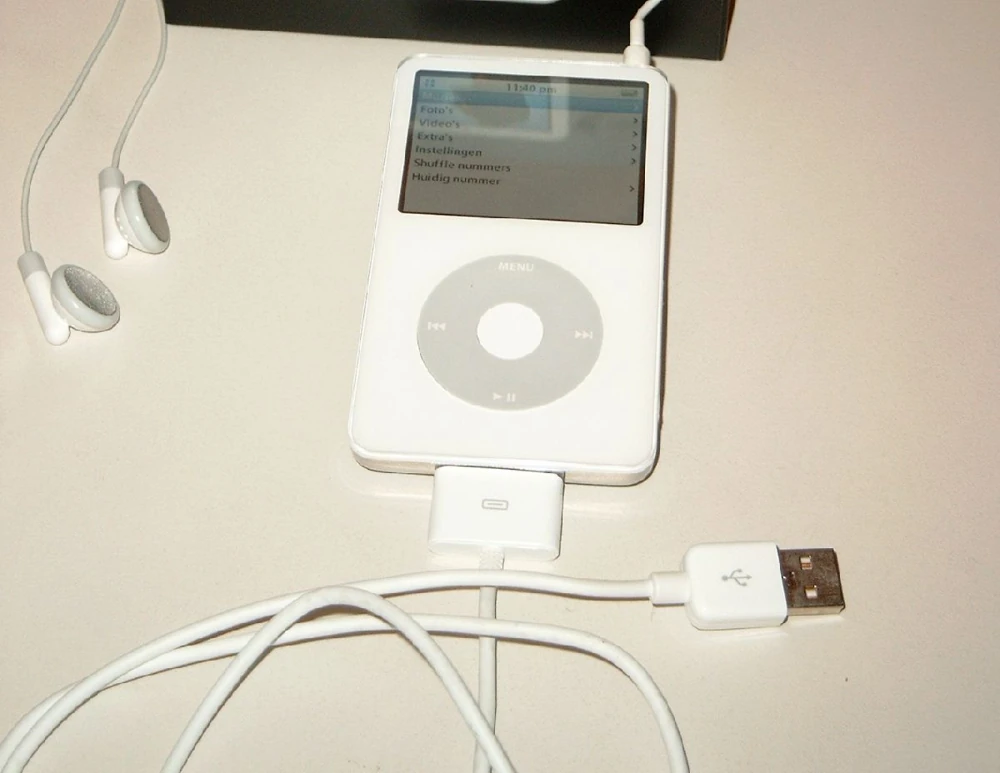
Wasily · Public domain (Wikimedia Commons) Commons version cropped by Gazebo in 2015 to remove packaging; resized and converted to WebP here, with no further crop or retouching.
Specs
| Key feature | MA002LL/A |
|---|---|
| Identifier | MA002LL/A |
| Documented storage | 30 GB |
| Navigation | Click Wheel |
| Display | Color LCD · 2.5″ · 320 × 240 |
| Headphone output | 3.5 mm |
| Computer connection | USB through Dock Connector |
| Height | 4.1 in |
| Width | 2.4 in |
| Depth | 0.43 in |
| Weight | 4.8 oz |
| Music: Apple maximum | Up to 14 h |
| Selected audio formats | MP3 / WAV |
History and documentation
This entry covers iPod (5th generation, 30 GB), identifier MA002LL/A, from 2005. The documented configuration offers 30 GB of hard-disk storage.
Design and specifications
It uses Click Wheel for navigation. Display: Color LCD · 2.5″ · 320 × 240. It includes video playback and photo viewing.
Use and context
It measures 4.1 in high, 2.4 in wide and 0.43 in deep, and weighs 4.8 oz. The technical sheet includes MP3 / WAV, among other audio formats.
Notes and image
Computer connection: USB through Dock Connector. Apple quotes up to 14 hours of music on a full charge under its test conditions. This is a historical figure, not a runtime guarantee or an assessment of a used unit's battery.
Sources
- Apple · technical specifications
- Apple · model identification
- Wasily · Public domain (Wikimedia Commons)
- ipod-4g-2004
- ipod-4g-2004 ⇄ iPod (5th generation, 30 GB) · MA002LL/A
The 30 GB iPod at the 2005 transition
Apple introduced this fifth generation in San Jose on October 12, 2005. The announcement did not promise delivery that day: shipping was to begin the following week. The launch range offered 30 and 60 GB, each in white or black; MA002LL/A specifically identifies white 30 GB, while MA146LL/A identifies black 30 GB. This is not the 2006 revision with an 80 GB option.
The announced US prices were $299 for 30 GB and $399 for 60 GB. These are launch prices for that market, not Spanish prices or present-day valuations. Although the release led with up to 15,000 songs, that figure belonged to 60 GB: the technical table assigns 7,500 to the 30 GB model, assuming four-minute songs encoded as 128 Kb/s AAC.
The panel helps explain the change in use: Apple described a 2.5-inch QVGA transflective LCD with a white LED backlight and 320 × 240 resolution. The introduction brought music, photographs and video together in the same Click Wheel player. That does not make 30 GB a fixed video capacity: published estimates depended on compression and on the other content stored.
The specifications distinguish the capacities physically. The 30 GB model is 0.43 inches thick and weighs 4.8 ounces; the 60 GB model increases to 0.55 inches and 5.5 ounces. Both share a height and width of 4.1 by 2.4 inches. A front photograph of the family, without further documentation, therefore cannot by itself establish the thickness or capacity of the unit described.
The internal rechargeable battery is lithium-ion. For 30 GB Apple claimed up to two hours of video and three hours of photo slideshows with music, alongside the fourteen hours of audio already noted. The release’s twenty-hour music maximum belongs to 60 GB. Full charging was estimated at about four hours, or about two hours to 80% for a fast charge. These are original figures, not a diagnosis of a used battery.
The player included earphones, a USB cable, a Dock adapter and a case. Apple sold the Universal Dock, Apple Remote and AV cable separately; they should not be mistaken for included accessories. Composite video output required the optional AV cable, while line output was listed through the Universal Dock. The player’s Dock Connector and 3.5 mm minijack are separate connections, not two names for one port.
More products
Historical catalogue links
Relationships already recorded in the catalogue, not a complete succession chain. Same-year variants are shown as related. A missing link does not prove that an earlier or later model does not exist.