
iPod (2003)
Dock Connector, 30 GB, April · A1040
This entry covers iPod (Dock Connector, 30 GB, April 2003), identifier A1040, from 2003. The documented configuration offers 30 GB of hard-disk storage.

Specs
| Key feature | A1040 |
|---|---|
| Identifier | A1040 |
| Documented storage | 30 GB |
| Navigation | Touch Wheel |
| Display | Monochrome LCD · 2″ · 160 × 128 |
| Headphone output | 3.5 mm |
| Computer connection | FireWire through Dock Connector |
| Height | 4.1 in |
| Width | 2.4 in |
| Depth | 0.73 in |
| Weight | 176 g |
| Music: Apple maximum | Up to 8 h |
| Selected audio formats | MP3 / WAV |
History and documentation
This entry covers iPod (Dock Connector, 30 GB, April 2003), identifier A1040, from 2003. The documented configuration offers 30 GB of hard-disk storage.
Design and specifications
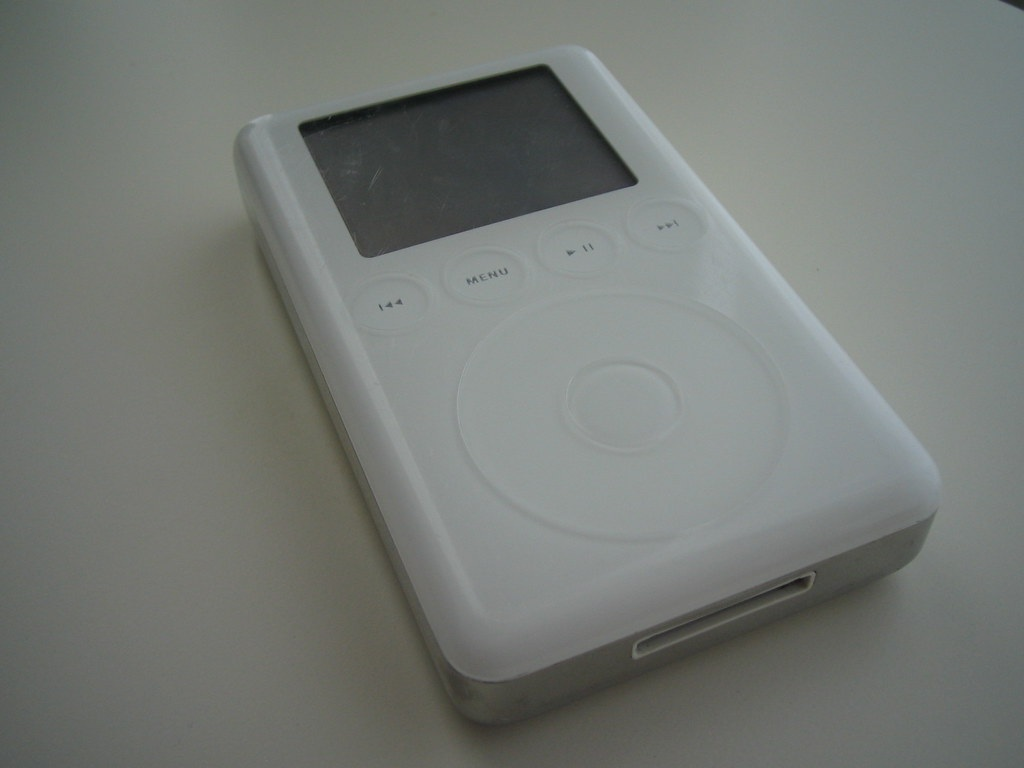
It uses Touch Wheel for navigation. Display: Monochrome LCD · 2″ · 160 × 128. The four buttons are above the touch wheel.
Use and context
It measures 4.1 in high, 2.4 in wide and 0.73 in deep, and weighs 176 g. The technical sheet includes MP3 / WAV, among other audio formats.
Notes and image
Computer connection: FireWire through Dock Connector. Apple quotes up to 8 hours of music on a full charge under its test conditions. This is a historical figure, not a runtime guarantee or an assessment of a used unit's battery.
Sources
Thirty gigabytes at the move to the Dock connector
Apple introduced this generation on April 28, 2003 and announced availability for May 2. The 30 GB model cost $499 in the United States, above the $299 10 GB and $399 15 GB versions. It was the top tier of that April range, not a capacity shared by every A1040 iPod: Apple also uses that identifier for later September variants.
The campaign promised up to 7,500 songs for 30 GB. The technical specification explains the assumption: four-minute songs encoded at 128 kbit/s in AAC or MP3. That is neither a fixed file count nor the available formatted capacity. The figure translated the hard disk into an estimated music library.
The control change was not a Click Wheel. Apple described a solid-state wheel and touch buttons with no mechanical movement, with illuminated buttons for low light; the official identification page places the four controls above the wheel. Marketing language about controls with no moving parts does not mean the player lacked a hard disk.
The bottom connector made the Dock a connection base, rather than merely a stand. It was included with the 15 and 30 GB models and provided line output for a stereo or powered speakers. The 30 GB package added a wired remote and carrying case alongside earphones, a power adapter, FireWire cable and four-to-six-pin adapter. This was not the same included equipment as the entry-level 10 GB model.
The announcement should be separated from later USB capabilities. In April, Apple announced USB 2.0 syncing for Windows from June through a free update and a separate cable. The technical specification ties that connection to a USB 2.0 + FireWire cable and documents charging through FireWire. Launch should not be presented as already providing one USB cable for every function and platform.
Library controls expanded with On-The-Go playlists created on the iPod itself, song ratings and a customizable main menu. Auto-Sync kept the library updated when connected to a computer. Documentation distinguished formats by platform: it included AAC, AIFF and Audible on Mac, while its Windows list named MP3, MP3 VBR and WAV. This describes that documentation, not every future update.
On the same April 28, Apple launched the iTunes Music Store with more than 200,000 songs at 99 cents each and no subscription fee. The initial store required a Mac with iTunes 4 and a card with a US billing address. Selling the iPod for Mac and Windows therefore did not mean both systems then had equal access to the new store. The player announcement included MUSICMATCH Jukebox Plus 7.5 for Windows.
The retained Thomas van de Weerd photograph is titled 'iPod 30gb te koop'; its page records both capture and upload on August 21, 2006. It shows a used unit, not the April 2003 launch or proof of its original accessories. Model documentation and image provenance serve different purposes.
More products
Historical catalogue links
Relationships already recorded in the catalogue, not a complete succession chain. Same-year variants are shown as related. A missing link does not prove that an earlier or later model does not exist.