
iMac (2008)
20-inch, 2.4 GHz, Early
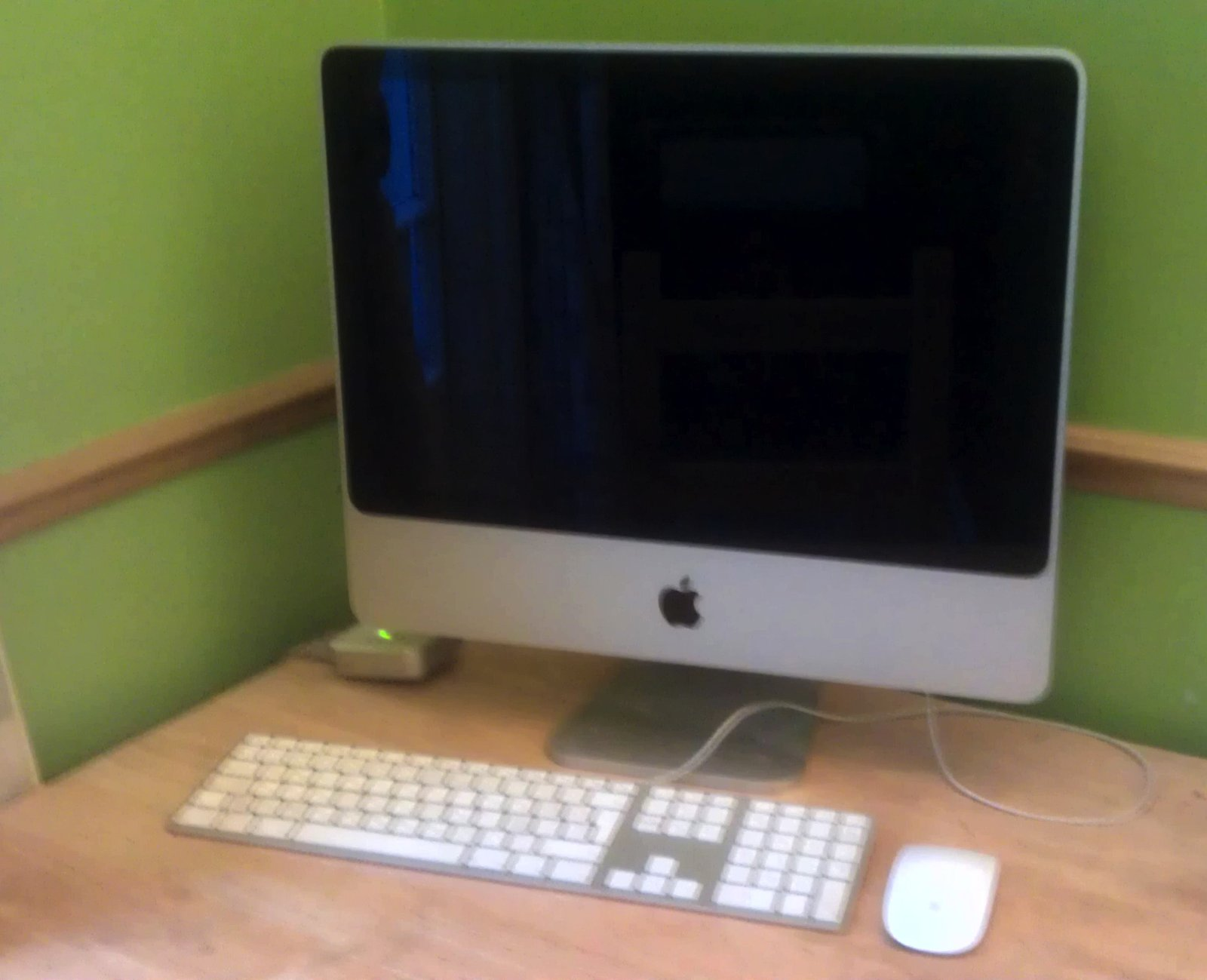
Apple announced this 20-inch iMac on April 28, 2008 at 1199 USD in the United States. The announcement stated immediate availability. Its design combines aluminum and glass with a glossy display. It is one of three Core 2 Duo configurations; the simultaneous versions are not successors to each other.
Specs
| Announcement | 2008-04-28 |
|---|---|
| CPU | Intel Core 2 Duo · 2.4 GHz |
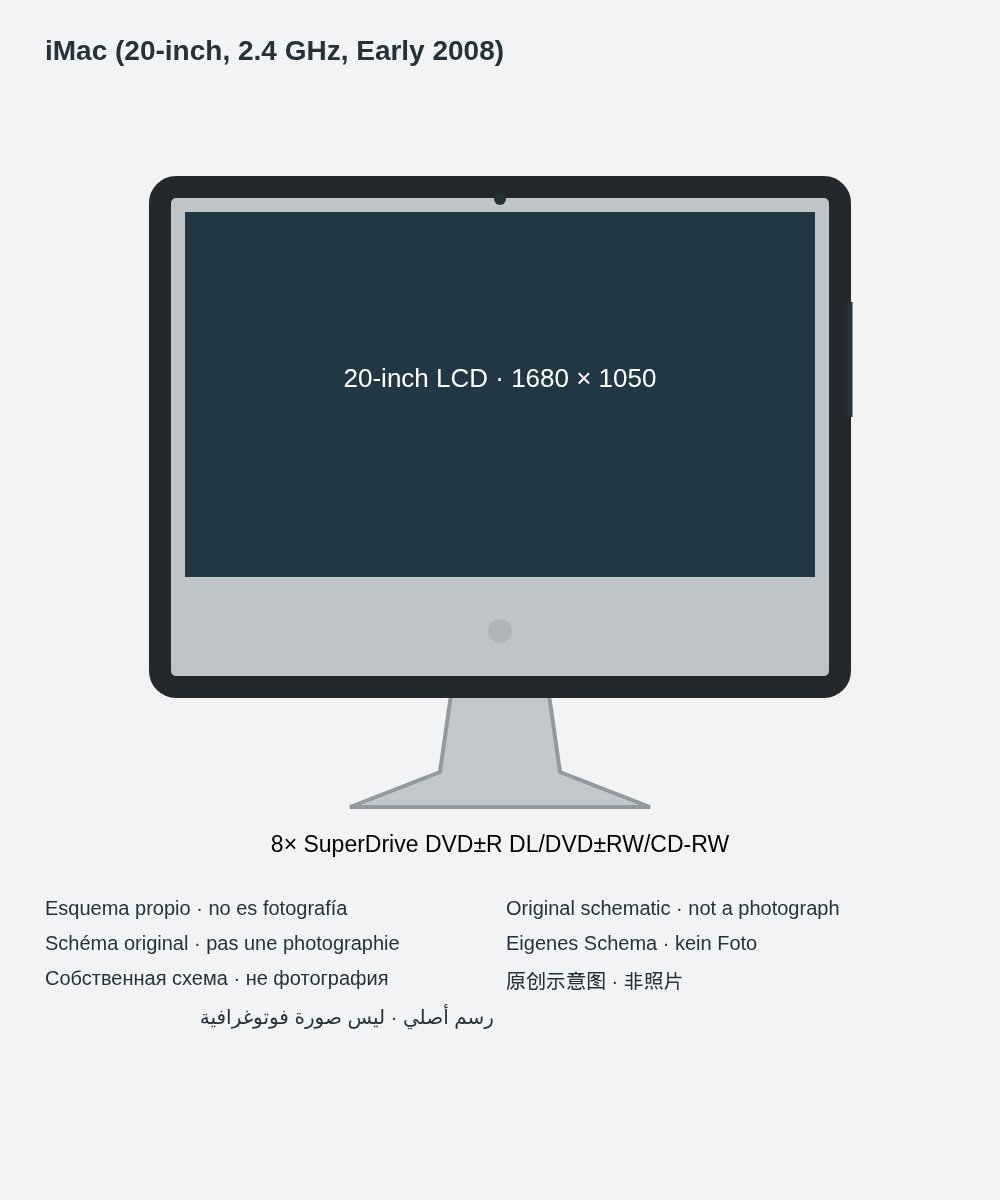
| Display | 20″ LCD · 1680 × 1050 |
| Standard and maximum RAM | 1 GB · DDR2 800 MHz · 4 GB |
| Disk | 250 GB Serial ATA · 7200 rpm |
| Graphics | ATI Radeon HD 2400 XT · 128 MB GDDR3 |
| Optical drive | 8× SuperDrive DVD±R DL/DVD±RW/CD-RW |
| Ports | FireWire 400 + 800 · 5 USB 2.0 (3 + 2 Keyboard) |
| Wired network | Gigabit Ethernet 10/100/1000 |
| Wireless | AirPort Extreme 802.11n · Bluetooth 2.1+EDR |
| System and apps | Mac OS X 10.5 Leopard · iLife ’08 |
| Announced price | 1199 USD |
History and documentation
Apple announced this 20-inch iMac on April 28, 2008 at 1199 USD in the United States. The announcement stated immediate availability. Its design combines aluminum and glass with a glossy display. It is one of three Core 2 Duo configurations; the simultaneous versions are not successors to each other.
Design and specifications
The standard configuration has a 2.4 GHz dual-core Intel Core 2 Duo, 1 GB of 800 MHz DDR2 SDRAM and a 250 GB Serial ATA disk at 7200 rpm. Graphics are ATI Radeon HD 2400 XT · 128 MB GDDR3 and the optical drive is 8× SuperDrive DVD±R DL/DVD±RW/CD-RW. Official RAM expansion reaches 4 GB; an order option is not presented as standard equipment.
Use and context
Includes iSight, AirPort Extreme 802.11n, 10/100/1000 Gigabit Ethernet, mini-DVI, stereo speakers and microphone. Mini-DVI adapters for DVI, VGA and composite/S-Video are sold separately. There are five USB 2.0 ports: three on the computer and two on the aluminum Apple Keyboard. One FireWire 400 and one FireWire 800. Bluetooth 2.1+EDR and Apple Remote are standard.
Notes and image
Includes Mac OS X 10.5 Leopard and iLife ’08 with iPhoto, iMovie, iDVD, GarageBand and iWeb. Leopard includes Time Machine, Quick Look and Spaces; Time Machine requires another disk, sold separately. Mighty Mouse and Apple Keyboard are included. A disk up to 500 GB is optional, not the 250 GB standard.
The 2.4 GHz configuration: memory, display and audio
This version starts with one 1 GB SO-DIMM at 800 MHz, not the two 1 GB modules of the 2.66 GHz version. Apple documents two slots and an official total maximum of 4 GB, with 6 MB of shared L2 cache at processor speed and a 1066 MHz frontside bus. This column offers optional disks of 320 or 500 GB; the 750 GB and 1 TB options in other columns do not carry over to this factory configuration. Apple · iMac 20 Early 2008 · Memory and storage
For the 20-inch screen Apple lists native 1680 × 1050, typical brightness of 290 cd/m², typical contrast of 800:1 and typical viewing angles of 160° horizontally and vertically. The 24-inch panel has different figures, not a uniform increase in every value: 385 cd/m², 750:1 and 178° on both axes. These are historical specifications, not measurements of a current example. Mini-DVI also supports an extended desktop up to 1920 × 1200 digital or 2048 × 1536 analog, or mirroring, through adapters sold separately. Apple · iMac 20 Early 2008 · Display and video
The two FireWire ports differ: one is FireWire 400 and one FireWire 800; Apple assigns 7 W to each port. This describes power delivery, not speed or an accessory's continuous consumption. Audio also distinguishes two combined connections: headphone/optical digital output and line-in/optical digital input, both minijacks. Optical input must not be omitted or mistaken for a second output. The stereo speakers are paired with an internal 24 W digital amplifier, not 24 W per speaker. Apple · iMac 20 Early 2008 · Connections and audio
Sources
- Apple · 2008-04-28
- Apple · 2008
- dimensionapple.com · Original schematic illustration
- imac20-mid-2007
- imac20-mid-2007 ⇄ iMac (20-inch, 2.4 GHz, Early 2008)
More products
Historical catalogue links
Relationships already recorded in the catalogue, not a complete succession chain. Same-year variants are shown as related. A missing link does not prove that an earlier or later model does not exist.