
iMac (2012)
27-inch, 3.2 GHz, Core i5, Late
Apple announced this 27-inch iMac on October 23, 2012 at 1999 USD in the United States. In November Apple announced orders for November 30 and shipping to begin in December. The aluminum and glass design has an IPS display with LED backlighting and a 16:9 aspect ratio. This entry describes one specific configuration, not all simultaneous versions.

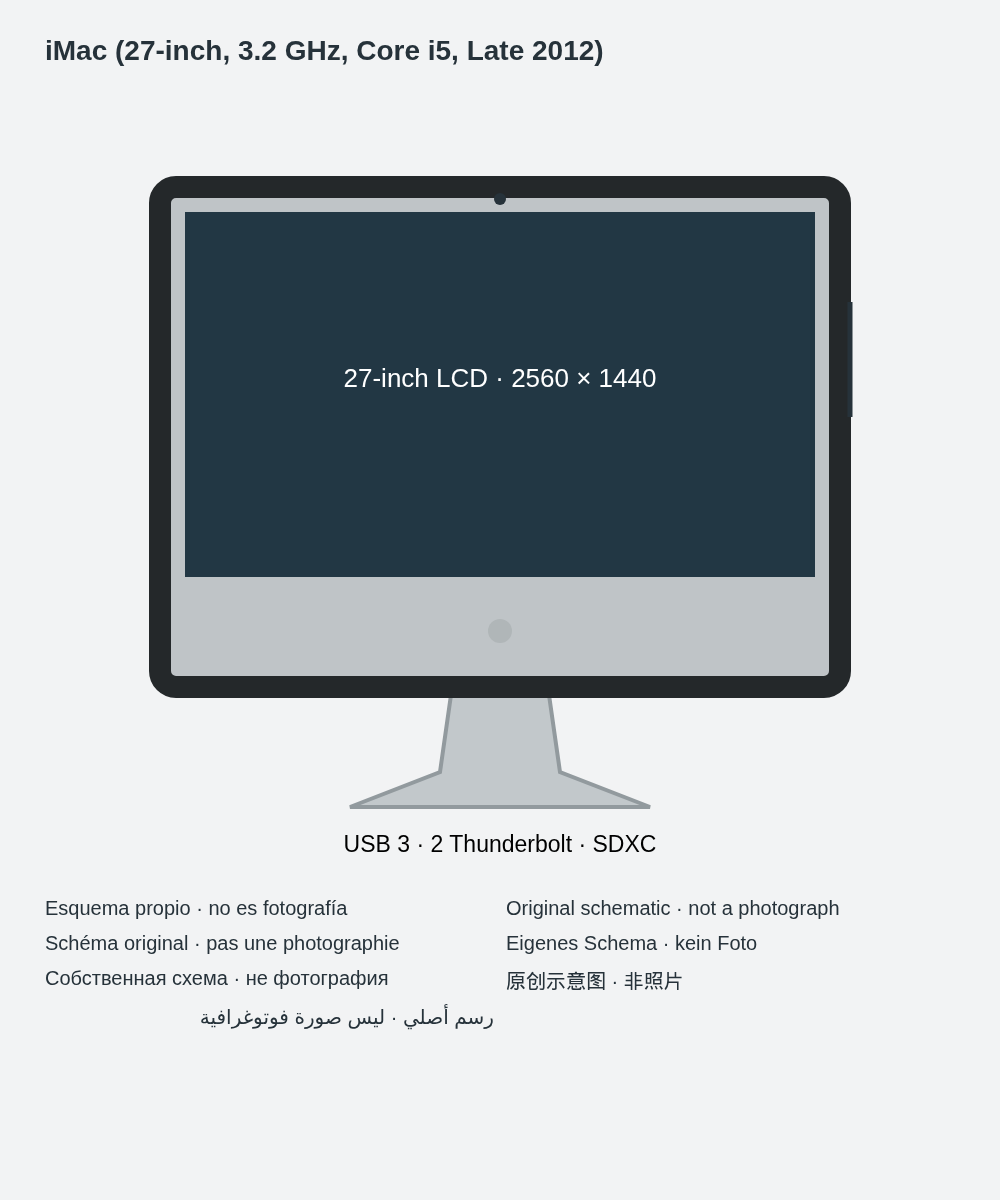
Specs
| Announcement | 2012-10-23 |
|---|---|
| CPU | Intel Core i5 (4-core) · 3.2 GHz |
| Display | 27″ IPS LED · 2560 × 1440 |
| Standard and maximum RAM | 8 GB · DDR3 1600 MHz · 32 GB |
| Disk | 1 TB HDD · 7200 rpm |
| Graphics | NVIDIA GeForce GTX 675MX · 1 GB GDDR5 |
| Optical drive | External USB SuperDrive optional |
| Ports | 2 Thunderbolt · 4 USB 3 · SDXC |
| Wired network | Gigabit Ethernet 10/100/1000 |
| Wireless | 802.11n Wi-Fi · Bluetooth 4.0 |
| System and apps | OS X Mountain Lion · iLife |
| Announced price | 1999 USD |
History and documentation
Apple announced this 27-inch iMac on October 23, 2012 at 1999 USD in the United States. In November Apple announced orders for November 30 and shipping to begin in December. The aluminum and glass design has an IPS display with LED backlighting and a 16:9 aspect ratio. This entry describes one specific configuration, not all simultaneous versions.
Design and specifications
This standard configuration has a 3.2 GHz Intel Core i5 (4-core), 8 GB of 1600 MHz DDR3 and a 1000 GB hard drive at 7200 rpm. Graphics are NVIDIA GeForce GTX 675MX · 1 GB GDDR5. Apple lists a maximum memory capacity of 32 GB; this is not installed RAM. The standard disk in this entry is not a Fusion Drive.
Use and context
Includes FaceTime HD, 802.11n Wi-Fi, Bluetooth 4.0, Gigabit Ethernet, stereo speakers and dual microphones. It has four USB 3 ports, two Thunderbolt ports and an SDXC slot. Mini DisplayPort provides video output through separately sold adapters. The box includes Apple Wireless Keyboard and Magic Mouse; Magic Trackpad is listed as an option.
Notes and image
Includes OS X Mountain Lion and iLife with iPhoto, iMovie and GarageBand. The announcement lists Messages, Notification Center and Gatekeeper among system features. The announced 5 mm edge is not the thickness of the entire computer. Prices are US launch prices, not current or Spanish prices.
3.2 GHz: order options, video and dimensions
The 3.2 GHz quad-core Core i5 has Turbo Boost up to 3.6 GHz and 6 MB L3 cache. The GTX 675MX with 1 GB GDDR5 is standard. The 3.4 GHz quad-core i7, with Turbo up to 3.9 GHz and 8 MB L3, and the GTX 680MX with 2 GB GDDR5 are order options, not standard components. The 8 GB of 1600 MHz DDR3 consists of two 4 GB modules in four user-accessible SO-DIMM slots. Order options were 16 GB as two 8 GB modules, or 32 GB as four 8 GB modules. Apple · iMac 27 Late 2012 · Processor and memory
The standard drive is a 1 TB 7200-rpm hard drive. Order alternatives are a 3 TB hard drive, 1 TB or 3 TB Fusion Drive, or 768 GB of flash storage, not added capacities. The internal 2560 × 1440 display can run simultaneously with one external display up to 2560 × 1600. Apple documents extended desktop and mirroring. The two Thunderbolt ports provide Mini DisplayPort output; DVI, VGA and dual-link DVI require separately sold adapters. Apple · iMac 27 Late 2012 · Storage and video
Height is 51.6 cm and width 65.0 cm; 20.3 cm is the stand depth, not screen thickness. The 9.54 kg weight varies with configuration and manufacturing. In the 3.2 GHz acoustic column, Apple declares 14 dB sound pressure at idle and 15 dB during hard-drive access, measured at the operator position. These are not the sound-power figures in bels, or a guarantee for the i7, GTX 680MX, every workload or used computer. Apple · iMac 27 Late 2012 · Size and acoustics
Sources
- Apple · 2012-10-23
- Apple · 2012
- Apple · 2012-11-27
- dimensionapple.com · Original schematic illustration
- iMac (27-inch, 3.1 GHz, Core i5, Mid 2011)
- iMac (27-inch, 3.1 GHz, Core i5, Mid 2011) ⇄ iMac (27-inch, 3.2 GHz, Core i5, Late 2012)
More products
Historical catalogue links
Relationships already recorded in the catalogue, not a complete succession chain. Same-year variants are shown as related. A missing link does not prove that an earlier or later model does not exist.