
Apple Cinema HD Display 23" (2002)
High definition on the desk, in 2002: 1920×1200 pixels to cut HDTV in Final Cut Pro without scaling.
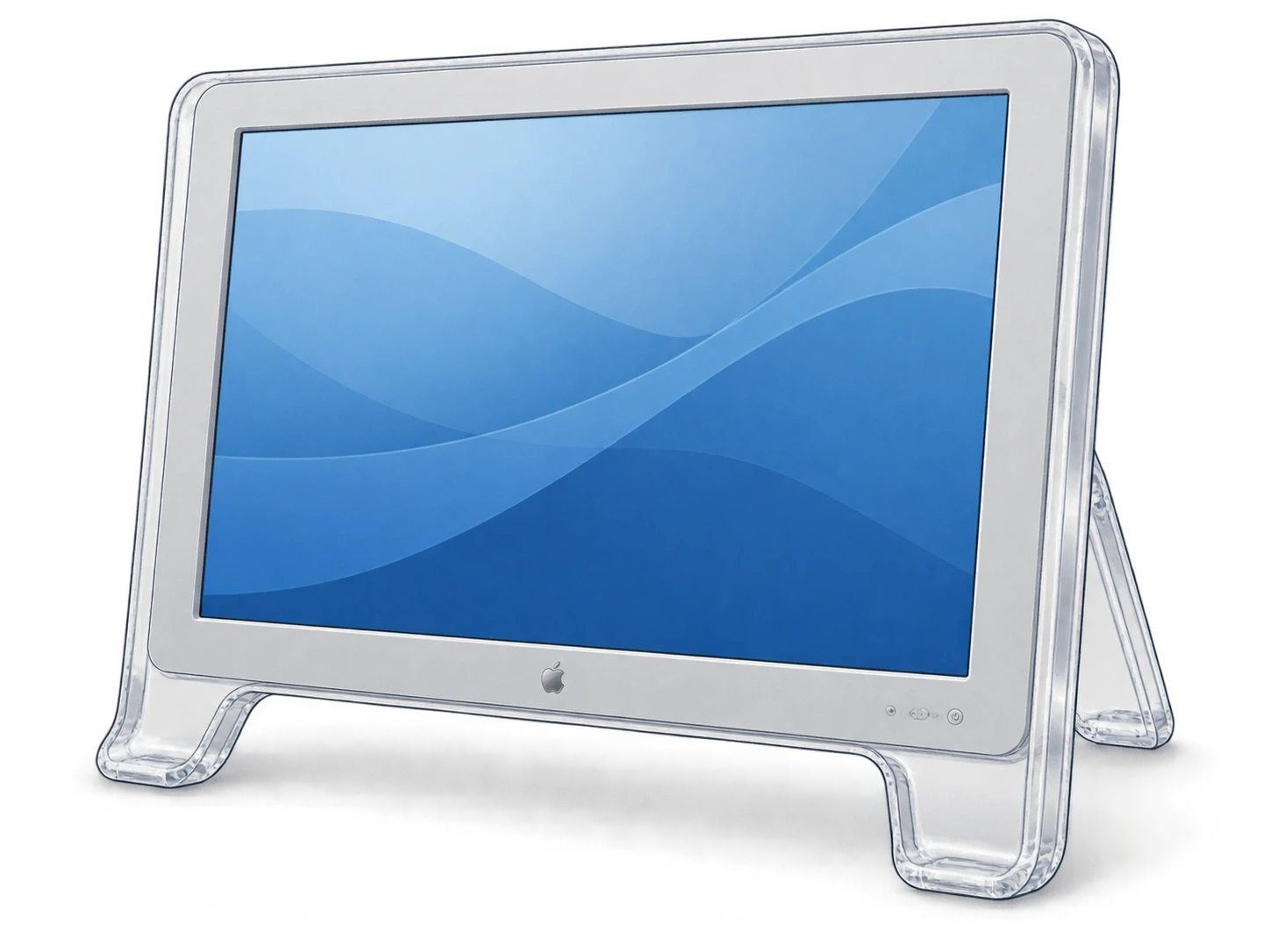
Model reconstruction, not a photograph.
Specs
| Panel | 23" LCD, 1920×1200, 16:10, 200 cd/m² |
|---|---|
| Connectivity | Apple Display Connector, two-port USB hub |
| Key feature | native HDTV resolution with room to spare, per Apple's release |
Launch
Apple introduced it at Macworld Expo Tokyo on March 21, 2002 (release dated March 20), per its official press release: the first Cinema HD Display, 23 inches with 1920×1200 pixels, enough to view HDTV content with room to spare and for Final Cut Pro users to author in native resolution. Jobs called it "simply the best computer display on the planet". It cost $3,499, shipped in April and required a Power Mac G4 with an ADC connector.
Marketing
The release highlighted the all-digital panel, distortion-free edge to edge, with 16.7 million colors, a 160-degree viewing angle, less than two inches thick and automatic ColorSync integration for demanding color work. On January 28, 2003 Apple cut its price from $3,499 to $1,999 and described it as "widely regarded as the finest quality flat panel display in the industry", per that day's release.
Flaws and fixes
The ADC connector was again its toll: it only worked with Macs equipped with it or with the DVI adapter Apple introduced a month later. In June 2004 it passed the baton to the aluminium generation, which kept its 1920×1200 resolution in the new 23" Cinema HD Display, per Wikipedia and Apple's June 28 release.
ADC is more than digital video
The Apple Display Connector carries digital video, USB data and power in one cable. To connect this Cinema HD Display to the DVI-equipped PowerBook G4, Apple announced an adapter with active components and an integrated power supply on April 29, 2002. It included an AC power cord and a two-metre cable with USB and DVI; the display connected to the adapter’s ADC port. It did more than change the shape of the plug. Apple · 2002-04-29 · Apple · Cinema HD
Before treating a preserved setup as complete, check the adapter and its power supply as well as the computer and display. The announcement explicitly names the 23-inch Cinema HD and the new PowerBook G4; it does not promise compatibility with every DVI output.
Buttons and diagnostic limits
The service manual for the 23-inch Cinema HD with ADC distinguishes two front controls: the power button and the Launch Button, which opens Apple Display preferences. The rear diagram identifies the USB ports and ADC connector. This documents the ADC version, not the later aluminum model with DVI. Apple · Service Source · ADC 23-inch · 2006 · Apple · DVI · 2004
In its symptom charts, Apple links two short flashes followed by a long flash, repeating after a pause, to trouble with the inverter, backlight bulbs, or their cables and connectors. The pattern alone does not identify a failed part; for a partially dim screen, the manual warns that it may not appear. It also warns of high voltage at the inverter when connected. This historical description is not a guide to opening or repairing the display. Apple · Service Source · ADC 23-inch · 2006
ADC POWER AND SOURCE-SPECIFIC FIGURES
The Apple Store technical page for this 23-inch ADC Cinema HD specifies a maximum of 70 W in operation and 3 W or less when the system is in energy-saving mode. These are documented limits for different states, not constant consumption or a present-day measurement of a preserved monitor. Apple Store · Cinema HD ADC
The same page specifies an input of 24.5 to 28 V DC. ADC combines power, digital video and USB in the cable to the Mac; that range is not a mains voltage to apply directly to the display. Identifying the ADC version remains essential to avoid transferring the power requirements of the later aluminum Cinema HD. Apple Store · Cinema HD ADC
The published viewing angle also depends on the document: the March 2002 announcement gives 160 degrees, while the Apple Store technical page states 170 degrees both horizontally and vertically. Both attributions are retained here; the documentary difference does not establish the date of a physical revision or justify silently replacing the announcement figure. Apple Store · Cinema HD ADC Apple · 2002-03