
Apple Wireless Mouse (2003)
Apple introduced Apple Wireless Mouse on September 16, 2003, at Apple Expo in Paris alongside Wireless Keyboard. It announced a US price of $69 and expected availability in two weeks, not verified immediate sales that day.
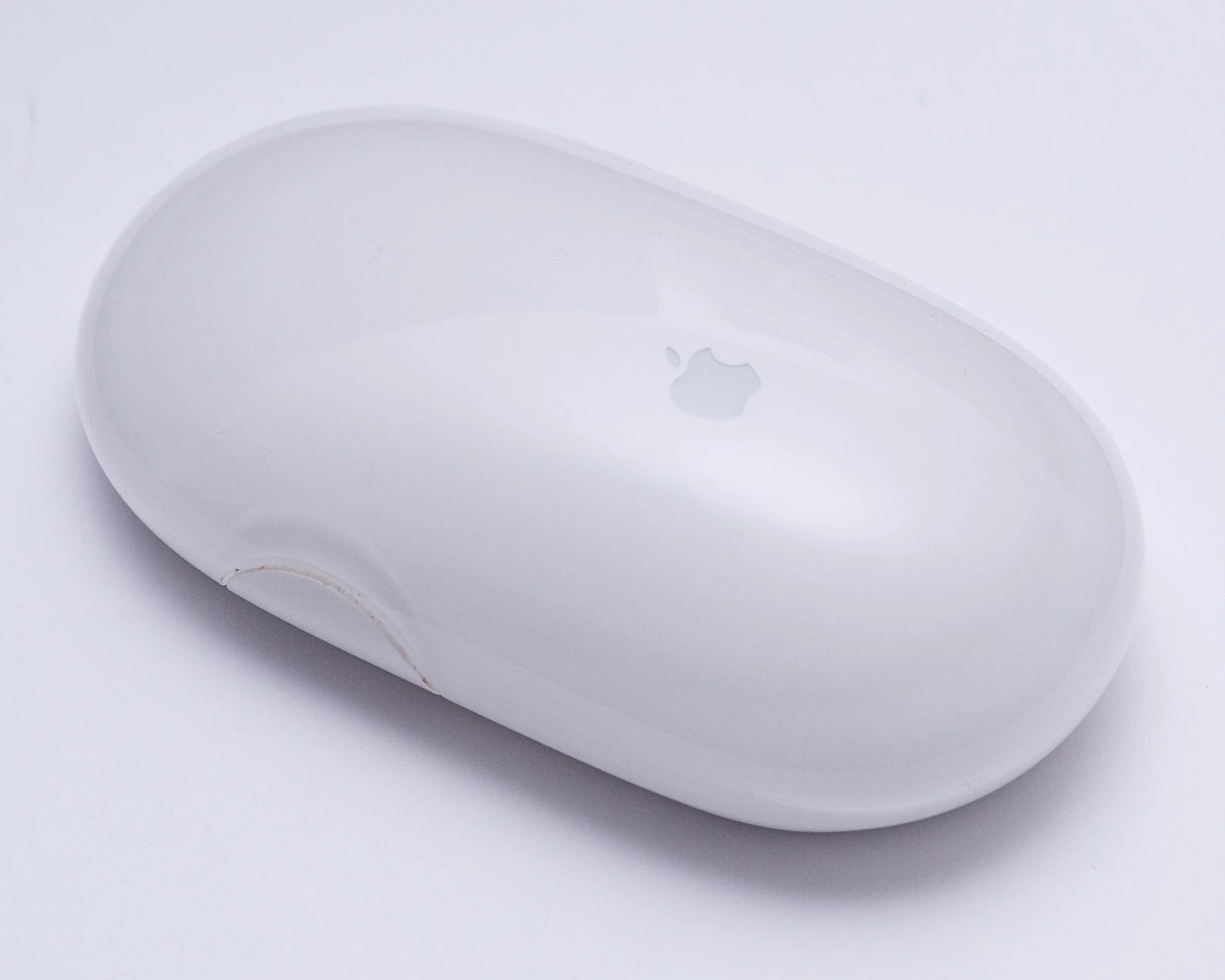
Specs
| Connectivity | Bluetooth; Adaptive Frequency Hopping |
|---|---|
| Power | 2 × AA; up to 3 months, Apple claim |
| Range | Up to 30 ft; Apple maximum claim |
| Requirements | Mac OS X 10.2.6+; Bluetooth |
| Price | 69 USD; US announcement |
| Availability | 2003-09-16; announced; expected in two weeks |
Launch
Apple introduced Apple Wireless Mouse on September 16, 2003, at Apple Expo in Paris alongside Wireless Keyboard. It announced a US price of $69 and expected availability in two weeks, not verified immediate sales that day.
Design and connection
The optical Bluetooth mouse had an ambidextrous design and used Adaptive Frequency Hopping to avoid frequencies occupied by other wireless devices. Apple advertised a range of up to 30 feet, about nine metres, a maximum rather than a guarantee in every setting.
Requirements and photograph
It included two AA batteries, with Apple claiming up to three months of use depending on usage. It required Mac OS X 10.2.6 or later and a Mac with built-in Bluetooth or the D-Link USB Bluetooth adapter. The original photograph shows the mouse, not the complete retail package.
Individual price, mechanism and limits of the tests
The US$69 announced by Apple on 16 September 2003 was for each accessory, not a keyboard-and-mouse set. Availability was expected two weeks later: the announcement date does not establish sales that same day. Nor is it a Spanish price or current valuation. The mouse’s battery claim was up to three months depending on use; the nine months in the same release applied to the keyboard. Apple · 16 September 2003 · US$69 each
Apple’s original guide, preserved in an FCC documentation repository, explains on pages 7 and 8 the front click and the side grip for lifting the mouse while keeping it clicked. These sides are not extra buttons. A tension selector inside the battery compartment changes the mechanical click resistance, not pointer speed or radio power. The Pro Mouse connection allows comparison of that interaction without confusing USB and Bluetooth connections. Apple · Wireless Mouse User’s Guide · pp. 7–8 Apple Pro Mouse (2000)
The manual qualifies the almost-any-surface claim: avoid clear, glossy or intricately patterned surfaces and halftone images; opaque, nonreflective surfaces without repetitive patterns work best. Pages 4 and 9 document two included lithium AA batteries and also allow alkaline or rechargeable cells; replace both together and do not mix types. These are period instructions, not certification of a surviving unit’s condition. Apple · Wireless Mouse User’s Guide · pp. 4, 7, 9
Short tests did not measure maximum battery life. William Porter, in MacTech volume 19, number 11 of 2003, described a week of almost constant use with the indicator virtually at one hundred percent. Yutaka Kobayashi, in ITmedia on 10 October 2003, tested six days with Daiso alkaline batteries and saw the bar around halfway, warning that he did not know whether its scale was linear. This cannot establish two-week battery life or make the two tests directly comparable as if their batteries and conditions were identical. William Porter · MacTech · 19/11 · 2003 Yutaka Kobayashi · ITmedia · 10 October 2003 · battery test
Range also needs context. Against Apple’s advertised maximum of 30 feet, about 9.1 metres, Kobayashi tested an iBook 800 with a DBT-120 adapter in a corridor: drawing in Photoshop became uneven around 6.5 metres, and the pointer stopped moving at 8 metres. That is a result for that setting and setup, not a new universal specification. The longer distances later in the article belong to the keyboard, not the mouse. Apple · advertised range · 16 September 2003 Yutaka Kobayashi · ITmedia · 10 October 2003 · corridor test
The wireless Mighty Mouse announced on 25 July 2006 also cost US$69, but added up to four programmable controls, a scroll ball, Bluetooth 2.0 and laser tracking. It could use one or two AA batteries. Those details must not be transferred to the 2003 optical Apple Wireless Mouse, whose manual calls for two. Comparing the entries distinguishes generations and interaction, not interchangeable variants of one model. Apple · 25 July 2006 · different wireless model Mighty Mouse Wireless (2006)