
Apple Wireless Keyboard (2007)
The desktop keyboard went pocketable: ultra-thin aluminium, three batteries and a MacBook layout, without a numeric keypad.
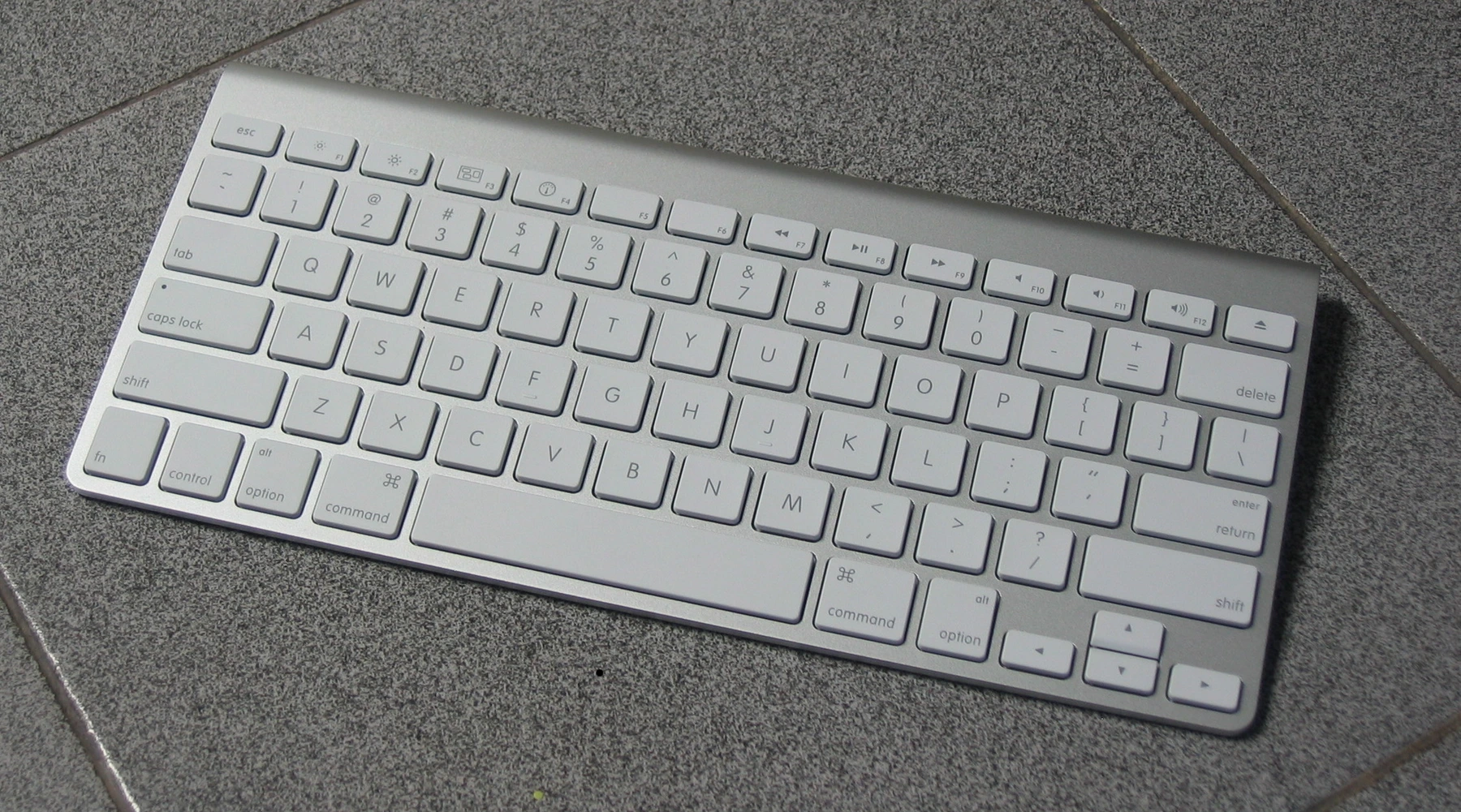
© Roadmr · CC BY-SA 4.0 ↗ Resized, no crop or retouching.
Specs
| Connectivity | Bluetooth |
|---|---|
| Power | 3 AA batteries |
| Key feature | first aluminium version of the Wireless Keyboard (A1255), per Wikipedia |
Launch
Apple announced it on August 7, 2007 alongside the new aluminium iMac, per its official press release: a compact option for anyone wanting a cable-free desktop, shipping by the end of August. The release set three US prices: $79 standalone, $30 as a build-to-order option with the iMac, and $50 together with the wireless Mighty Mouse. Per Wikipedia, it was the second generation of the Wireless Keyboard, model A1255.
Marketing
It shared the design language of the wired Apple Keyboard introduced the same day: an aluminium enclosure with the same slim profile and new functions on the function keys, such as media controls and Dashboard, per the press release and Wikipedia. Wikipedia adds that its layout resembled the MacBook's, with no numeric keypad, the power button on the right-hand side and protection against accidental Caps Lock activation.
Flaws and fixes
Compactness came at a price: it lost the numeric keypad and the USB ports of the wired model, per Wikipedia. It ran on three AA batteries, one fewer than its 2003 predecessor. In October 2009 the A1314 revision arrived, cutting power needs to two batteries, per Wikipedia.
Price, controls and the limits of miniaturisation
The amounts in the 7 August 2007 announcement are not three equivalent prices: Apple set US$79 for the standalone keyboard, versus new-iMac configuration surcharges of US$30 for the keyboard or US$50 with the wireless Mighty Mouse. Keyboard shipping was expected by late August, not established as immediate. In his original Applesfera review of 24 September, Miguel Michán quoted €79: contemporary testimony to that euro price, not a dollar conversion or a current valuation. Apple · 7 August 2007 · US prices and shipping forecast Miguel Michán · Applesfera · 24 September 2007 · €79
Apple’s original page preserved in an August 2007 capture explicitly describes the wireless model’s low-profile anodised-aluminium frame. This avoids assigning it the 0.33-inch front-edge measurement that the iMac release gave the wired keyboard. The same page separates the wired model’s two USB 2.0 ports and extended layout from the compact Bluetooth design. The related 2007 Apple Keyboard entry allows those decisions to be compared without treating them as one product. Apple · original Keyboard page · August 2007 archive Apple Keyboard (2007)
The original Apple manual bound to A1255 in filing BCGA1255, document 826166, shows on pages 3 and 4 the coin-opened side cap, three batteries in the rear tube and the power button at the opposite end. Page 7 specifies three included alkaline AA cells and allows lithium or rechargeable batteries, replacing them together without mixing types or old and new cells. These are not the four AA cells of the 2003 Apple Wireless Keyboard, nor a maximum-life test or evidence of a surviving unit’s condition. FCCID.io · Apple document 826166 · A1255 Apple · Wireless Keyboard · pp. 3–4, 7 Apple Wireless Keyboard (2003)
In his 8 October 2007 Ars Technica review, Charles Jade stressed that the physical numeric keypad was not the only omission: there was no Num Lock key to enable a virtual keypad either. He contrasted that loss with dedicated playback, volume and brightness controls. The diagram on page 5 of the manual documents the control row; it does not itself prove that every control works with every current system. Jade’s typing preferences are his own, not an ergonomic consensus. Charles Jade · Ars Technica · 8 October 2007 Apple · Wireless Keyboard · p. 5 · control diagram
Jade’s comparison with an Adesso SlimTouch separates observations from measurements: he liked the key response and absence of perceptible first-key lag after inactivity, but noted the lack of a touchpad for his living-room computer use. He said battery life was still unknown. This is not an instrumented latency test, a universal range measurement or confirmation of months of battery life. Michán liked the feel after a few days, also too short to establish maximum life. Charles Jade · Ars Technica · observations and limits Miguel Michán · Applesfera · short-term test
For external care, page 6 of the period manual says to remove batteries, use a slightly damp soft lint-free cloth and avoid moisture in openings, sprays, solvents or abrasives; page 7 recommends removing batteries for extended non-use. This is historical Apple guidance, not permission to dismantle the keyboard, recover corrosion or guarantee a repair. A reviewer’s individual cleaning experience is not turned into an official recommendation. Apple · Wireless Keyboard · pp. 6–7 · care and batteries