
Apple USB Mouse (1998)
The original iMac's round mouse: one button, a mechanical ball and a translucent Bondi blue shell, nicknamed the "hockey puck", as remembered for its shape as for the criticism it drew.
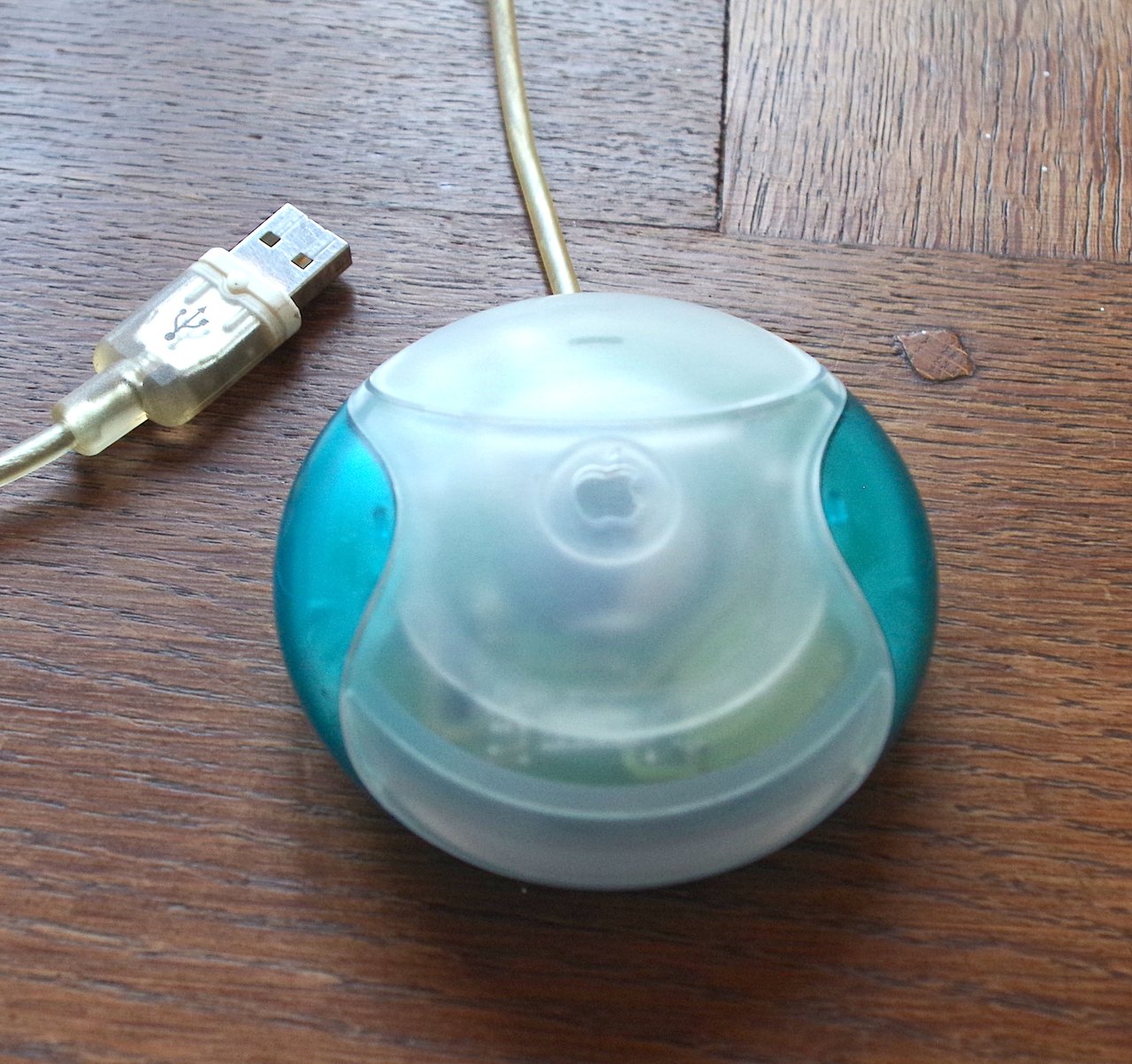
© Factory · CC BY-SA 4.0 ↗ Resized, no crop or retouching.
Specs
| Connectivity | USB · mechanical ball · one button |
|---|---|
| Price | bundled with the iMac ($1,299) |
| Key feature | Apple's first USB mouse |
Launch
Apple announced it on May 6, 1998 at the Flint Center on the De Anza College campus in Cupertino, as part of the iMac introduction: the official press release, preserved in a MacTech reproduction, listed the Apple USB Keyboard and Apple USB Mouse in the box. That day Jobs called the iMac "the Internet-age computer for the rest of us" and pitched it as next year's computer for $1,299, not last year's for $999. The mouse arrived with the iMac in August 1998: round, translucent and Bondi blue to match the computer, with a single button and a USB connector, Apple's first mouse with that port instead of the longstanding ADB. Excerpts of the event survive in an archival copy on the Internet Archive.
Marketing
No campaign of its own is documented: it was advertised inside the iMac campaign, Apple's largest up to that point according to 9to5Mac, with an estimated spend of around $100 million in 1998. The TV and print ads came from agency TBWA Chiat/Day with Jeff Goldblum as spokesman, as Adweek's October 1998 critique describes, and the internally produced "Simplicity Shootout" film premiered at Macworld Expo New York in July 1998, introduced on stage by Jobs himself: a seven-year-old boy got an iMac up and running and online long before an MBA student managed the same with a Windows 95 PC. In those pieces the mouse appeared as part of the matching set. Archival copies of those ads survive on social media; one of them, "Three steps", is on YouTube in an unofficial upload by the Apple Archive channel.
Flaws and fixes
The perfectly round shape made it hard to orient without looking, and its size felt small for many hands; the cable, designed to plug into the keyboard, ran short for other uses. Apple later added a dimple on the button so users could feel which way it pointed. A small remedies market appeared: shells like the iCatch that gave it an oblong body, and adapters like Griffin's iMate that let people keep using the older ADB mouse. In 2008 Wired magazine listed it among "Apple's most notorious flops". With the colored iMacs of 1999 it came in matching fruit tones, and in July 2000 Apple replaced it with the Apple Pro Mouse, optical and oblong, unveiled at Macworld Expo New York, where keynote attendees got one free, and standard on the new desktop computers.
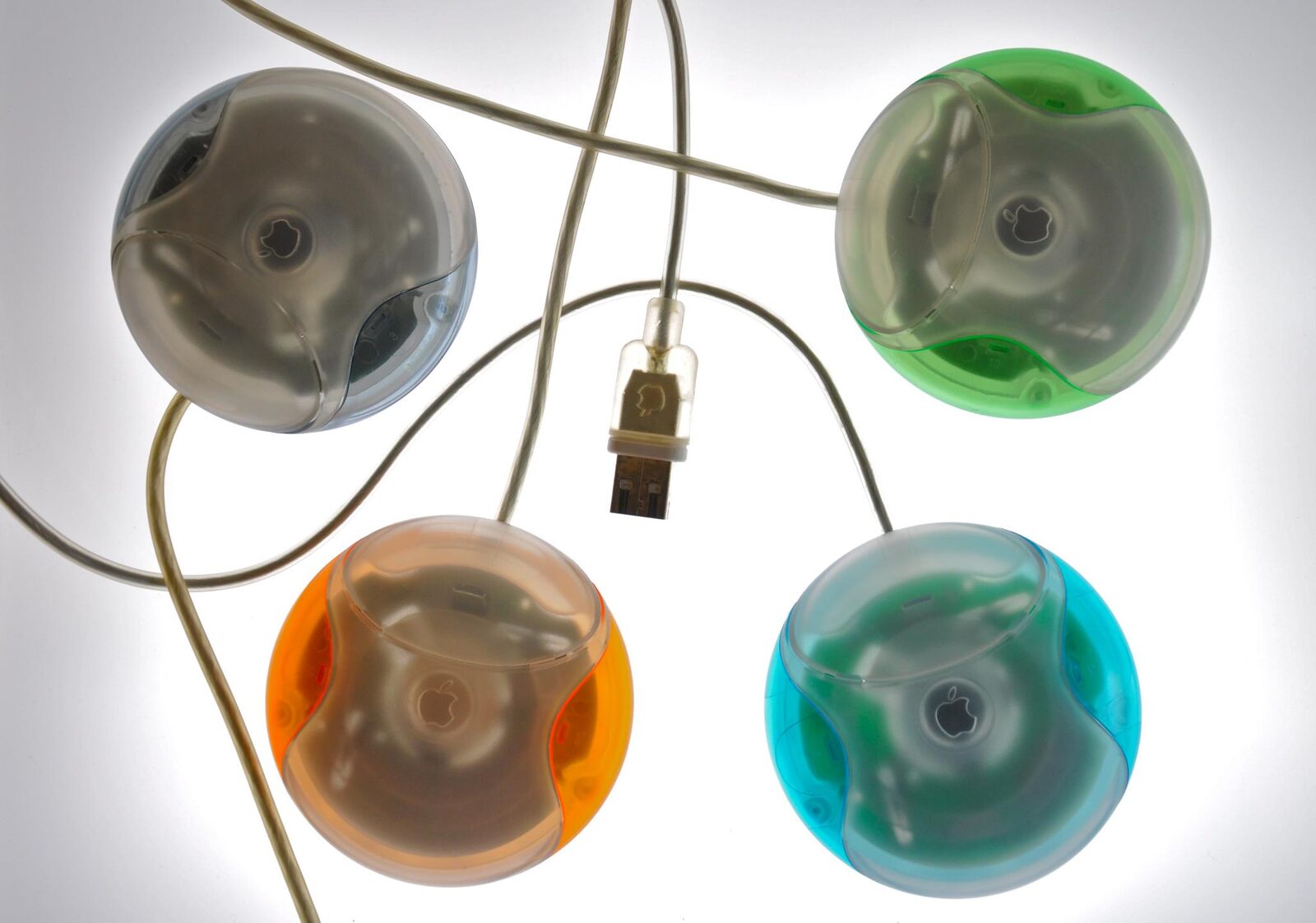
Documented price, mechanism and comparison across generations
Apple’s original May 6, 1998 release, preserved by MacTech, includes the USB keyboard and mouse in the iMac’s $1,299 price; it does not establish a separate mouse price here or a Spanish price list. Campaign and spending also need separating: on August 14, the Los Angeles Times reported Apple’s announcement of more than $100 million for the iMac through the end of 1998. This is the computer’s announced campaign budget, not verified completed spending or a campaign exclusively for this accessory. Apple · 6 May 1998 · MacTech archive Los Angeles Times · 14 August 1998
The 1998 iMac Developer Note, pages 33 and 34, describes the round, two-tone case and explicitly says it has no internal light source: transparency does not mean the mouse glows. It compares the mechanism with the Apple Desktop Bus Mouse II and documents a ball removable for cleaning. Mechanical similarity does not establish interchangeable parts or turn USB into ADB. This documentation explains the product’s principle, not the condition of the ball, rollers or cable in the photographed unit. Apple · iMac Developer Note (1998) · pp. 33–34
Museums Victoria records model M4848, a height of 30 mm, diameter of 75 mm and USB cable length of 600 mm for its Bondi blue unit HT 13351.3. These describe that museum object, not new measurements of this page’s photographs. The Computer History Museum catalogues another M4848 as X1654.99 with dimensions of 7.62 × 2.86 × 7.62 cm, explicitly excluding the cable. Both records are kept separate, without averaging measurements or inferring shared provenance, manufacture or condition. Museums Victoria · HT 13351.3 Computer History Museum · X1654.99
The mouse belonged to a connection system: page 33 of Apple’s note describes the keyboard as a bus-powered two-port USB hub and warns that it cannot power another bus-powered hub. The second hub must connect to the computer’s other port. The Apple USB Keyboard page explains where the mouse connected and why an available port does not mean unlimited power. That relationship does not guarantee compatibility with current accessories or turn the hub into an independent power supply. Apple · iMac Developer Note (1998) · p. 33 Apple USB Keyboard (1998)
The Apple Pro Mouse comparison has a different date and price: Apple’s July 19, 2000 release presents the optical, ball-free successor with an elliptical shape and adjustable clicking tension. It bundles it with the new iMac, Power Mac G4 Cube and Power Mac G4 and announces separate US sales for $59 beginning in September. This was availability announced at that time and a price for the 2000 Pro Mouse, not the round 1998 mouse or a current valuation. The technical change alone does not establish a specific reason for its replacement. Apple · Pro Mouse · 19 July 2000 Apple Pro Mouse (2000)