
Apple Standard Keyboard (1987)
The "standard" keyboard that didn't come as standard: the basic companion to the Macintosh II and SE, with Alps switches and two ADB ports.
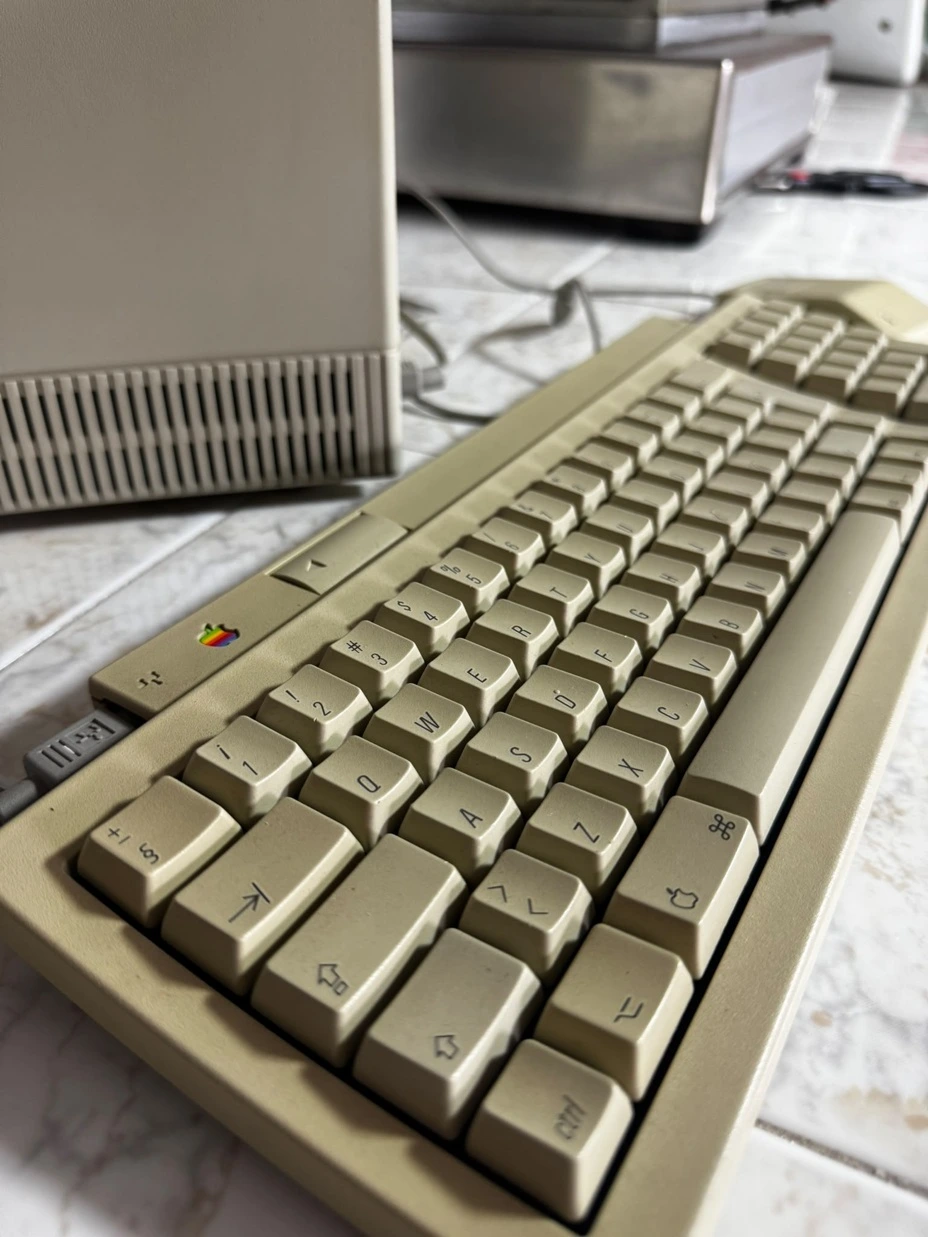

Apple Standard Keyboard family with Spanish ISO layout. The model label is not visible; this unit is not identified as the page’s ANSI M0116. Unit identifiers are blurred where visible.
Specs
| Connectivity | Apple Desktop Bus, two bidirectional ports, detachable cable |
|---|---|
| Switches | Alps SKCM tactile |
| Key feature | first keyboard sold separately from the Mac, per Wikipedia |
Launch
When Apple introduced the Macintosh II and Macintosh SE in 1987, neither came with a keyboard: buyers chose between this basic model (M0116) or the more complete Extended Keyboard, which cost $100 more according to Apple, a figure recorded by Wikipedia. It was the first keyboard Apple sold separately from the computer, inaugurating that choice between basic and advanced keyboards, per the same source. It was manufactured between 1987 and 1990, per Deskthority.
Documented channel price, format and service
The Apple Education & Government list of 2 March 1987, printed page 9, records Apple Keyboard M0116 at US$129 education list and $90.30 in its five institutional purchasing steps. Each step requires a minimum net order value, starting at $1,000 for the first. Extended M0115 appears on the same page at $229 and $160.30. This comparison has a specific US date, currency and channel: it does not establish a universal retail price or a unit’s current value. Notes 3 and 4 required choosing one of the two separately sold keyboards with each Macintosh SE or II in that list. Apple · Education & Government · 1987-03-02 · p. 9
Apple’s March 1987 M2228 data sheet presents M0116 for business and higher education and documents 81 keys, a numeric pad and four cursor keys. It states 418 mm width, 142 mm depth, 44.5 mm height and 1 kg, and includes keyboard and cable in the order. These are specifications of the documented product, not a measurement or identification of the Spanish ISO unit photographed on this page: its label is not visible and that limitation remains. Apple · M2228 · March 1987
Apple’s May 1987 revised parts list, Figure 9 and page IPL.17, distinguishes service reference 661-0383 from retail order M0116. It lists top case 815-1016, bottom case 815-1017, cable 590-0361 and Alps locking keyswitch 970-1263; the figure locates the latter at Caps Lock. This describes the assembly and its parts in that document, not proof that every regional variant uses the same case or that these parts remain available. Apple · Technical Procedures · 1987 · IPL.17 / 2.39
The March 1987 service section distinguished sending the entire unit without cable for exchange from removing the mechanism only to replace a keyswitch: historical support did not always mean replacing the whole keyboard. For a format comparison, Apple’s original July 1987 M2229 sheet documents 105 keys and 15 function keys on Extended M0115, against M2228’s 81. This explains what the Extended tier bought without treating the compact keyboard, the ISO photograph and the Extended as one configuration. Apple · Technical Procedures · 1987 · IPL.17 / 2.39 Apple · M2229 · July 1987 Apple Extended Keyboard (1987)
Marketing
It was a more solid version of the Apple Desktop Bus Keyboard, with a much thicker frame and more weight, a design Wikipedia describes as the visual embodiment of the new Macs' power. Its two bidirectional ADB ports allowed the detachable cable to plug into one side and the mouse into the other, equally comfortable for right- and left-handed users, per Deskthority. The keys combined Alps SKCM tactile switches with a physically locking Alps switch under Caps Lock, and the italic legends were dye-sublimated onto PBT plastic (except the ABS space bar), details documented by Deskthority.
Flaws and fixes
It kept two oddities inherited from the Apple II era: the backwards L-shaped Return key, the last on any Macintosh keyboard, and a Control key to the left of A, unique among Mac keyboards, per Deskthority. In 1990 it gave way to the Apple Keyboard II, lighter and cheaper to manufacture, per Deskthority and Wikipedia.