
Apple Pro Mouse (2000)
The answer to the " hockey puck ": Apple's first optical mouse, oblong and wrapped in clear plastic, without a single visible button; you clicked by pressing the whole shell down.
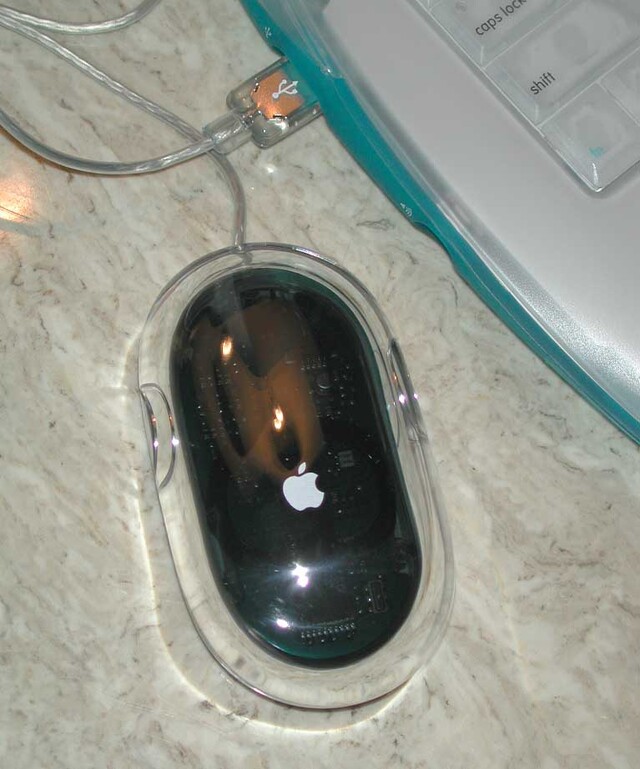
© All About Apple Museum · CC BY-SA 2.5-it ↗ Resized, no crop or retouching.
Specs
| Connectivity | USB · optical · whole-body click |
|---|---|
| Price | standard with desktop Macs; $59 separately |
| Key feature | first optical mouse standard across an entire desktop line |
Launch
Apple introduced it on July 19, 2000 at Macworld Expo New York, in the same keynote that debuted the Power Mac G4 Cube; the keynote recording survives on the Internet Archive. According to a later Macworld retrospective, Jobs held up a press headline calling the previous mouse, the "hockey puck", the worst mouse ever made, and promised to change that. Apple's official release boasted that Apple was the first company to ship an optical mouse standard on all its desktop computers, and Jobs said no competitor did, "much less one that costs $799". Jobs also announced that attendees would take one home for free, though per TidBITS only the 4,000 people in the main auditorium had vouchers under their seats and the 3,000 in the overflow room went without. It was also sold separately from September, for $59.
Marketing
No dedicated ad campaign is on record: its showcase was the keynote itself and the fact that it came standard with every new desktop, from the $799 iMac to the Power Mac G4, per Apple's official release. Design did the rest: the black body under a thick layer of clear plastic followed the same transparent-case motif as the Power Mac G4 Cube unveiled that same day, and the absence of buttons and ball was the visible proof of the jump to optical tracking, as a Macworld retrospective noted. The click tension could be adjusted, an idea Apple advertised at the time and dropped from later models because it was barely noticeable.
Flaws and fixes
The cable was still short and prone to failure with use, as the Macworld retrospective records; Apple came to bundle USB extension cables with desktop computers, a practice of the era documented by Wikipedia. The clear plastic scratched easily. Pressing the whole body down to click often moved the pointer right at the moment of clicking, and the tension adjustment was hard to notice. While the rest of the industry had settled on two buttons and a scroll wheel, Apple stuck with a single click and no wheel, and reviewers kept pointing it out. A 2003 refresh turned it white, dropped the click-force dial and the "Pro" name, and that same year a Bluetooth wireless version appeared, the Apple Wireless Mouse, per the record collected by Wikipedia. In August 2005 the Mighty Mouse replaced it as Apple's mouse, per Apple's 2005 release.

Historical price, mechanical click and optical tracking limits
Apple’s July 19, 2000 release distinguishes two distribution routes: bundled with the new iMac, Power Mac G4 Cube and Power Mac G4, or separate US sales announced for September at $59. This is not a Spanish price or a current valuation, and does not itself show that separate sales had already begun in July. The Apple Pro Keyboard shares the announcement and individual price, not a $59 keyboard-and-mouse package. Apple · 19 July 2000 Apple Pro Keyboard (2000)
Optical does not mean entirely motionless or touch-sensitive without movement: the tracking ball disappears, but the shell still operates a mechanical click. Page 43 of the original G4 Cube manual says to press the body until a click is felt and squeeze the side grips to lift it while keeping it pressed. The bottom ring offers three resistance settings; AppleCare article 58655 confirms the minus and plus directions. It adjusts the force needed to click, not pointer speed or a scrolling function. Apple · About Your Power Mac G4 Cube · p. 43 AppleCare · 58655 · click tension
The almost-any-surface promise has documented limits. AppleCare 58650, created July 17 and modified July 21, 2000, warns of slow or absent tracking on glass, glossy materials and halftone images such as some printed mouse pads. It explains that the sensor needs reference points in surface texture to translate movement into pointer motion. This is an operating condition of optical tracking, not proof that an individual mouse is faulty or a guarantee for every desk. AppleCare · 58650 · July 2000
Lawrence I. Charters tested a promotional unit in Washington Apple Pi Journal, September–October 2000, pages 36–38; the reproduction on his own website preserves that provenance. He reported good results on wood, paper and other tested materials, but warned that a short test did not establish long-term reliability. His sample was a Macworld giveaway, not a purchased retail unit. That scope matters: his experience does not certify every surface, the condition of the mice pictured here or other units’ lifespan. Lawrence I. Charters · Washington Apple Pi · 2000
Contemporary reviews do not form a single verdict either. In Macworld on September 30, 2000, Jim Heid praised handling and noted the short cable and missing second button. In Ars Technica on July 28, John Siracusa praised low-speed accuracy, described tracking loss with fast movements and returned to his ADB mouse because the shell felt too low. These are attributed observations and differing preferences, not a universal defect or an independent comparative measurement of every model. Jim Heid · Macworld · 30 September 2000 John Siracusa · Ars Technica · 28 July 2000
The link to the 1998 Apple USB Mouse makes the specific change from mechanical ball to optical tracking and from circular to elliptical case visible; it does not make them variants of one model. Removing the ball removes that maintenance component, not the cable, click mechanism or surface requirements. The existing white-mouse photograph remains a later comparison, not another view of the black 2000 model. Although its inherited caption calls it the 2003 revision, MacTech had already reported separate sales of the white Pro Mouse for US$59 on March 1, 2002. That report neither dates the photographed object nor identifies its exact revision, but prevents treating 2003 as the first documented existence of the white colour. Apple USB Mouse (1998) MacTech · 1 March 2002 · white Pro Mouse