
Apple Pippin (1996)
A Macintosh-based multimedia platform, designed by Apple and marketed by Bandai under license.
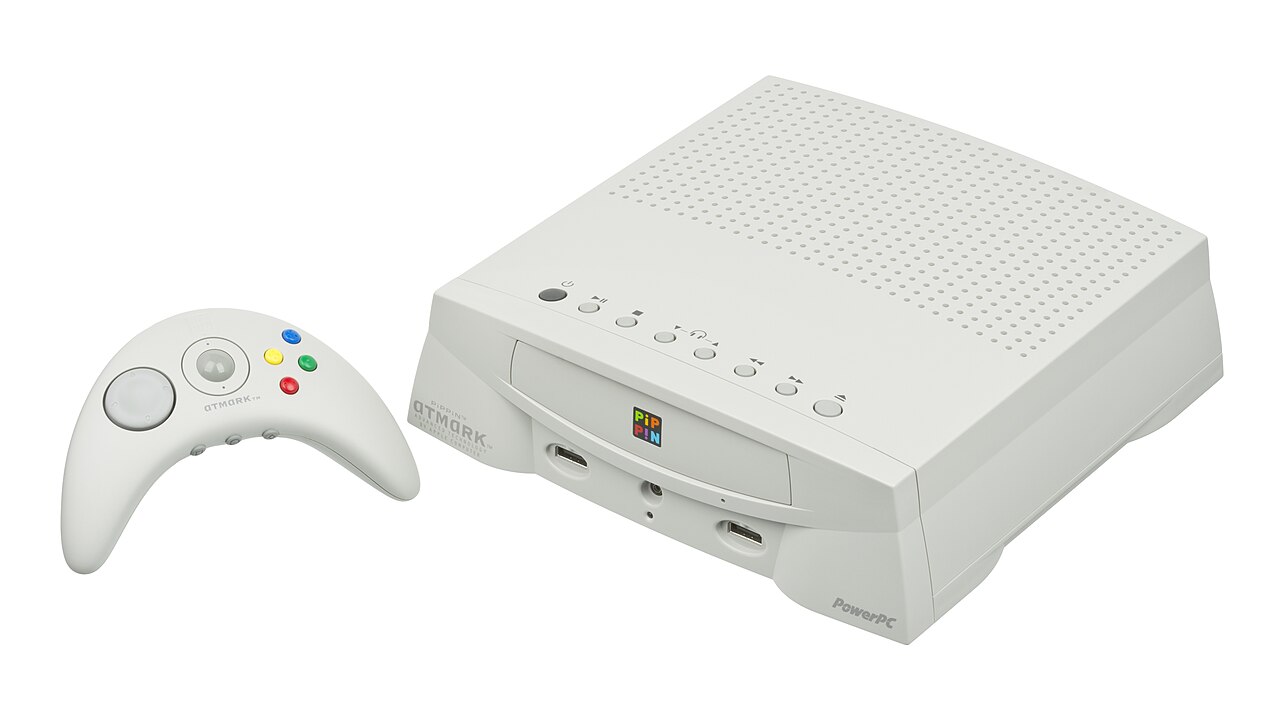
© Evan-Amos · Public domain Resized, no crop or retouching.
Specs
| Processor | PowerPC 603 at 66 MHz, 6 MB RAM |
|---|---|
| System | Mac OS System 7.5.2 loaded from 4x CD-ROM |
| Key feature | TV video output · 14.4 kbps modem · Wikipedia |
Launch
Apple announced the Pippin platform in Tokyo on December 13, 1994, with Bandai as its first partner, per Wikipedia. The idea, reconstructed by Ars Technica from those involved: Apple led engineering and design and collected a per-unit license fee, while Bandai took on manufacturing, branding and marketing. The white ATMARK went on sale in Japan in March 1996 at 64,800 yen with a modem and four CDs, and on June 18, 1996 Bandai announced the black @WORLD for the United States: with availability planned for September at $599, with a web browser and a PSINet Internet access CD, per its press release. · Bandai (1996)
The name was chosen by the team itself: Eric Sirkin, head of Macintosh OEM products, tells Ars Technica that they codenamed the project Pippin, after an apple variety whose trademark Apple had already registered but never used. The project was born from Bandai's ambition, per the same reconstruction: with CD-ROMs booming (Myst was often the first thing people bought), president Makoto Yamashina saw the chance to conquer the living room with a Mac-based multimedia machine carrying its toy licenses (Dragon Ball, Sailor Moon, Power Rangers), avoiding the problem of the 3DO, which had no software.
Marketing
It was not just a console: with a 14.4 kbps modem and a browser, Bandai sold it as a gateway to the Internet from the living-room TV, including email and word processing through the TV Works software, per its press release. Ars Technica recounts that Apple even advised against the Internet focus and that Bandai was the one who insisted on the modem. The catalog mixed games and educational CD-ROMs, and Apple also licensed the platform to Katz Media, whose KMP 2000 targeted kiosks and vertical markets, per Wikipedia. · Bandai (1996)
Expectations were enormous and must be read as such: Bandai projected 500,000 units sold in a year and was preparing to spend $100 million promoting it in Japan and the United States, per Ars Technica. On Apple's side, executive Steve Franzese went as far as telling the Los Angeles Daily News that he expected three million units across all partners in three years, with a royalty below $15 per console and $3 per software title, as Ars Technica reports. These were forecasts, not results.
Flaws and fixes
To keep it from competing with the Mac, Apple limited it: no hard drive, one application in memory at a time, and the operating system loaded from each CD, as Ars Technica details. Ars Technica describes the difficulty of positioning it between a dedicated console and a computer. According to Wikipedia, Bandai stopped production in mid-1997 and remaining inventory went to DayStar Digital in February 1998. Published sales estimates do not agree.
The end was internal and quick, per Ars Technica's account: Apple shut the Pippin project down in March 1997, within the restructuring that cut 4,100 jobs, and it was Sirkin himself who offered it up while his team was already working on a second generation with a real graphics engine. At Bandai, Yamashina left the presidency in 1997 after middle managers revolted against the planned merger with Sega.