
Apple MessagePad 2100 (1997)
The Apple MessagePad 2100 is a Newton 2.1 handheld computer, separate from the MessagePad 2000. Apple's November 1997 brochure, reference L02553A and order H0244Z/A, presents it for mobile work with e-mail, a web browser, word processor, spreadsheet, contacts and scheduling. That is the document date, not independent proof of first shipment or sale.
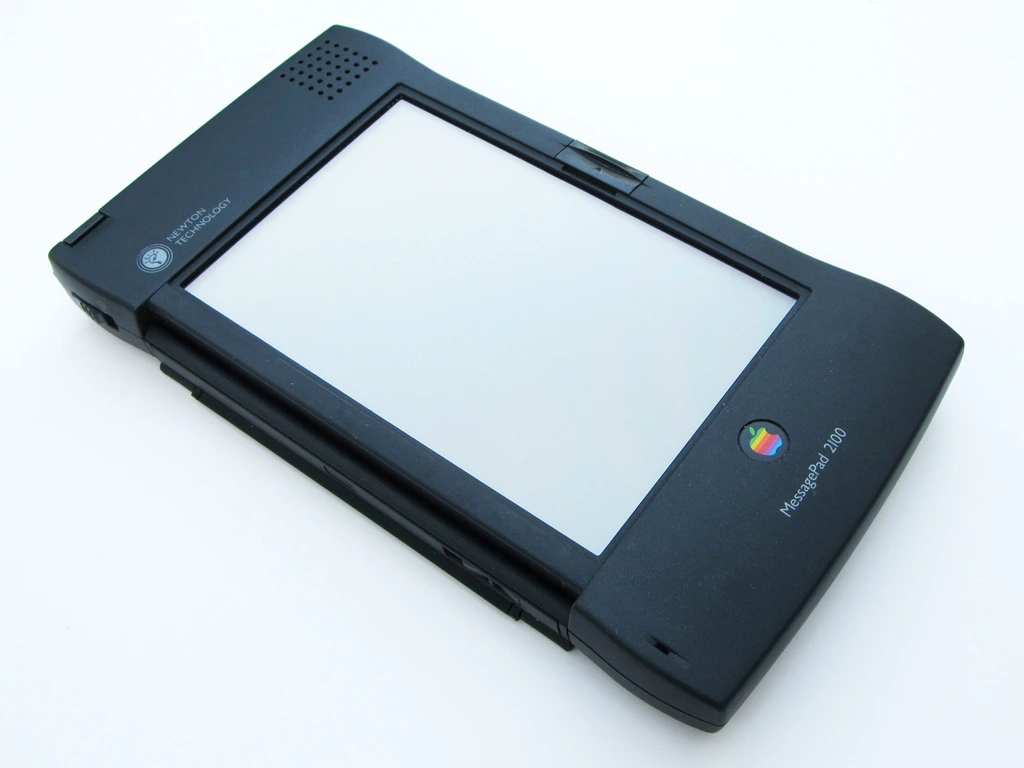
© Christopher W. · CC BY-SA 2.0 ↗ Resized, no crop or retouching.
Apple MessagePad 2100. Christopher W., CC BY-SA 2.0. August 2011 Commons original. No new changes.
Specs
| Key feature | H0244Z/A |
|---|---|
| Processor | StrongARM SA-110 · 162 MHz |
| Memory | 8 MB = 4 MB DRAM + 4 MB Flash |
| ROM | 8 MB ROM |
| Display | 480 × 320 · 16 grey levels · EL backlight |
| Input | Resistive tablet and pen |
| Slots | 2 Type II PC Card slots |
| Ports | Newton InterConnect |
| Infrared | IrDA ≤115 kbit/s · ASK ≤38.4 kbit/s · ≤1 m |
| Audio | Microphone and speaker |
| Power | 4 AA alkaline; optional NiMH and 9 W adapter |
| Dimensions | 210.3 × 118.7 × 27.5 mm |
| Weight | 1.4 lb with AA (TIL); <1.8 lb with NiMH (manual) |
Identity and document
The Apple MessagePad 2100 is a Newton 2.1 handheld computer, separate from the MessagePad 2000. Apple's November 1997 brochure, reference L02553A and order H0244Z/A, presents it for mobile work with e-mail, a web browser, word processor, spreadsheet, contacts and scheduling. That is the document date, not independent proof of first shipment or sale.
On February 27, 1998, Apple announced it would stop new development of Newton and products based on it, including MessagePad 2100 and eMate 300. Jobs, then interim CEO, described the decision as concentrating software resources on Macintosh. The same announcement said Apple would continue selling inventory and supporting users. The date therefore documents the announcement of the end of development, not the last sale or the end of support for each device.
Apple, Newton announcement, 27 February 1998
Memory and display
The brochure specifies a StrongARM SA-110 at 162 MHz and 8 MB combined memory: 4 MB DRAM and 4 MB Flash, plus 8 MB ROM. The Service Source shared with the 2000 confirms those 8 MB and describes improved 2100 performance; this page does not turn that description into a measured result. The 480 × 320 display provides 16 grey levels, electroluminescent backlighting and resistive pen input.
Planned price and an upgrade for its predecessor
Apple's release of 20 October 1997, preserved by MacTech, estimated a retail price of around US$1,000 in the United States and announced English and German versions for November. These are an approximate price and an availability forecast, not a Spanish price list, an exact $999 figure or proof of first delivery. Writing in Heise on 21 October, Volker Weber said the German price had not yet been set: the US amount should not simply be transferred to another market. Weber · Heise · 21 October 1997 Apple · Release of 20 October 1997 · preserved by MacTech
The same release documents a service link with the MessagePad 2000: Apple offered to expand its system memory to the 2100's 4 MB of DRAM by sending it to the Apple Service Center. For 2000s purchased before 7 November 1997, it announced US$99, excluding shipping and local taxes; the program ran until 30 April 1998 or while supplies lasted. This was a historical, conditional service, not a current offer, the purchase price of a 2100 or proof that any surviving 2000 received the upgrade. Apple · Release of 20 October 1997 · preserved by MacTech MessagePad 2000 (1997)
Expansion and communications
Two Type II PC Card slots accept communications and memory cards; Newton InterConnect supports serial connections, LocalTalk, power and audio. The brochure rates infrared up to 115 kbit/s in IrDA mode and 38.4 kbit/s in ASK within one metre. Internet needs an optional LAN adapter or modem and may require an access provider. Those options are not integrated Wi-Fi. The Newton Keyboard and serial adapter are not included in Apple's illustrated configuration.
Power and photograph
The brochure includes four AA alkaline cells and offers NiMH and the Newton 9 W adapter as options. Its up-to-24-hour battery life is Apple's historical claim, not a current test. It gives 1.4 lb with alkaline cells; Service Source gives under 1.8 lb with NiMH. Metric dimensions are 210.3 × 118.7 × 27.5 mm. Christopher W.'s CC BY-SA 2.0 photograph is the original uploaded to Commons in August 2011, recovered from its history, not the version cropped and adjusted in 2012. No new changes have been applied.
