
Apple MessagePad 2000 (1997)
The Apple MessagePad 2000 is a Newton 2.1 handheld computer, distinct from the MessagePad 130 and the later 2100. Apple technical note TIL20991, created February 18, 1997, documents handwriting and drawing recognition, on-screen keyboards and assistance with communications and scheduling. The note's date is not treated as evidence of first shipment or a sale day.
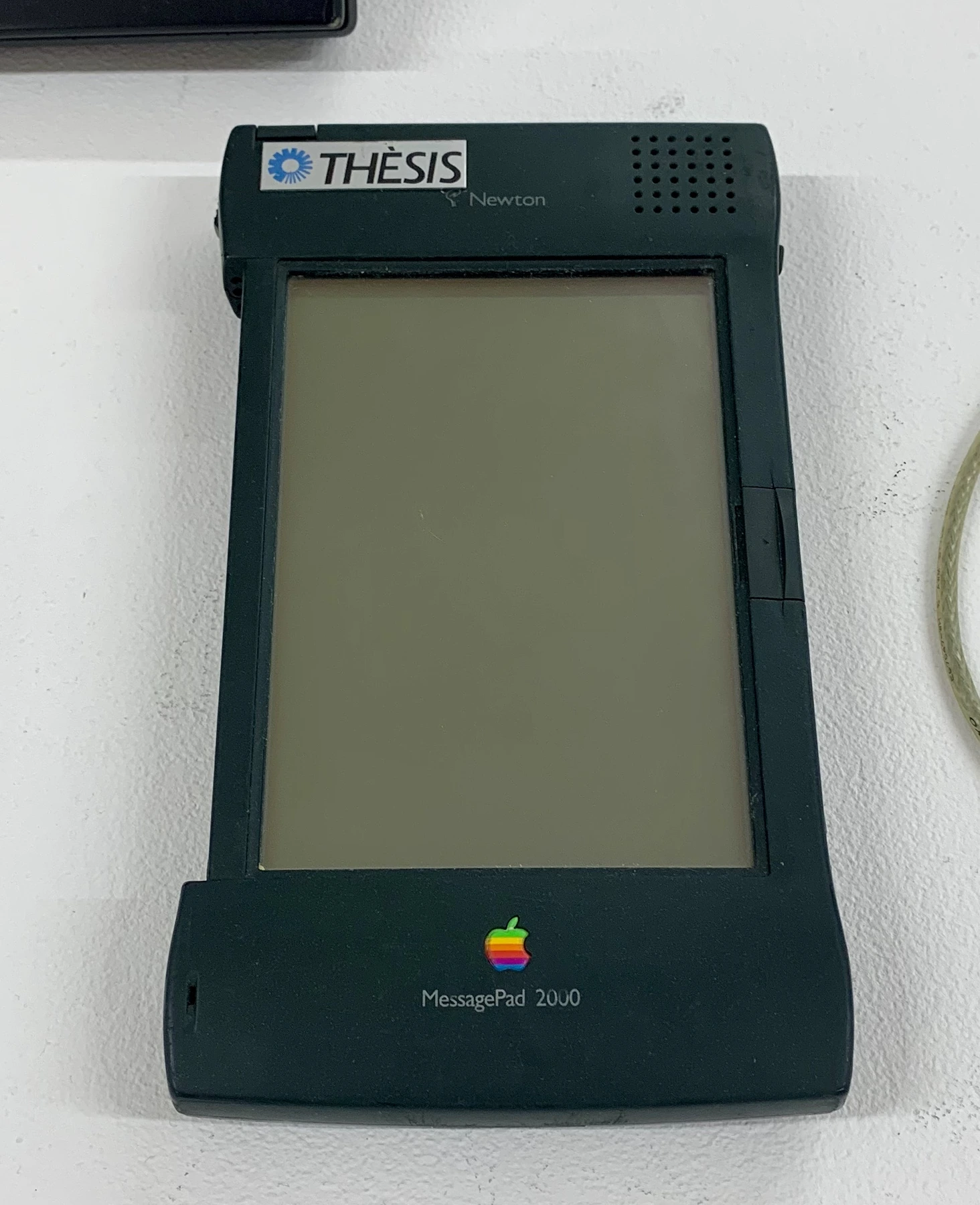
© Federigo Federighi · CC BY-SA 4.0 ↗ Resized, no crop or retouching.
Apple MessagePad 2000. Photo: Federigo Federighi, CC BY-SA 4.0. Unmodified; specimen sticker retained.
Specs
| Key feature | MessagePad 2000 |
|---|---|
| Processor | StrongARM 110 · 161.9 MHz (TIL); 162 MHz (manual) |
| Memory | 5 MB = 1 DRAM + 4 Flash (TIL); manual: 3 MB overview / 4 MB table |
| ROM | 8 MB ROM |
| Display | 480 × 320 · 16 grey levels · EL backlight |
| Input | Resistive tablet and pen |
| Slots | 2 Type II PC Card slots |
| Ports | Newton InterConnect |
| Infrared | IrDA ≤115 kbit/s · ASK ≤38.4 kbit/s · ≤1 m |
| Audio | Microphone and speaker |
| Power | 4 AA alkaline; optional NiMH and 9 W adapter |
| Dimensions | 210.3 × 118.7 × 27.5 mm |
| Weight | 1.4 lb with AA (TIL); <1.8 lb with NiMH (manual) |
Identity and document
The Apple MessagePad 2000 is a Newton 2.1 handheld computer, distinct from the MessagePad 130 and the later 2100. Apple technical note TIL20991, created February 18, 1997, documents handwriting and drawing recognition, on-screen keyboards and assistance with communications and scheduling. The note's date is not treated as evidence of first shipment or a sale day.
Memory and display
Apple TIL20991 specifies a StrongARM 110 at 161.9 MHz and 5 MB combined memory: 1 MB DRAM and 4 MB Flash, plus 8 MB ROM. The joint 2000/2100 Service Source rounds the clock to 162 MHz but differs on memory: its overview says 3 MB (1 DRAM + 2 FEPROM), while its table says 4 MB. These three figures remain attributed, not added together or used to invent hardware revisions. The display has 480 × 320 pixels, 16 grey levels and an electroluminescent backlight.
Press price and advertised battery life in context
In his eMate review published by The New York Times on 21 August 1997, Joe Hutsko puts the MessagePad 2000 at $1,100. This is a dated US press reference, not a Spanish price list or a present-day valuation. The article contrasts two Newton formats: the handheld MessagePad and the eMate with its built-in keyboard. That comparison does not transfer the eMate's prices, accessories or memory configuration to the MessagePad. Hutsko · The New York Times · 21 August 1997
Apple's release of 3 February 1997, preserved by MacTech, forecast three to six weeks of typical use on four AA batteries for the MessagePad 2000. That interval is not weeks of continuous operation or battery life guaranteed today. The same release said Apple expected the MessagePad 2000 and eMate to reach the market the following month: it documents the announced plan, not a first-shipment day. Nor does it turn those figures into specifications for the later MessagePad 2100. Apple · Release of 3 February 1997 · preserved by MacTech eMate 300 (1997) MessagePad 2100 (1997)
Expansion and communications
There are two Type II PC Card slots and Newton InterConnect for communications, audio and serial expansion. Infrared transfer is rated up to 115 kbit/s in IrDA mode and 38.4 kbit/s in ASK mode within one metre, according to the note. E-mail, Internet and fax need appropriate cards or modems; communications support is not turned into integrated Wi-Fi or cellular service. The note also documents a microphone, speaker, pen and removable display lid.
Power and photograph
Power can come from four AA alkaline cells or an optional NiMH pack; the Newton 9 W adapter and rechargeable pack are not assumed included with every configuration. TIL20991 gives 1.4 lb with alkaline cells, while Service Source says under 1.8 lb with NiMH, different conditions. Both give 210.3 × 118.7 × 27.5 mm, though their inch equivalents differ. Federigo Federighi's photograph shows a MessagePad 2000 from the Pisa museum with its specimen sticker intact, under CC BY-SA 4.0.
Sources

More products
Historical catalogue links
Relationships already recorded in the catalogue, not a complete succession chain. Same-year variants are shown as related. A missing link does not prove that an earlier or later model does not exist.