
Apple iSub (1999)
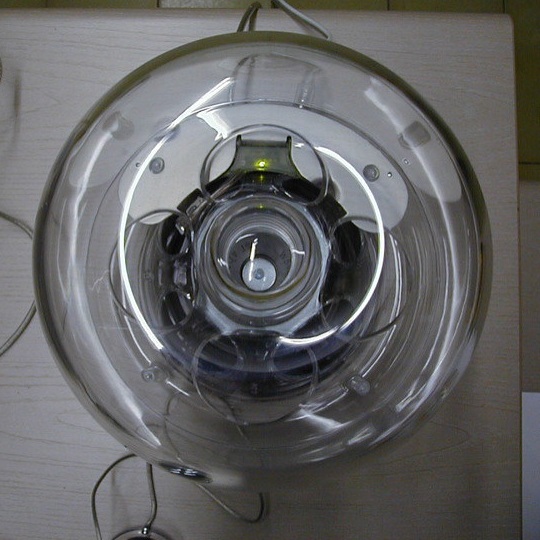
The iMac's transparent subwoofer: a 6-inch woofer with digital sound over USB, designed by Apple, built by Harman Kardon, and later, in a revised form, the centerpiece of the SoundSticks.
Specs
| Connectivity | USB (digital audio) · 20 W |
|---|---|
| Price | $99 |
| Key feature | designed by Apple, built by Harman Kardon |
Launch
Apple announced it on October 5, 1999 at the Flint Center in Cupertino, the same stage where the Macintosh had been introduced fifteen years earlier, at an invitation-only event where Steve Jobs presented the new iMac family with digital video, Mac OS 9, Sherlock 2 and iMovie, according to TidBITS' report that day. On that stage it appeared as a 6-inch subwoofer reinforcing the Harman/Kardon Odyssey sound system of the new iMacs, alongside slim speaker towers called SoundStick. It was a translucent jellyfish-shaped piece, designed by Apple's industrial design team and manufactured by Harman Kardon, receiving sound digitally over USB and decoding it with its internal amplifier. It reached stores in early 2000: by March 2, 2000 it was on sale at the Apple Store for $99, per Macs Only!'s notice that day. A recording of the event survives on the Internet Archive.
Marketing
No dedicated ad campaign is on record: it was sold as the sound companion for the slot-loading iMacs, the only computers it worked with at launch. At the July 2000 Macworld Expo in New York, Harman Kardon and Apple introduced the SoundSticks: a 2.1 system pairing a new revision of the iSub with two transparent four-driver towers, for $199, with plug-and-play support from Mac OS 9.0.4. The Apple-led design of the SoundSticks won a gold award at the 2000 Industrial Design Excellence Awards and made the cover of I.D. magazine, according to coverage cited by Wikipedia. In 2001, The Mac Observer praised the SoundSticks' clear sound without audible distortion and its results with music and movies, though it criticized a price above comparable systems.
Flaws and fixes
Its USB connection was also its limit: at first it only worked with slot-loading iMacs, because Apple's software (bundled from Mac OS 9.0.4) was what split frequencies between the iSub and the internal speakers so they would not overlap. By March 2001 it also worked with the new Power Mac G4s. It moved bass between 44 and 180 Hz. On March 11, 2001 the Apple Store cut its price by 40 percent, from $99 to $59, according to Macworld. The line corrected course in 2004: the SoundSticks II replaced the USB input with a standard 3.5 mm audio jack, opening the set to any sound source.
They look alike, but are not interchangeable
The standalone iSub and the SoundSticks system’s subwoofer are not the same component. In his May 2001 guide, Paulo Rodrigues explains that the iSub lacks the amplifiers and connectors required by SoundSticks satellites; those speakers receive amplification from their own system’s subwoofer. Nor can the SoundSticks subwoofer supplement an iMac’s internal speakers. Low End Mac · Paulo Rodrigues · 2001
When identifying used equipment, a transparent case and the word USB are not enough: check whether it is the standalone iSub or the original SoundSticks system. The difference concerns the equipment’s function and connections, not only its appearance.