
Apple Extended Keyboard II (1990)
Apple's last mechanical keyboard: Alps switches, two ADB ports for daisy-chaining the mouse, and an adjustable foot that still inspires a collector cult.
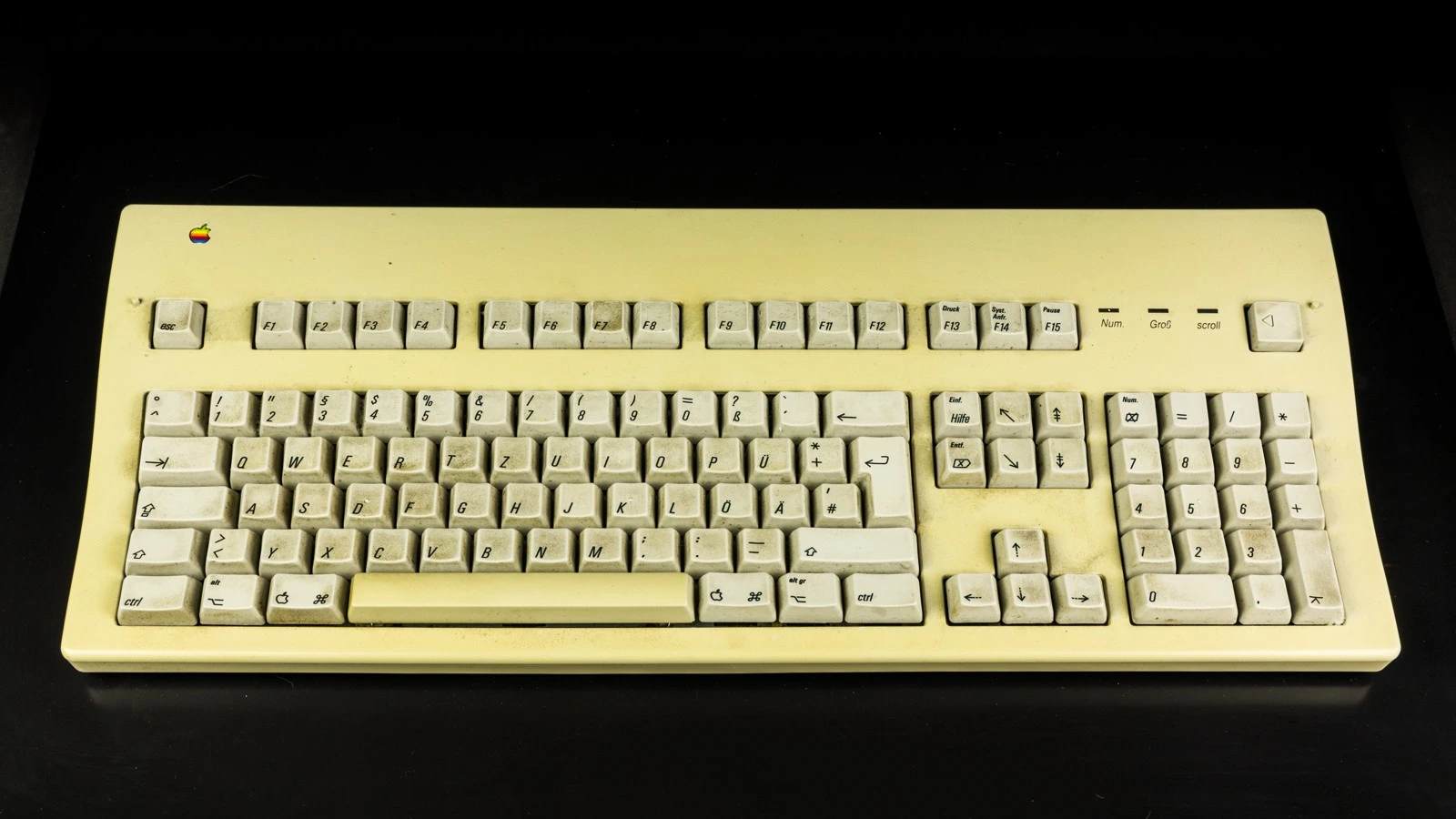
© Raimond Spekking · CC BY-SA 4.0 ↗ Resized, no crop or retouching.
Specs
| Connectivity | Apple Desktop Bus (ADB), two ports |
|---|---|
| Price | $185 list in 1992, per TidBITS |
| Key feature | Alps or Mitsumi mechanical switches, PBT keycaps |
Launch
Apple refreshed its extended keyboard in October 1990, bundled with Apple's professional desktop Macs starting with the IIsi, per the record collected by Wikipedia; the Computer History Museum holds a unit dated 1990 whose label combines the M3501 family number with a serial ending in M0312. Compared with the original Extended Keyboard, the second generation traded the swooping curve for a wave-profile case and added a rear slider to adjust the typing angle, per the Rhode Island Computer Museum. The layout was nearly the IBM Model M's, with the Mac's Command keys and a power key beside the indicator lights, and the Caps Lock used a latching switch that stayed down like a typewriter's, a detail iFixit highlights in its teardown. The design patent was filed on November 15, 1990.
Documented price, adjustment and use
The Fall 1993 Apple Catalog offered the Extended Keyboard II for US$185, reference E1000. This matches the comparison price Adam Engst used in TidBITS on 26 October 1992. These are two dated records, not a 1990 launch price or a current valuation; the other keyboard at roughly $250 in that 1992 article was still a rumour, not a confirmed Adjustable price. Apple · The Apple Catalog · Fall 1993 · p. 54 Adam Engst · TidBITS · 1992-10-26
Apple’s owner’s guide, copyright 1989, explains a tilt range of 6 to 14 degrees from the desk, using a rear slider that extends a support bar. This tilts a single body rather than opening two halves sideways like the Apple Adjustable Keyboard. The document establishes the mechanism and range, not proven clinical benefit or equal comfort for everyone. Apple · Extended Keyboard II · Owner’s Guide Apple Adjustable Keyboard (1993)
The two ADB ports do not mean two independent computer connections. The guide describes connecting the mouse on one side and the computer cable on the other, choosing the mouse side to suit the hand used. It also requires turning the computer off before connecting. This is an ADB daisy-chain layout, not a USB hub or an instruction to hot-plug. Apple · Extended Keyboard II · Owner’s Guide
The triangular key did not have a universal role either. In the systems covered by that guide, it started the Macintosh II, whereas the Macintosh SE used its rear power switch; on the Apple IIGS it was Reset and power was also switched at the rear. The manual adds that the key was not used to turn the Macintosh II off. These distinctions matter when displaying the keyboard alongside different computers. Apple · Extended Keyboard II · Owner’s Guide
Comparisons with its successor need an author and context. In TidBITS on 19 June 1995, Steven H. Lee, describing his Power Macintosh 6100/66 DOS Compatible, reported that Apple had discontinued the Extended II and Adjustable and found the half-price AppleDesign less responsive. This is dated contemporary testimony and Lee’s assessment, not the exact date of the last unit manufactured or a proven opinion of every user. Steven H. Lee · TidBITS · 1995-06-19
Marketing
Apple sold it as the professional alternative to the era's Apple Keyboard and Apple Keyboard II, per LowEndMac's retrospective, and in 1992 TidBITS cited it at a $185 list price. It stayed in the lineup for years: Deskthority documents units manufactured through 1995, and in June of that year TidBITS was already reporting that Apple had discontinued the Extended Keyboard II along with the Adjustable Keyboard, leaving the AppleDesign Keyboard as the only option, at half the price but less responsive in the eyes of era users. The reputation outlived the discontinuation: in 2005 LowEndMac remembered it as the biggest and heaviest keyboard Apple had ever made, noting that comparison with its membrane successors reinforced its legendary status.
Flaws and fixes
Time caught up with it in two ways. The first was the connector: ADB vanished from Macs, and the home fix was the Griffin iMate ADB-to-USB adapter, which iFixit mentions in its guide. The second was wear: the Alps switches went out of production, and per iFixit's teardown the case and spacebar are ABS, a plastic that yellows with age, while the other keycaps are PBT. Deskthority documents the switch variants and their partial resurrection as the Matias Quiet, and in 2005 LowEndMac presented the USB Matias Tactile Pro as the Extended Keyboard II's modern return.