
Apple Adjustable Keyboard (1993)
Apple's ergonomic experiment: two halves folding open on a hinge, contoured wrist rests, and a numeric keypad that travelled separately.
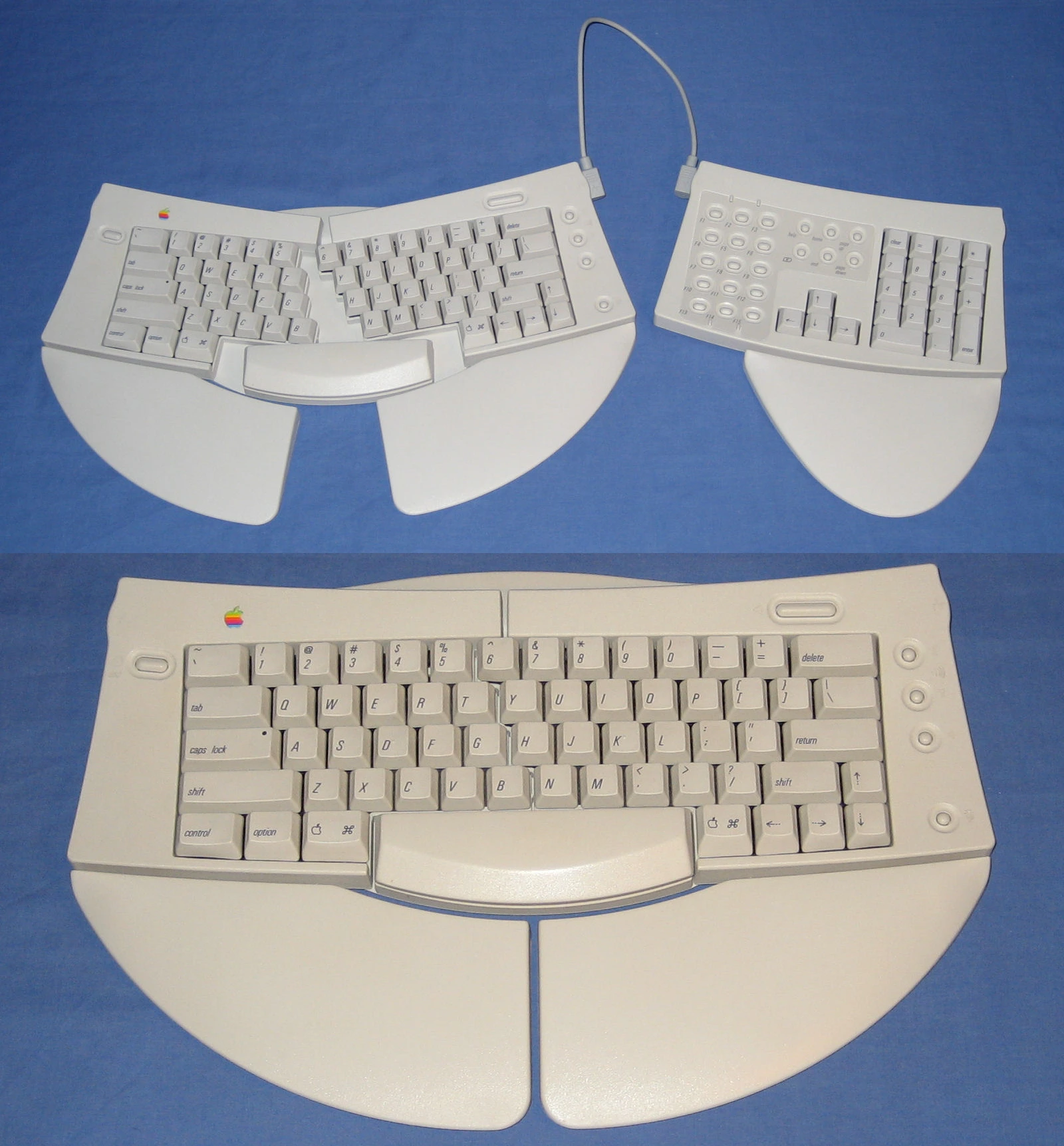
© Stephen Edmonds · CC BY-SA 2.5 ↗ Resized, no crop or retouching.
Specs
| Connectivity | Apple Desktop Bus |
|---|---|
| Switches | Alps SKFS, tactile |
| Key feature | $219 in 1993, per Wikipedia |
Launch
Apple introduced the Adjustable Keyboard in 1993 at $219, per Wikipedia. Its core idea was the top hinge: users could open the angle between the left and right halves until they found a comfortable posture. The split fell between the key pairs 5/6, T/Y, G/H and B/N, and the space bar floated midway between the two parts, as Wikipedia describes.
Two price references in 1993
Adam Engst wrote in TidBITS on 11 January 1993 that a $219 list price was expected when the keyboard shipped the following month. This was a forecast of price and availability, not proof of February delivery. The Fall 1993 Apple Catalog later offered it for $185, reference E1501. These are two dated US records, not a present-day valuation or proof of what every buyer paid. Engst · TidBITS · 1993-01-11 Apple · The Apple Catalog · Fall 1993 · p. 54
Page 54 also offered the Apple Extended Keyboard II for $185, reference E1000. The link compares two options at the same price in that edition, not equivalent keyboards: the Adjustable entry described opening up to 30 degrees, detachable palm rests and a separate keypad; the Extended II entry highlighted 15 built-in function keys. These design descriptions do not establish medical benefits or a universal typing preference. Apple · The Apple Catalog · Fall 1993 · p. 54 Apple Extended Keyboard II (1990)
Contemporary reception helps explain the design compromise. After trying a paragraph or two at a demonstration, Engst reported few errors even at maximum opening; this was a brief impression, not a long-term test. He also wanted more vertical adjustment and questioned the small function and Escape keys. Horizontal opening should not be confused with full vertical articulation. Engst · TidBITS · 1993-01-11
Writing in TidBITS on 1 March 1993, Joe Clark welcomed the opening mechanism but criticised the separate module for heavy function-key users. He described fifteen function keys in five rows of three and combinations split across two units; he also distinguished forward Delete from Backspace when explaining the reach to the module. His criticism records a particular workflow and an identified opinion, not proof that every user preferred another keyboard. Joe Clark · TidBITS · 1993-03-01
Marketing
The package included contoured plastic wrist rests and a separate numeric keypad with function and arrow keys: it was the third and last time Apple offered a separate keypad, and unlike its predecessors this one was not sold separately, per Wikipedia. On the right edge it carried volume buttons and a record button, a detail recorded by the same source.
Flaws and fixes
Its Alps SKFS switches gave tactile feedback with a slightly clicky feel, per Wikipedia, which also notes the compatibility limit: the last Mac usable with this keyboard without a USB-to-ADB adapter was the blue and white Power Macintosh G3, the last one with an ADB port.